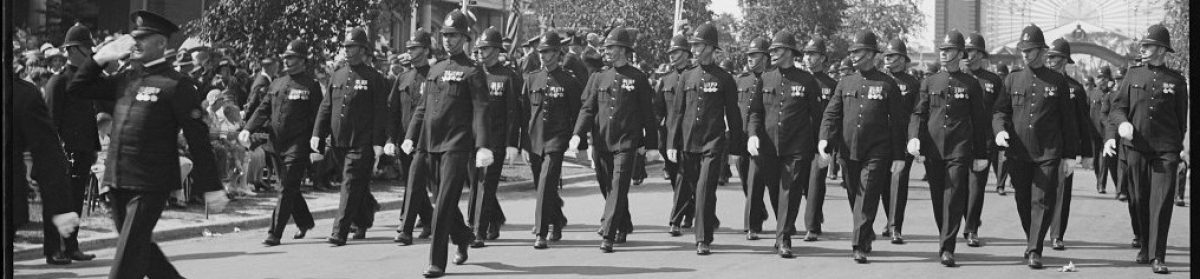
Profiles in Courage: Toronto Police on D-Day

Researched and Written by Matthew Scarlino.

This article was originally written in June 2019 and versions were published in Blue Line Magazine and featured on TPS News.

It was spring 1944. The Second World War had been raging for four and a half years. Most of Europe lived under the dictatorship of Adolf Hitler.

Canadian troops headed toward Juno Beach on June 6, 1944. (Library and Archives Canada MIKAN No. 3205254)

Millions of Jews, visible minorities, queer people, political dissenters, and people with disabilities were being rounded up and sent to death camps. Rights and freedoms disappeared and occupied peoples were forced to work towards the Nazi war effort. The Western Allied armies of Great Britain (including Canada and other Commonwealth nations), France, Belgium, The Netherlands, and other European nations, had been pushed out of mainland Europe since 1940 when Nazi Germany invaded in their blitzkrieg – “lightning war”. The Western Allies escaped to Britain, where they remained under attack from the air, but persevered. When the Americans joined the war, they too would sail to England and prepare to fight.

Meanwhile, the Nazis fortified Europe using slave labour to build the Atlantic Wall, coastal defences made of concrete bunkers, weapons pits, landmines and other defences to make re-invasion impossible. The Western Allies instead invaded through Italy in 1943, but the narrow and mountainous terrain heavily favoured the defenders – casualties were high and progress was slow. In the east, the Soviet Union was also taking heavy losses pushing Nazi forces out of Eastern Europe. The situation was bleak and there needed to be a breakthrough elsewhere.

A plan was made to form a massive armada of ships, planes, and troops and invade Occupied France across the English Channel at Normandy. Five beaches would be assaulted, the Americans and British responsible for two beaches each, and the Canadians responsible for the last beach – code-named “Juno”. It wasn’t clear if the plan would work and casualties were expected to be extremely high. After bad weather postponed the attack, it was finally settled that it would take place on June 6, 1944, code-named “D-Day”.

On June 6, 2019, Canadians across the country are commemorating the 75th anniversary of the daring invasion, which marked the beginning of the end of World War II. The successful Normandy Campaign commenced a drive to Germany that would see the war end in less than a year. And just like the many Toronto policemen who fought in the First World War, 235 members (men and women) of the Toronto City Police Force, would leave to serve in the Second World War(1). Many of them took part in the D-Day invasion.

This is the story of a half-dozen police officers, just a small sample of the many Toronto Police members who contributed to victory in the Normandy Campaign at sea, on land, and in the air.

At Sea

Some of the first Toronto Police members in action on D-Day were three burly constables aboard the HMCS Skeena. Fred Davies, Len O’Hara and Ken Peglar were all towering policemen who had joined the Royal Canadian Navy together as stokers – whose main duties were to feed coal into the ship’s boilers – in 1940. Deputy Chief Charles Scott described them as “outstanding” track and field athletes in the Toronto Police Force Amateur Athletic Association, who would be “an asset to any ship.”(2)
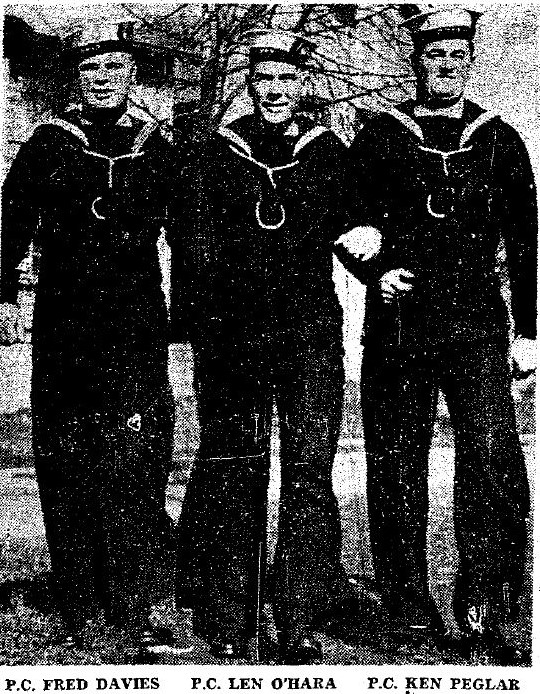
Constables Frederick Davies (#284), Leonard O’Hara (#55) and Kenneth Peglar (#108) in their Royal Canadian Navy uniforms, as they appeared in a 1942 edition of the Toronto Daily Star

The men had survived terrifying sea battles in the years leading up to this momentous day, including being involved in the first sinking of an enemy submarine by Canadian forces. While on convoy duty, on the night of September 8 & 9, 1941, the ships they were protecting were attacked by a “wolfpack” of German submarines known as U-Boats. In the epic 66-hour battle that ensued, the Skeena launched depth charge after depth charge in chaotic fighting in which Constable Peglar was wounded by a powerful blast that launched the 6’4”, 245-pound policeman through the air into a bulkhead. (3) When the smoke settled two U-Boats were sunk at a loss of 16 merchant ships. 

Now veteran seamen, they were on board one of the 63 Canadian warships participating in the greatest sea-borne assault in history. In the hours leading up to the D-Day invasion, the trio toiled below-deck stoking the steam engines in the sweltering boiler rooms of the Skeena. Their destroyer was paving the way for the invasion force by clearing the sea lanes of enemy ships, and starting at 5:45 a.m., bombarding the coastal defences where enemy machine guns and artillery were laying in wait, zeroed-in on the landing beaches. (4)

About two hours later, Canadian assault troops landed at Juno Beach into murderous fire from the entrenched enemy who by now were expecting an attack.

While the first waves of Canadian infantry and tanks fought through the beaches and into the town, the SS Sambut was just sailing out of England’s River Thames, carrying reinforcements for the blood-stained sands of Normandy. It was taking an indirect route to avoid detection. Among the vehicles, munitions, and troops on board was a 28-year-old Lance Sergeant in the Royal Canadian Army Service Corps (RCASC) named Clarence Verdun Courtney. (5) Following in the footsteps of his father, Courtney joined the Toronto Police Department, graduating as a constable in 1938. After three years of service, he put his career on hold and answered the call to arms to defeat tyranny. He rose quickly up the military ranks and passed specialized training including advanced infantry training, platoon support weapons, mine detection and clearing and military motorcycle riding. He was posted to No. 84 Company RCASC, part of the 2nd Armoured Brigade, and was tasked with providing logistical support to tanks in battle.
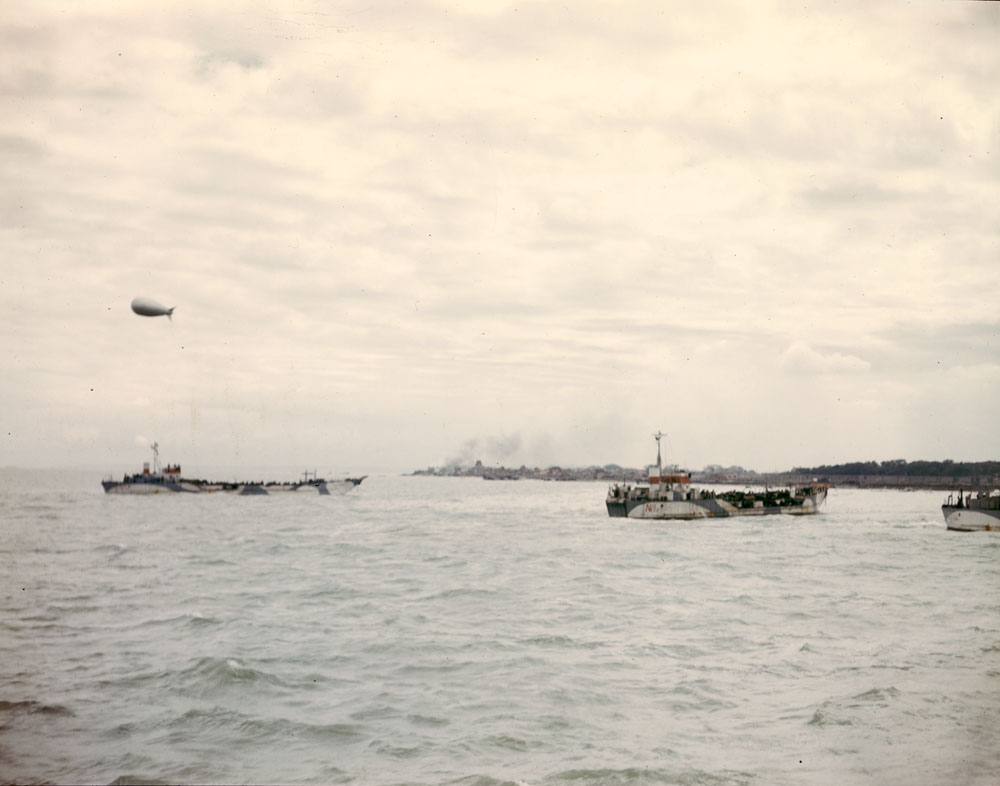
A rare colour photo of special Tank Landing Craft moving toward Juno Beach on D-Day. Patrol Sergeant H.L. Smuck came ashore aboard these ships (Library and Archives Canada)

While crossing the Straits of Dover, the Sambut encountered fire from German coastal batteries in the nearby French city of Calais, and at 12:15 p.m. she was hit in the side by 15-inch shells. Shrapnel tore into Courtney’s abdomen, and the fuel and trucks on deck around him were set ablaze, shortly followed by the explosion of an ammunition cache in the ship’s hold. In a chaotic scene, soldiers began throwing ammunition off the side of the ship, while secondary explosions sent shrapnel flying around them. (6) A British medical officer found Courtney and began dressing his wounds. Within 15 minutes, however, the order was given to abandon ship.

While thoughts surely flashed through Courtney’s mind of his wife Margaret and their peaceful home on Glendonwynne Road, he was helped to life rafts by his comrades. He then clung to the side of a crowded raft as long as he could, but the young Lance Sergeant succumbed to his wounds and slipped into the sea,(7) robbed of any chance to fight back.

Courtney was one of the hundreds of Canadians who died that day. He is commemorated on the Bayeux Memorial in France.
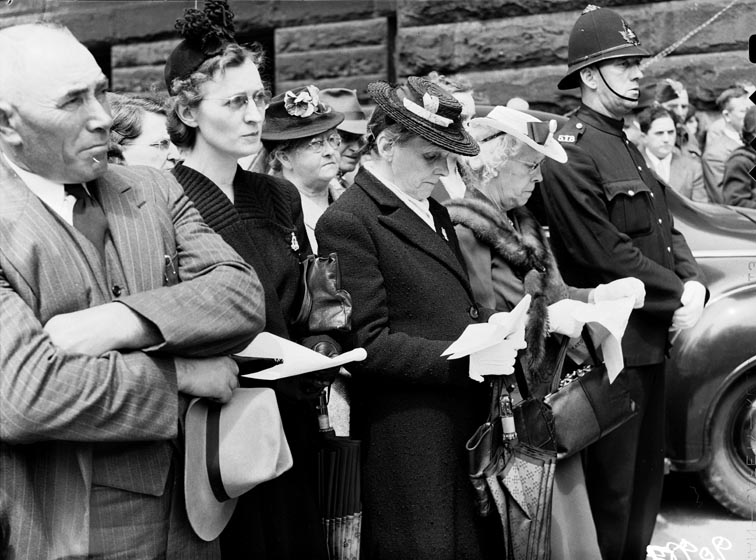
A Toronto Police constable stands with citizens during an impromptu D-Day prayer service at Old City Hall (City of Toronto Archives, Fonds 1266 Item 90982)

ON LAND

In the following days, the Allied soldiers established their toe-hold into occupied France and pushed out from the beaches, fighting through the towns, fields and hedgerows of Normandy. The weaker German coastal defence troops were being reinforced by crack tank divisions from further inland. 

Amidst the Canadian forces fighting their way inland was Harry Lee Smuck, a captain in the 6th Canadian Armoured Regiment (1st Hussars) – a tank unit. The 41-year-old was a Patrol Sergeant in the Toronto City Police Force, who joined back in 1926 and served at the Belmont Street and Claremont Street stations as well as the Mounted Unit. At 5’10 and ¾”, the fair-haired blue-eyed policeman was short compared to his colleagues in an age of height requirements on the force. (8)

To ‘do his bit’, Smuck enlisted in the 1st Hussars soon after the war broke out, and said goodbye to his wife Hettie, and children William and June. As a young man, Smuck had served seven years in the Canadian militia with the Royal Canadian Dragoons, another armoured outfit. Due to his police service and prior military service, he rose quickly through the ranks and was commissioned as an officer.
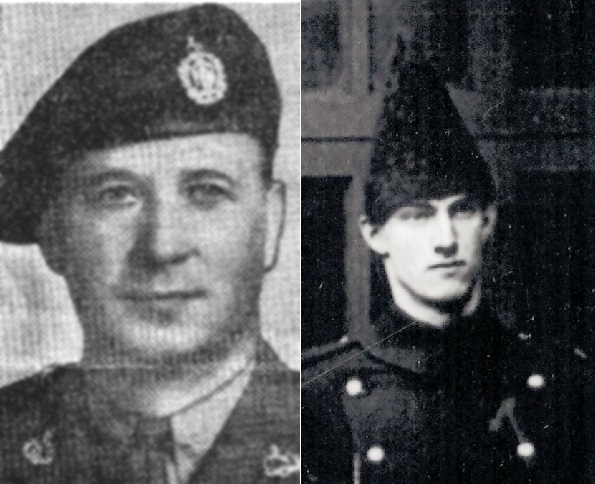
Patrol Sergeant Harry Lee Smuck, in military uniform (Canadian Virtual War Memorial), and Constable (#302) Clarence Verdun Courtney in winter dress (1938 Toronto Police Recruit Class Photo– Author’s Collection).

Harry Smuck and his troops had made the hellish assault on Juno Beach, in specially equipped Sherman tanks that could operate while partially submerged underwater. Landing near Courseulles-sur-Mer in the second wave of the attack, he and his “C” Squadron tanks put their 75mm cannons and machine-guns into action to the relief of the battered infantrymen on the shore. They fought hard breaking out from the beach, through intense street battles in town and into the fields beyond. (9) The 1st Hussars, through skilful deployment of tanks led in part by Smuck, were the only element of the entire Allied invasion force to meet their final D-Day objective. But there would be no time to rest.

After five days of fighting, Smuck received orders on the morning of June 11, 1944, that his tanks would support the Queen’s Own Rifles in an assault on German troops occupying the town of Le Mesnil-Patry. Unbeknownst to them, their radio codes had been captured some days earlier and the enemy was listening. When the attack set off in the afternoon, the Germans held their fire until the Canadians were halfway into the town. (10) The Hussars and Queen’s Own were suddenly met by tremendous machine-gun and mortar fire from a great number of troops lying in wait in the hedgerows, haystacks and buildings of the town. In response, Smuck’s tanks unleashed devastating fire (11)on the enemy and the survivors were beginning to flee. The tanks pressed on toward the village, where they found another trap waiting. As they approached, “B” Squadron started taking fire from 7.5cm anti-tank guns, which were knocking out the Canadian tanks. Then, powerful German Panzer IV tanks took the field and engaged them – the 2nd Battalion, 12th SS Panzer Division Hitlerjugend, a fanatical Nazi unit made up of experienced fighters and members of the Hitler Youth, was counter-attacking. A fierce tank battle ensued. Smuck and his ‘C’ Squadron tanks were ordered forward into a field of burning tanks,(12) and continued the fight.

Canadian tanks fighting in a Normandy field June 1944 (Library and Archives Canada MIKAN No. 3524524)

In the chaos that followed, the Canadians were ordered to withdraw. Of the over 50 tanks from the 1st Hussars that went into action, only 13 made it back. Many men were killed, wounded, or taken prisoner. Some, like Harry Smuck, were simply listed as missing. In the first six days of the Normandy campaign, over 1,000 Canadians would be killed, and over 2,000 wounded. (13)

IN the air

Pressing on the attack in the air was a motorcycle cop from East York,(14) Constable Norman Crook, flying with No. 433 “Porcupine” Squadron of the Royal Canadian Air Force. Crook joined the air force in the summer of 1942 and by D-Day, was a navigator on a Halifax bomber plane on an overnight mission to drop sea mines into the English Channel to protect the invasion fleet. 

After the Allies established a foothold in France, Crook’s squadron went to work bombing enemy troops, positions, railways and other infrastructure that could be used to send reinforcements against the Canadians.

One such mission took place on the night of June 28, 1944. Crook’s Halifax Bomber, tail number LV-839, took off on a bombing run to Metz, France, piloted by Hamilton McVeigh of Port Arthur, Ontario. En route to the fortified city, Crook and his crew suddenly encountered tracer fire coming out of the darkness – three German Ju-88 night fighters were attacking the slower bomber plane. After evading three waves of attacks from the fighter planes, the bomber was finally hit while flying in an evasive corkscrew manoeuvre. “The one shooting at us was just a decoy,” recounted Crook, “we were too busy watching him to see the guy behind. All of a sudden we got walloped. The first shell missed the rear gunner by inches and lopped off one of the rudders. Another shell went through the wing – then another, and finally one wing tip was chipped off.”(15)

The crippled aircraft, with its massive bomb load still on board, went into a tight spin at 13,000 feet in the air. The engines were failing and the pilot ordered the crew to bail out of the aircraft, which some started to do. Crook, however, made his way to the pilot, McVeigh, wanting to say goodbye to his friend before parachuting out. At that point he changed his mind and decided to stay on board – meanwhile McVeigh levelled off the aircraft at 6,000 feet. Crook, the plane’s navigator, set a course for England, to an alternate airfield with long dirt runways suitable for a crash landing. Two minutes after midnight, the aircraft made a hard 155-mph landing at Woodbridge, England, the remaining crew safe and their ordeal over. (16)

Crook’s action that night would later be recognized by the second highest award of bravery an airman could receive. His recommendation read, in part: “ …when attacking Metz his aircraft was attacked three times by fighters and was very severely damaged. So much so that two members of the crew abandoned on order of the Captain, and the aircraft lost 7,000 feet before control was regained. At that time the port outer engine cut so the bomb load was jettisoned and a course set for England. Pilot Officer Crook cooly and skilfully navigated his damaged aircraft back to a diversion base, avoiding the heavily defended areas en route, and a high-speed landing was made at an emergency landing field.” For this action and his overall flying record, he would receive the Distinguished Flying Cross.
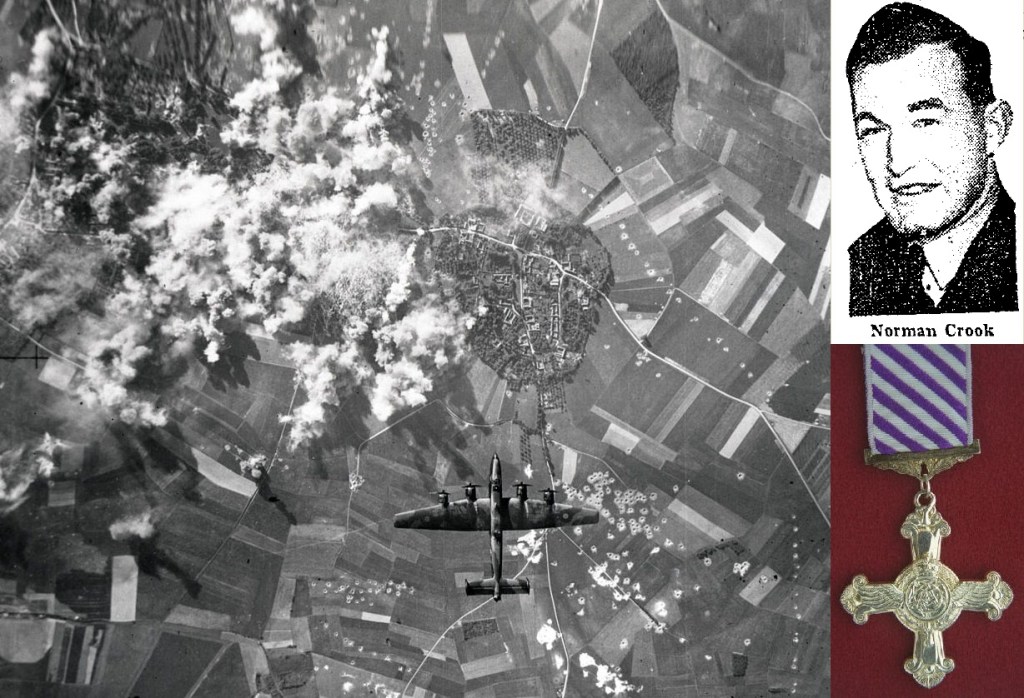
Halifax bomber on a raid. (Library and Archive Canada MIKAN No. 4002568) Top Right: Toronto Daily Star newspaper photo of Constable Norman Crook (Toronto Public Library – Historical Newspaper Database). Bottom right: The Distinguished Flying Cross

towards freedom and justice

The fighting in Normandy, France would go on until the end of August 1944. It marked the turning point in the war and from there Canadians pushed on through Belgium, the Netherlands and finally into Germany. The Nazis would surrender unconditionally in May 1945, and the true extent of their evil deeds became known – concentration camps were discovered, liberated and their victims freed. Millions who had lived under oppression would start to rebuild. The rule of law was re-established and war criminals were put on trial.
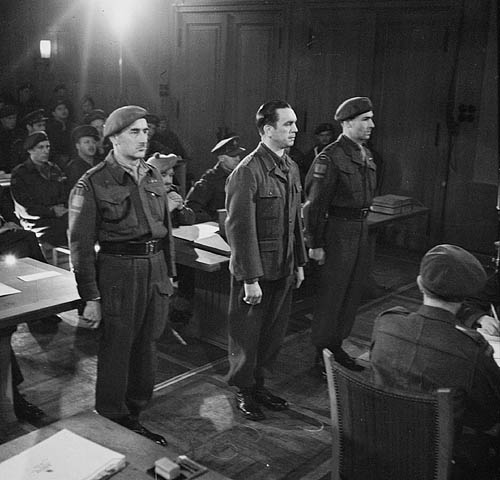
SS General Kurt Meyer on trial for war crimes in a Canadian military court. (Library and Archives Canada MIKAN No. 3191556)

One such war criminal was the Nazi General Kurt Meyer, who was tried by a Canadian War Crimes court. It was during these proceedings that the fate of Patrol Sergeant Harry Lee Smuck was discovered, thanks to the Canadian War Crimes Investigation Unit. During the battle for Le Mesnil-Patry, Smuck’s tank had been knocked out by enemy fire and he and his crew, some wounded, managed to bail out and make a break for their lines. They became separated in a firefight and Smuck and one of his men hid under another destroyed Canadian tank to re-group. 

Suddenly, the pair were swarmed by enemy troops and they decided to each make a run for it. Captain Smuck was captured and marched off to a secluded area with other Canadian prisoners of war, including some of his own tank crew, also captured in the chaotic battle. Once there, Smuck and the other men were lined up, callously shot, and buried in a shallow grave. (17) It was an unjust end for a brave man.

General Meyer was found guilty of ordering the killings, and other atrocities. Though sentenced to death, another unjust turn of events would see him only serve five years in a Canadian prison before returning to Germany, and ultimately being freed by 1954. Smuck’s remains were re-interred at the peaceful Ryes War Cemetery in Bazenville, France.

The sacrifices that many Toronto Police members made during the Normandy Campaign should never slip from our memory. On this 75th anniversary of the D-Day landings on June 6, 1944, let us pause to remember those who came before us and risked it all so that we could be free.

Sources and further reading:

(1) D. Draper. Annual Report of the Chief Constable of the City of Toronto for the Year 1939, Toronto: The Carswell Co Ltd City Printers, 1940.

(2) Toronto Daily Star 1940-09-14, p.15 “Policemen Join Up and Stick to Blue

(3) R.H. Gimblett. The Naval Service of Canada p.90-91; Toronto Daily Star 1942-01-10, p.9 “Many Toronto Men Helped Skeena Beat Off Wolk Pack”; Toronto Daily Star 1942-01-03, p.7 “PC Fred Davies, et al”; Toronto Daily Star 1942-01-03, p.3 “Says 20 U-Boats in Pack of Which Skeena Sinks 3

(4) Cobourghistory.ca/stories/hmcs-skeena; The Naval Service of Canada p.71-72

(5) Library and Archives Canada. Personnel File of B80413 Clarence Verdun Courtney.

(6) T. McCarthy. True Loyals – A history of 7th Battalion, The Loyal Regiment (North Lancashire) / 92nd (Loyals) Light Anti-Aircraft Regiment, Royal Artillery 1940-1946. Regimental History, Chapter 8: Disaster on the Sambut (Trueloyals.com/new-page-18)

(7) Library and Archives Canada. Personnel File of B80413 Clarence Verdun Courtney; Statement of Pte. J.S. Poulton, No 84 Coy, RCASC

(8) City of Toronto Archives. 1926 Nominal and Descriptive Roll of the Toronto Police Department.

(9) J. Marteinson & M.R. McNorgan. The Royal Canadian Armoured Corps – An Illustrated History. D-Day: The 1st Hussars and 7 Infantry Brigade. p.232-236.

(10) T. Copp. A Well Entrenched Enemy: Army Part 92 (Legion Magazine). Kanata: Canvet Publications Ltd, 2011.

(11) Library and Archives Canada. War Diary of the 6th Canadian Armoured Regiment(1H), June 1944.

(12) J. Marteinson & M.R. McNorgan. The Royal Canadian Armoured Corps – An Illustrated History. The Hussars at Le Mesnil-Patry. p.245-248.

(13) Veterans Affairs Canada – Normandy 1944 (veterans.gc.ca/eng/remembrance/history/second-world-war/normandy-1944)

(14) Toronto Daily Star 1944-11-28, p.13 “4 for a Fight, 3 for a Trip, Need 120 Points for Leave”

(15) Toronto Daily Star 1944-11-28, p.13 “4 for a Fight, 3 for a Trip, Need 120 Points for Leave”

(16) Collections Canada. Operations Record Book of No 433 Squadron RCAF – June 1944 Summary of Events, p.6

(17) H. Margolian. Conduct Unbecoming: The Story of the Murder of Canadian Prisoners of War in Normandy. Pages 111-115, 235-237. Toronto: University of Toronto Press, 1998.
Service and Sacrifice: The Toronto Police Service and the First World War

Researched and Written by Matthew Scarlino.

This article was originally written in November 2018, with a version featured on TPS News.

One hundred years ago, the people of Toronto and its police service would experience the crucible that was the First World War. It was perhaps the most trying time the Toronto Police Service has experienced in its history. Canadians far and wide are reflecting on the experience of that war, the human cost of the victory, and what it meant for Canada going forward. In anticipation of Remembrance Day 2018, the centennial of the victory of that war, we would like to honour the memory of the men and women of the Toronto Police, and the part they played serving the residents of Toronto at home, and serving Canada abroad.

Part 1: The Home Front – A City at War, a Force under Strain

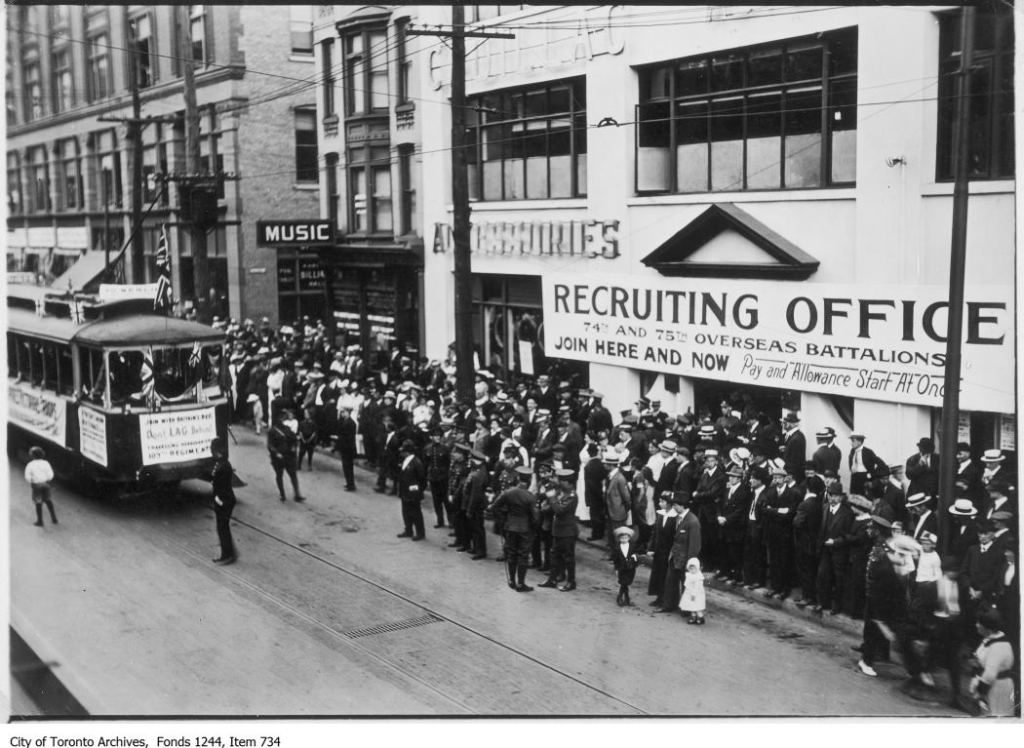
A lone constable directs traffic around a busy recruiting centre.
(City of Toronto Archives Fonds 1244, Item 734)

When the biggest war the world had yet seen broke out in August 1914, the Toronto Police Force, as it was then called, was policing Canada’s second-largest city with 626 sworn officers of all ranks, two pioneering “police women” (Mary Minty and Maria Levitt), 3 surgeons, 3 stenographers, two matrons and a censor. When Canada declared war on the Central Powers of Germany and Austria-Hungary after Belgium and France were invaded, dozens of officers went on leaves of absence to enlist. Staff shortages forced a further slew of volunteers to resign completely from the department in order to join the colours (graciously, the Police Commission would re-hire them after the war, including many wounded men). By war’s end 155 members had enlisted. This constitutes close to 25% of the pre-war strength of the department. And with the average age of a 1st Class Constable in Toronto being 42.9 years old in 1910, it is clear that a huge proportion of the force’s young, fighting-aged males were away.

Fortunately, while short-staffed, crime in the city went down in the months after war was declared in an apparent sign of civic unity. Concerned about the “home front”, the force immediately trained its officers in the use of military rifles, hired new special constables to help protect critical infrastructure, and stepped up patrols standing on guard against enemy spies and agents believed to be operating in the city. In 1915, when armouries in Windsor and railroads in New Brunswick were bombed by German spies, patrols, and anti-German and Austro-Hungarian sentiment and suspicion only intensified. There were 3 cases of high treason in the city, and in December 1915, Mayor “Tommy” Church announced German spies had been discovered applying to the Toronto Police Force. No attacks would materialize in Toronto.

Toronto Police Recruits in the winter of 1914-1915, training with military-grade Ross Rifles.
(Author’s Collection)

Canada’s national policy at the time, under the War Measures Act, was to unjustly intern thousands of recent immigrants and labourers from enemy countries on arbitrary grounds due to these suspicions. In Toronto the internees were housed at Stanley Barracks and guarded by the military. Though most would be “paroled” by 1916 in order to work, they were still required to report to local police.  Therefore, the Toronto Police Force participated in the registration and monitoring of the so-called “enemy aliens” by Detective staff, and the arrests of those who contravened the Act. The Force also seconded some officers to the Enemy Alien Office. The perhaps less-than-impartial P.C. Angus Ferguson, back from the war after having been gassed, imprisoned and having his leg forcibly amputated by his German captors after the fighting at St Julien, was accommodated with such a desk job.

Liberty Street, looking east from Dufferin Street. Artillery shells produced in Liberty Village’s factories line the streets where the Toronto Police Service’s Central Garage and Traffic Services units stand today.
(City of Toronto Archives, Fonds 1244, Item 848)

As the years went on, the officers who remained on the home front found themselves policing an increasingly rough and crowded city, now swelling with soldiers, nurses, newsboys, war industry workers and others. “The presence of a large number of soldiers in training” – Chief Henry J Grassett reported – “is taken advantage of by street walkers for solicitation”. Around the city, military camps and hospitals as well as munitions plants, shipyards and airplane factories sprang up. Roads were clogged with everything from horse-drawn carriages to automobiles, streetcars and military trucks.  In January 1916, the Chief would be knighted by King George V, for his efficiency in policing the city in this challenging environment.

Keeping the peace between over-worked labourers, elites, soldiers (both raw recruits and battle-hardened veterans), malingerers and criminals was no easy task for the constables on the beat. Officers would be injured patrolling these chaotic roads – such as Constable Percy Fleming, severely injured in August 1916 when launched from his motorcycle so hard in a head-on collision that the soles of his boots were ripped off. Other officers would be wounded in assaults, civil unrest, and even shootings – officers such as Mounted Constable George Tuft, dragged from his horse and beaten during a March 1916 riot between soldiers and prohibitionists, or Constable John May, shot through the forearm in May 1918 while confronting car thieves in Sunnyside. There was also no shortage of courage at home, like Constable William Garrett who, in January 1915, arrested Private Douglas McAndrews, a local soldier on a shooting rampage around Yonge Street; or P.C. Medhurst promoted for bravery in June 1915 for daring attempts to rescue victims of a fiery industrial explosion in West Toronto.

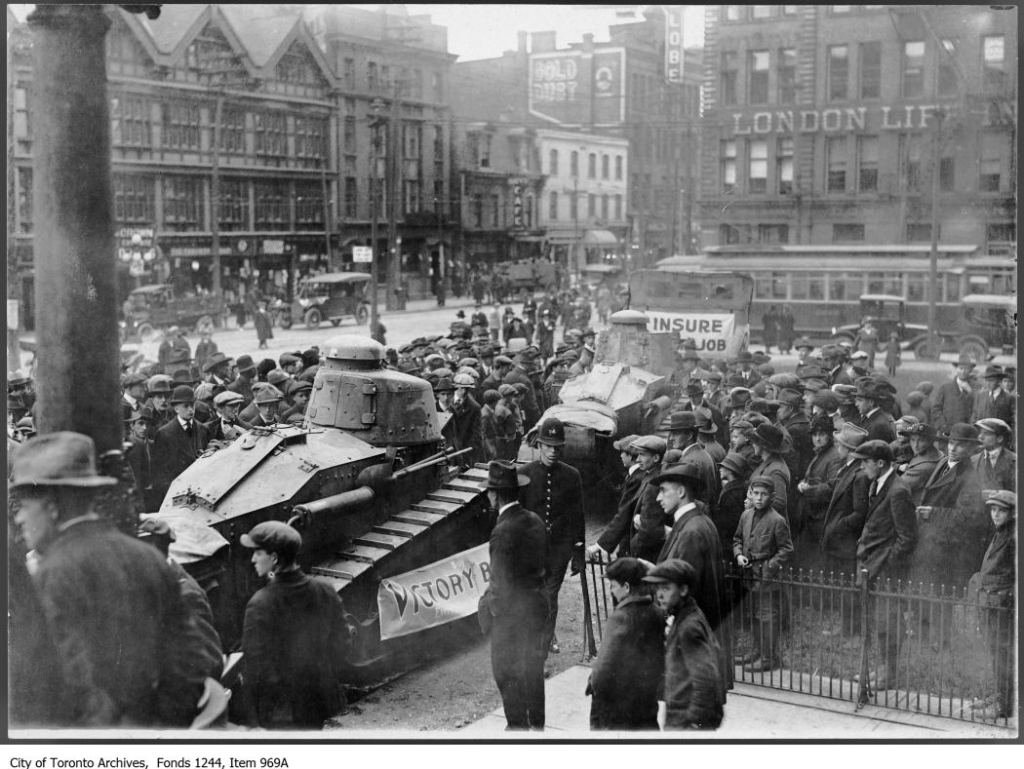
A constable and a Tank at a Victory Bond rally at Old City Hall. Toronto Police officers donated a minimum of one-day’s pay per month to the Patriotic Fund, raising tens of thousands of dollars.
(City of Toronto Archives. Fonds 1244, Item 969A)

By 1917, losses from the Somme offensive the previous year had created a significant manpower shortage among the Canadian Expeditionary Force, only to be worsened after costly victories at Vimy Ridge and beyond. The Chief reported that the strength of the force had decreased by 24 compared to the previous year (with most of the men joining the military for overseas service), and that the vacancies would not be filled. The Toronto Police Commissioners gave the officers a temporary raise – but then cancelled their weekly day off. To make matters worse, after reducing their shifts to 8 hours, their work days were again increased to 12 hours. Also, in order to support their colleagues fighting in the trenches, all officers voluntarily donated one days’ pay a month to the Patriotic Fund – which in one ten-month period had raised $20,000. The officers even found time around their long shifts to plant Victory Gardens around their police stations. In 1917 alone they cultivated 22 acres of land, and by war’s end they had donated 1,820 bags of potatoes to military hospitals in the city, as well as other hospitals and charities.

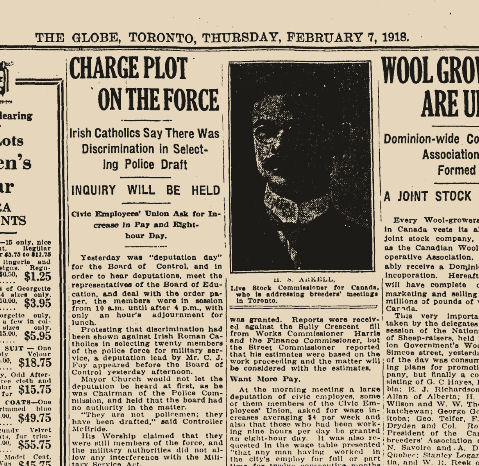
A public scandal about hidden issues on the Force hit the pages of the Toronto Globe.
(Toronto Public Library, Historical Newspapers Collection).

Due to the mounting losses overseas, the Canadian government enacted the Military Service Act towards the end of 1917, allowing for conscription of military-aged men. While at first it seemed the police force was an essential occupation, it too would have to provide a list of names of eligible men “most easily spared”, from which twenty would be drafted. When screening out officers who were sole providers for their families, had medical conditions or were over-age, had siblings killed or wounded overseas, or other considerations, this left about 40 officers to choose from. A scandal soon erupted in the religiously divided city of the time. Constables of Irish Catholic backgrounds alleged in the newspapers that the list of names forwarded was overwhelmingly Catholic, though they only made up a small percentage of the largely Protestant police force. Constable James Lee, who had already been granted an exemption by the military tribunal, even had his exemption papers seized by a Deputy Chief in order to be named to the list of available men. Tempers flared over the sectarian problems in the department. A Board of Inquiry was to be established, but cooler heads prevailed, and only 5 of the 18 men on the force’s final list who would eventually called to serve were of the Catholic denomination.

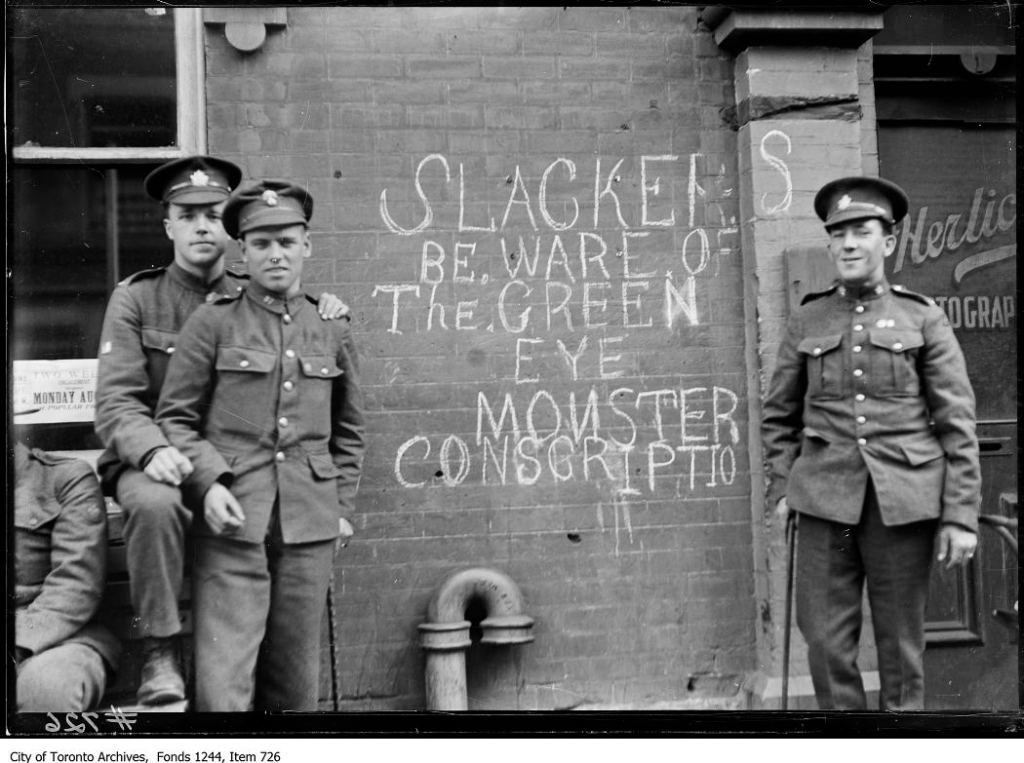
Returned soldiers near one of Toronto’s many military hospitals pose in front of graffiti, 1917. Tension between soldiers and “slackers” would soon erupt into violence.
(City of Toronto Archives, Fonds 1244, Item 726.)

Later, in early August 1918, what would be dubbed the Toronto Anti-Greek Riots broke out. It raged for three days and to this day is the largest riot in the city’s history. It began on a hot summer weekend when many veterans descended on the city for the first-ever national congress of the Great War Veterans Association, with grievances of returned soldiers a main topic of discussion. When a disabled soldier was denied service at the Greek-owned White Star Café on Yonge Street for being drunk and abusive to staff, he was removed and police were called. This area was home to a veteran’s hospital and many boarding houses in which returned soldiers lived. Tensions had already existed there, as a number of Toronto’s Greek immigrant population refused to join the Canadian forces due to their home country being officially neutral, fearing a scenario where they would be interned or have to fight their own countrymen if Greece joined the Central Powers. However many Toronto Greeks did serve, and Greece did join the Allies after all in mid-1917. Many of the local Greek business owners contributed regularly to the Patriotic Fund.

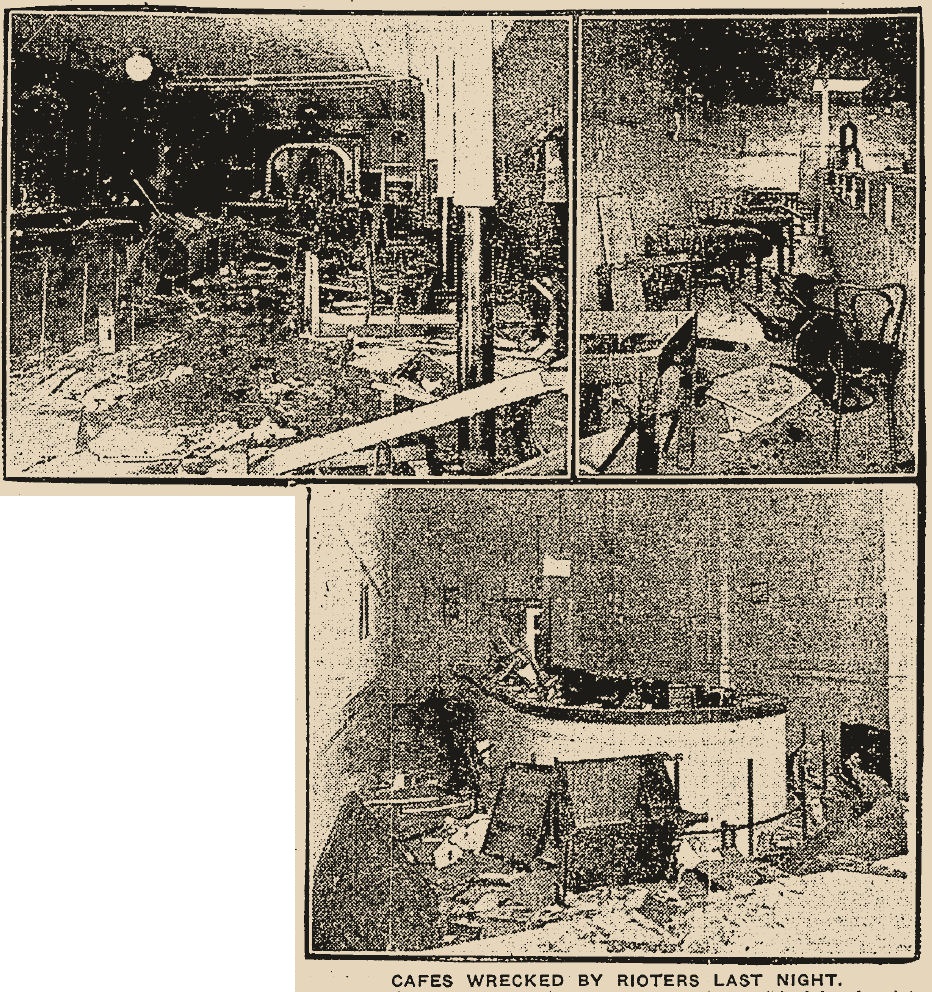
None of this mattered to the angry mob of soldiers who gathered and destroyed the business after hearing about the incident. The group of soldiers and sympathetic civilians continued to grow into hundreds, and later thousands, and went on to attack the many other Greek-owned restaurants downtown. The police attempted to disperse the crowds but believed the military police had jurisdiction over their soldiers and asked for help which never came. Many businesses were destroyed and the police were under scrutiny in the press for their ineffective response.

Damage from the 1918 Toronto Anti-Greek Riot as reported by the Toronto Daily Star on August 4th 1918. (Toronto Public Library, Historical Newspapers Collection.)

The following evening, soldiers with bugles played the “Call to Arms” and crowds gathered for another night of Anti-Greek destruction. After ringleaders of the mob were arrested, a crowd formed around No. 1 Police Station near King and Church Streets where they were held. The crowd tried to storm the police station and free the men. Constables ran out of the station and led a baton charge to disperse the crowd, while mounted officers staged nearby did the same, trapping the rioters and any onlookers that had gathered. While the Toronto Daily Star reported that the “officers used their batons mercilessly on everybody within reach,” the soldiers fought back, arming themselves with bricks and other missiles. The soldiers-turned-rioters regrouped at “Shrapnel Corner,” Yonge and College Streets, but were again charged by the Mounted Squad. More crowds would attack the No. 2 Police Station at Bay and Dundas Streets, where officers repulsed three separate attempts to storm the station. Everywhere the soldiers re-formed they were met by baton-wielding police. Pitched battles were fought into the night, the largest of which was a decisive engagement at Yonge and Queen Streets. A little after 2 a.m., all was finally clear. The police had suppressed the riot in which thousands had taken part. Twenty businesses were destroyed, 500 people were injured, and at least ten were arrested. The damage was so extensive that the area was mostly abandoned by the Greek people who then re-settled along Danforth Avenue. 

As 35 people had been seriously injured during the police response, an inquiry was held. Many policemen were injured too, such as Patrol Sergeant Hobson who received a brick to the head while on his horse. Many complaints of excessive baton use were heard and two inspectors, a patrol sergeant and a constable were dismissed from the force. However, five officers were promoted and seven received Merit Marks for their exemplary performance in the chaos. Daily headlines would keep this incident in the minds of Torontonians for months to come. News of mounting victories overseas known as “Canada’s Hundred Days” offensive, however, would bring welcome relief.

Jubilant crowds celebrate Armistice, November 11th 1918, at Queen Street West and James Street.
(City of Toronto Archives, Series 372, Item 0540)

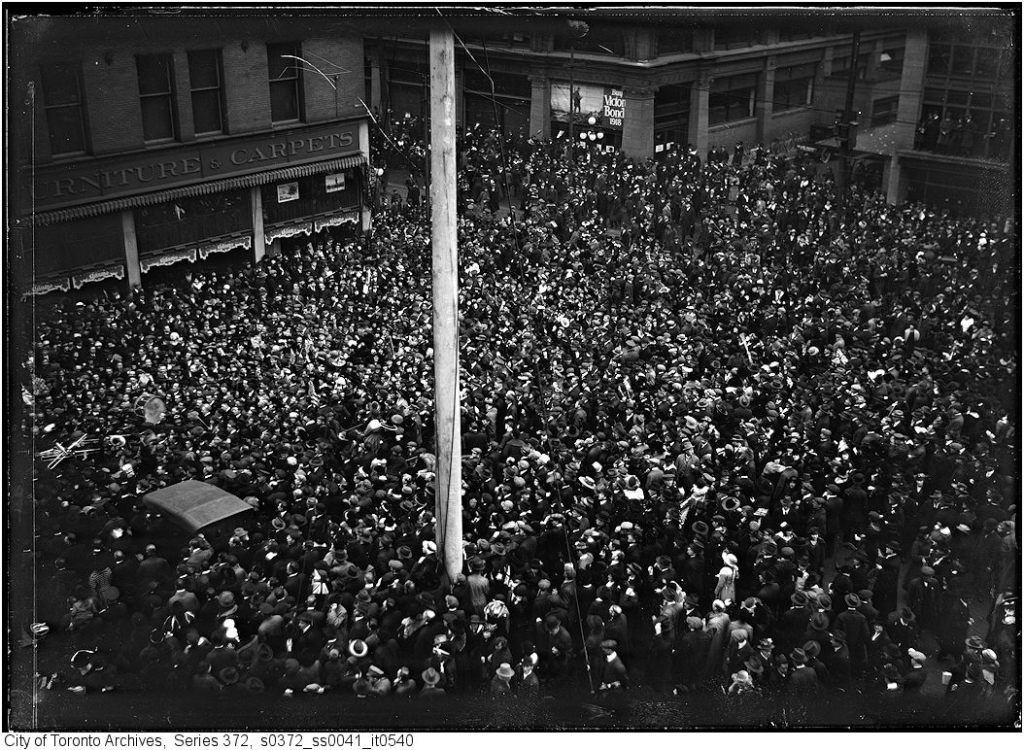
At 11 o’clock on the 11th day of the 11th month – November 11th, 1918, church bells rang out and newsboys sang headlines of an Armistice. The guns in Europe fell silent and the war was over. Canada and her Allies were victorious. Crowds packed the streets shoulder-to-shoulder, and Chief Grasett observed: “The armistice was celebrated with great rejoicing by the entire population, whose behavior in the streets was admirable, giving the police little trouble with the good natured crowds who did not go home till well on through the night.” Police and citizens celebrated openly in the streets and breathed a collective sigh of relief.

            All was not yet well however. Merely a week later, on the night of November 18th, 1918, Acting Detective Frank Albert Williams was shot through the heart while investigating a suspicious person in a stable near King and Bathurst Streets. The killer gunman, Frank McCullough, argued at his trial that he shot Williams out of self-defence because the officer was armed with his baton, referencing the rhetoric that had been playing out in the media. It didnt work, and he was sentenced to hang eight months later – where yet another riot broke out, by a large group of supporters of McCullough who agreed the man was justified. It can therefore be said that the Toronto Police Force’s first line of duty death also had its roots in the war.

In December 1918, with the war in the rear-view mirror, the membership of the Toronto Police Force – scrutinized in the press; overworked, understaffed and underpaid due to the war shortages; and having felt the sting of its first line of duty death – wanted to unionize. This was denied, and a sizeable contingent of the department went on an unheard-of strike. The strike lasted for four days. Though a failure in the short term, negotiations in the following year would see the Toronto Police Association born, in 1919. Together with the reforms to the Toronto Police Commission (the precursor to today’s Police Services Board), made after the previous year’s riot inquiry, permanent changes were made that would secure a better future for the working conditions of the constables on the beat. With many experienced Toronto Police officers returning from the front and rejoining the ranks of the department, together with the injection of many new recruits, the last strenuous chapter of the war on the home front was over. Membership in the Toronto Police Association, the Amateur Athletic Association, and War Veterans Association were growing. Morale was restored. Swagger returned to the step of the constables on the beat just in time to face the Roaring 20s and new challenges ahead.

Patrol Sergeant Robert Alexander D.C.M (centre), hero of the attack on the Drocourt-Queant Line, trains the next generation of Toronto Police recruits, 1920’s. (Author’s Collection)

PART 2: From blue to khaki: remembering the sacrifice overseas

Apart from the important work the force did on the home front, the 155-member strong Toronto Police contingent that enlisted in the military for active service overseas punched well above its weight. They were spread throughout many different units in the Canadian and British forces – mostly in the infantry and artillery, but also the cavalry, the military police, and logistical and medical units.

Soldiers undergo bayonet drill at Exhibition Camp on the CNE grounds.
(City of Toronto Archives, Fonds 1244, Item 759.)

The police officers made natural leaders, and many held important leadership positions. Seventeen would end the war as Sergeant-Majors, the highest position for an enlisted soldier. Fifteen others would have the honour of being commissioned as officers from the ranks, many for bravery. For their valour, Toronto Police constables were awarded three Distinguished Conduct Medals (DCM), a rare warrant officer’s Military Cross, seven Military Medals, a Meritorious Service Medal, two Mentions-in-Despatches, and a Serbian Silver Medal for Bravery. The citation for Mounted Squad officer Thomas Crosbie’s D.C.M., received for actions during the Second Battle of Arras while serving with the Royal Canadian Artillery, is representative of the courage of the police contingent:

“For gallantry and devotion to duty. About 9am on 28th August 1918, a large enemy shell landed in [an ammunition] dump located at the Arras-Cambrai Road between Arras and Faub St. Sauveur killing seven men and wounding five of the dump personnel. He was blown twenty to thirty feet by the explosion and wounded slightly, but with great gallantry and utter disregard for personal safety he immediately got water and put out the burning ammunition and prevented more casualties. Notwithstanding his wounds and the severe shock he had received he continued to issue ammunition until relieved. His example throughout was most inspiring to the men.”

Thomas Douglas Crosbie D.C.M., seated, pictured in the Toronto World Newspaper in 1917. 
One of three Toronto constables to receive the Distinguished Conduct Medal, second only to the Victoria Cross. Crosbie would rise to become the Inspector of the Mounted Squad after the war.
(Toronto Public Library, Historical Newspapers Collection)

Twenty-seven members of the Force would be killed overseas. All but one of the nineteen police horses donated for service with the Canadian Artillery, such as Canada and Crusader, St. Patrick and Vanguard, would die too. Fifty-seven Toronto policemen were wounded in battle, some twice or even three times – Constable “Len” Bentley, was wounded two times in the chest and later shot through the nose. Seven men would be diagnosed with Shell Shock (an ancestor of today’s Post-Traumatic Stress Disorder), like Constable James Farlow, whose doctor noted he was “broken by dreams of France” after he was buried alive by a shell on the Somme and later gassed at Vimy Ridge. Two others would be captured and sent to Prisoner of War camps after falling wounded at the Second Battle of Ypres, like Old No. 4 Station’s Harry Rainbow who languished behind barbed wire for years.

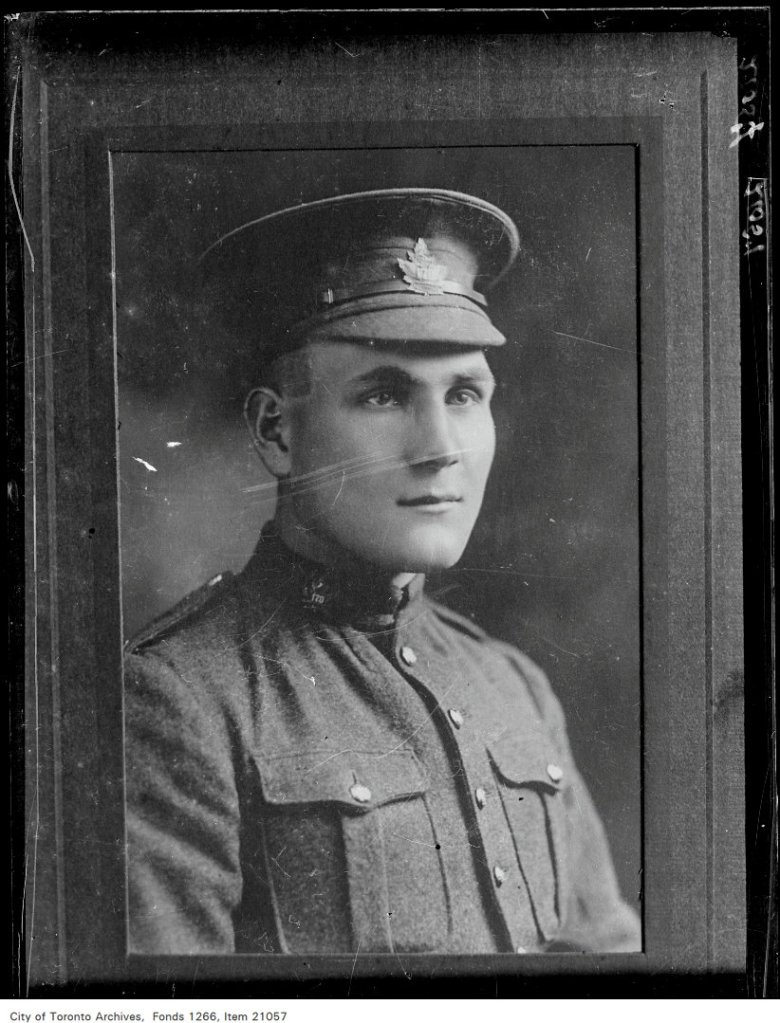
Constable Russell Stanley Dodds after trading in his police blue for army khaki. The future detective would be wounded twice while serving with the 58th Battalion of Canadian Infantry.
(City of Toronto Archives, Fonds 1266, Item 21057.)

The surviving men that returned to the Toronto Police Force, as well as new veterans hired after the war, formed the Toronto Police War Veteran’s Association to support each other and honour the fallen. The memorial plaque in the lobby of Toronto Police Service Headquarters was erected so the names of the fallen would never be forgotten. Over time however, details were lost and the life stories of the Toronto Police war dead have mostly slipped away from our collective consciousness. Thanks to the veterans’ foresight in erecting the plaque, and recently digitized military personnel service files at Library and Archives Canada, their stories can finally be told. On the eve of the 100th anniversary of victory in the First World War, we re-commit to remembering their lives and honouring their sacrifice.

Read more about the Toronto Police First World War fallen:

Sources and further reading:

  • H. Grasett – Annual Report of the Chief Constable of the City of Toronto, Nominal and Descriptive Roll of the Toronto Police Force. (1914, 1915, 1916, 1917,1918 and 1919 editions).
  • Library and Archives Canada – Personnel Records of the First World War; Circumstances of Death Registers; Honours and Awards Citation Cards 1900-1969
  • Commonwealth War Graves Commission – Casualty Details.
  • Toronto Public Library – Historical Newspapers Collection: 19140803 The Globe – Toronto Policemen May Go To Front; 19140923 The Globe – Drill and Shooting for City Officers; 19150123 Toronto Daily Star – Soldier Ran Amuck, Wounded Small Boy; 19150514 Toronto Daily Star – Toronto Policeman Missing; 19150621 Toronto Daily Star – Windsor Armouries and Walkerville Plant Attacked; 19151101 The Globe – Have Leg Amputated, or Be Shot; 19151115 The Globe –  Foe Deny Atrocity; 19151201 Toronto Daily Star – Mayor Says German Spies Try to Get on Police Force; 19160101 The Globe – Many Canadians are Included in the King’s New Years Honor; 19160126 Toronto Daily Star – $20,000 from the Police; 19160314 The Globe – Soldiers as Police for Men in Khaki; 19160405 The Globe – Gave Way to Fear of  Being Killed by Mob; 19160808 The Globe – Policeman Hurt Badly When Auto Hits Cycles; 19170110 Toronto Daily Star – Toronto Soldiers Given Commissions; 19170207 Toronto Daily Star – Letters: Policemen’s Pay; 19171116 Toronto Daily Star – 14 City Policemen Ordered to Put on Khaki; 19171117 Toronto Daily Star – Of 57 Policemen Up on Friday, 36 Must Serve; 19180123 The Globe – Says Austrian Tried Bribery, Selects Police to Put on Khaki; 19180207 The Globe – Charge Plot on the Force: Irish Catholics say there was Discrimination in Selecting Police Draft; 19180501 Toronto Daily Star – Policemen Get in Spuds; 19180928 The Globe – Policemen Tell Their Story; 19181003 The Globe – From Inquiry to Inquiry Mounted Officer has to Explain to Chief as well as Police Board; 19181101 The Globe – Youth Fires At Constable; 19190301 Toronto Daily Star – Eight Hour Day for Policemen.
  • B. Wardle – The Mounted Squad : An Illustrated History of the Toronto Mounted Police 1886-2000.
  • J.M.S. Careless – Toronto to 1918: An Illustrated History.
  • J.L. Granatstein – Hell’s Corner: An Illustrated History of Canada’s Great War 1914-1918.
  • M. G. Marquis – Working Men in Uniform: The Early Twentieth-Century Toronto Police
  • The Canadian Encyclopedia [online] – Internment in Canada
  • J. Burry/A Burgeoning Communications Inc.  – Violent August: The 1918 Anti-Greek Riots in Toronto. [ Documentary Film]

Remembering a Humble Hero: Henry Earl Scott MM

Researched and Written by Matthew Scarlino.

Note: This article was originally written in September 2017 and a version was featured on TPS News.

Throughout this 150th year of Canadian Confederation, Canadians look through our past to identify our greatest heroes and celebrate those qualities which have made and continue to make this country an amazing nation. Today we remember Patrol Sergeant Henry Earl Scott, M.M., one of the most distinguished police officers in the history of the Toronto Police Service. Twice decorated for exceptionally brave deeds – by Kings George V and George VI respectively; he is only one of two Canadians ever awarded both the Military Medal and the King’s Police and Fire Services Medal for Gallantry.

Patrol Sergeant H. Earl Scott in winter patrol dress, 1928.

Like many heroes, Henry Earl Scott (who went by his middle name Earl) came from humble beginnings. Scott was born on May 8th, 1882 in Beeton, Ontario, to Robert and Ann Scott. Earl grew up in the town an hour north of Toronto with his four brothers and two sisters. Not much is known about these early years but it is believed he helped with his father’s local lumber business. As Earl Scott grew older, he left Beeton and traveled to the City of Toronto, moving into 82 Gloucester Street.

At 28 years of age, Scott joined the Toronto Police Force on April 1st, 1910, the same year his father died. Scott served the next few years as Police Constable No. 24 in the bustling downtown core of the growing city. In 1913, Scott made the newspaper, along with his partner P.C. Edward Koster, after raiding a Queen Street Opium den, arresting 15 men and seizing $3,600 worth of drugs – a modern-day value of $77,000 when adjusted for inflation.

In late 1914, soon after the outbreak of the First World War, Earl Scott went on military leave to enlist as a Private in the Canadian Expeditionary Force, as many other Toronto Police officers were doing at the time. Scott enlisted with the 2nd Divisional Cyclist Corps, an elite unit of bicycle mounted infantry, recruited from men deemed to have above-average intelligence and fitness. The army doctor who inspected Scott noted his modest appearance with some unflattering notes – describing him as a “dark ruddy” man with blue eyes and brown “mud coloured” hair. He was just over 5’10 with a chest measuring 41 inches. Scott and his fellow Cyclists began their advanced training to act as scouts, sentries, trench guides, stretcher-bearers, prisoner escorts, dispatch riders and couriers. In the spring of 1915, after some local training, he sailed to England on the SS Corinthian, bound for the trench-ridden and battle-scarred Western Front in France and Belgium.

By the fall of 1916, a major offensive on the River Somme pitting France and Britain against Germany, was in full swing and had cost hundreds of thousands of casualties.

On the morning of October 8th, 1916, now Corporal Scott was detailed to command a squad of stretcher-bearers forward of the town of Courcelette, where British and Canadian troops were fighting the German 1st Army for control of the Ancre Heights. In the previous 72 hours, the bitter fighting there had cost the lives of Toronto constables Alfred Sim and Francis Smith, and wounded PC James Farlow.

On the following day, with the battle still raging, the following deeds took place which made Scott stand out among his peers. Now staged in the front line with the battle raging all around, Scott heard a strained voice calling “Stretcher!” and sprang into action leading his men over broken ground to the casualty. Scott and his men were unarmed and had white armbands marked “S.B.” in red – this was supposed to prevent them from being targeted. But all around him, Scott’s fellow stretcher-bearers were being cut down by bullets, artillery, and gas. Among the chaos, Scott found the wounded man, and two more. What happened next was nothing short of incredible. Scott picked up the helpless soldier and ran, without help, 275 metres to the Advanced Dressing Station under heavy artillery fire. After dropping the man off, Earl turned around and made his way back to the wounded men, picked up another, and carried him back through to safety. Stunned observers watched our hero take off a third time through the murderous fire. To their amazement, he soon-after reappeared, exhausted, with the last wounded man.

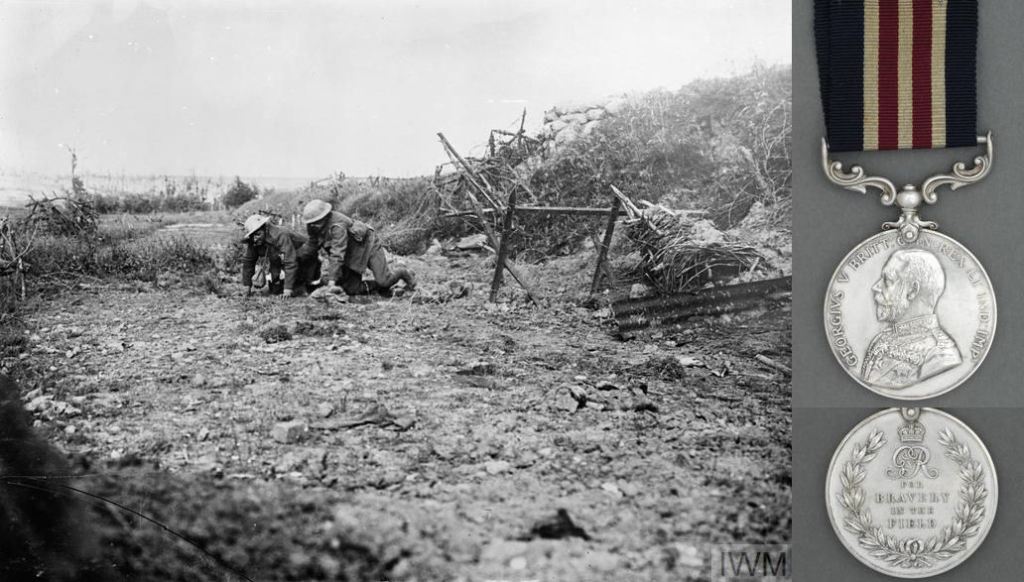
Left: Bringing in the Wounded, 1916; Right: The Military Medal

By midnight, Scott and the surviving stretcher-bearers returned to their camp exhausted. Their party had suffered 11 casualties over the last two days at the front. His superior, made aware of the incident, recommended Scott for the Military Medal, a decoration for bravery in action. The recommendation read “On the 9th October while in charge of a party of stretcher bearers engaged in bringing in wounded from the front line to the advanced dressing station unaided, carried in instant succession, three wounded men, three hundred yards under heavy shell fire.” A notice in the London Gazette on January 6th, 1917 announced that “His Majesty the KING has been graciously pleased to award the Military Medal for bravery in the Field to … 76 Cpl. H.E. Scott, Cyclist Bn.”

The War to End All Wars carried on for another two years but Scott survived, and once demobilized, returned to Toronto. Earl moved in with his widowed mother Ann, at 316 Garden Avenue in Parkdale, and returned to duty with the Toronto Police Force. Scott was soon promoted to Patrol Sergeant, at the Queen and Claremont Streets’ No. 3 Station. Scott found that he had come back to a different city, it was now the prosperous “Roaring ’20s”, the population was booming, and the relative unity and peace during the war was over. Most notably, Prohibition had been in effect since 1916. Police had their hands full enforcing the Ontario Temperance Act, and dealing with all the crime and violence of underground liquor consumption and black market trade. In those years, the now 42-year-old Earl Scott finally met the love of his life. He married May Hesson in 1925, with his mother Ann as his witness.

The 1920s came and went, and the 1930s brought in the Great Depression. Unemployment was at an all-time high, the city was crowded, and violent bank hold-ups and labour demonstrations were the new normal. In 1933, at one such demonstration in Trinity-Bellwoods Park, a lone constable was mobbed by the angry crowd. Responding to the call for assistance, Patrol Sergeant Scott arrived to the melee where he and his fellow officers were also attacked. They managed to disperse the crowd but not before our hero received a blow to the eye so hard he was sent home to recover.

Scott returned to duty soon after and, in 1935, was celebrated at a dinner with his peers after 25 years on the job at the Prince George Hotel where the TD Centre now stands. Earl Scott, however, was not finished protecting and serving the people of Toronto.

The Old No. 9 Police Station, Keele and Dundas Streets.

On Saturday, February 5, 1938, a greying 56-year-old Earl Scott was now assigned to No. 9 Station, at Keele and Dundas Streets in the city’s west end. When Sergeant Scott went into work for the night shift as the station duty sergeant, he had no reason to believe it would be anything but a quiet night. His duties were to manage the internal operations of the station for the night. Outside temperatures dropped below freezing after having rained all day. Scott was sitting at his desk as the hours passed when, just after 2 a.m., he heard a muffled gunshot and shouting outside. Scott immediately grabbed a flashlight and ran out to the street to find a 30-year-old Norman Ford shot in the gut and dying on the sidewalk in front of the police station. A married couple, passing by, witnessed the shooting and saw the perpetrator flee down an alleyway, so Scott ran south on Keele Street in order to cut him off.

Suddenly, he encountered the man coming out from the laneway by the nearby post office.

Out of the darkness, as Scott’s eyes fixed on the threat, he saw the suspect aiming a .32 automatic pistol. Click. The gun jammed. Scott threw a powerful right hook, knocking him to the ground where the sergeant wrestled the man who again tried to shoot him. Scott overpowered the killer, pried the gun from his hands, and brought him to his feet under arrest.

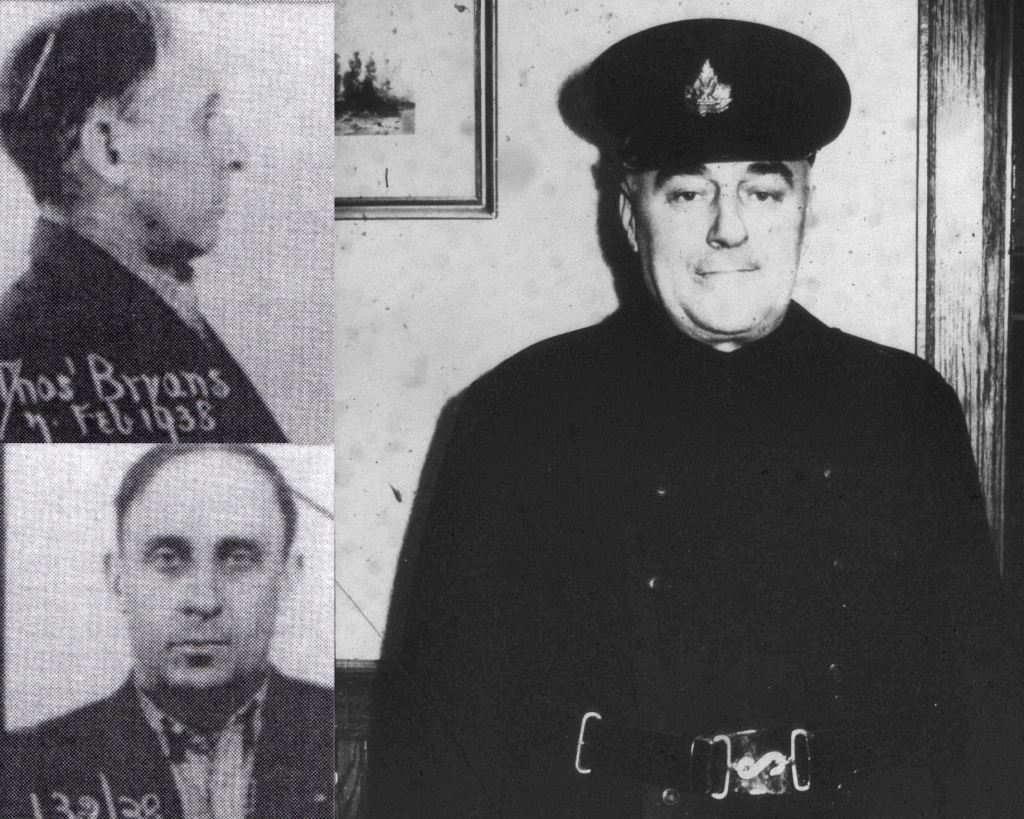
Left: Shorty Bryans’ arrest mugshot. Right: The heroic arresting officer Scott is photographed by the Globe and Mail.

The murderer was identified as Thomas “Shorty” Bryans, a career criminal who had broken out of the Kingston Penitentiary in 1923 where he was serving time for Manslaughter. Bryans had been a member of the Red Ryan Gang, notorious for violent robberies, hold-ups and murders throughout Southern Ontario since the early 1920s.

While newspaper editors praised Scott’s bravery and his restraint in not shooting the suspect, it came out later that our hero was actually unarmed throughout the incident. As the station duty sergeant, Scott was not wearing a gun belt as usual. After finding the shooting victim out front of the station, and with utter disregard for his own safety, Scott immediately chased after the suspect, fearing any delay could allow the perpetrator to escape and kill again.

In the aftermath, Chief Draper recommended Scott for the King’s Police and Fire Services Medal for Gallantry, a decoration instituted by King Edward VII in 1909 to recognize exceptional bravery by individuals in the emergency services throughout the British Empire.

Meanwhile, for his latest crime, “Shorty” was sentenced to hang, smirking in court when his sentence was read. Bryans’ execution was carried out four months later at the Don Jail.

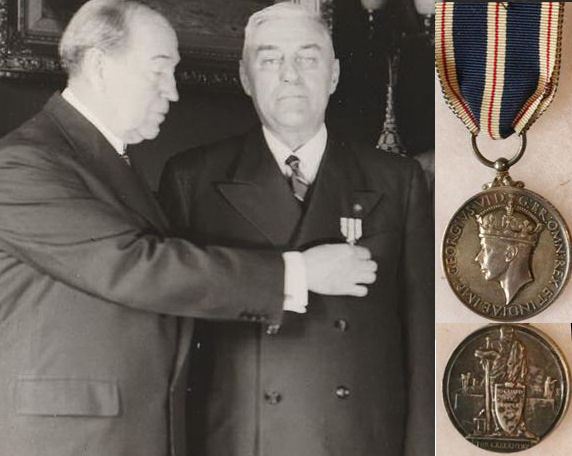
Scott quietly continued working until, after 32 years on the job, he retired on May 1, 1942. After years of bureaucratic process, award of the King’s Police Medal was announced by Canada’s Secretary of State in the Canada Gazette on March 20, 1943. Ten days later, at a yearly police parade and inspection at St Paul’s Church on Bloor Street East, a now-retired Scott was presented his decoration by Lieutenant-Governor The Honourable Albert E. Matthews on behalf of King George VI, becoming one of only 32 Canadian police officers ever decorated with the award.

Retired Patrol Sgt. H.E. Scott being presented with the King’s Police and Fire Services Medal for Gallantry. At right, a close up of a KPFSM medal.

Earl Scott then lived out the rest of his days in the companionship of his loving wife, May, until he passed away on April 27, 1955, at the Toronto Western Hospital. Scott is buried at Trinity United Cemetery in his home town of Beeton, Ontario.

In keeping with the highest traditions of the Toronto Police Service, our humble Patrol Sergeant Henry Earl Scott spent his life putting others before himself, to protect and serve, and should be forever remembered as a true Canadian hero.

With Thanks to Jack Templeman and Bob Pyefinch.

Photo Credits:

  • “Patrol Sergeant H. Earl Scott, M.M., in winter patrol dress, 1928” Courtesy of The City of Toronto Archives,
  • Fonds 1266, Item 13017
  • “Bringing in the Wounded near Albert, 1916” Courtesy of the Imperial War Museum ©IWM Q752
  • “The Military Medal” Courtesy of the Imperial War Museum ©IWM OMD5788
  • “The Old No. 9 Police Station” Courtesy of the Toronto Reference Library, Baldwin Collection Item S 1-854.
  • “Shorty Bryans’ mugshot.” Courtesy of Library and Archives Canada
  • “Scott photographed by the Globe and Mail.” Courtesy of City of Toronto Archives, Fonds 1266 Item 49441
  •  “Retired Patrol Sgt. H.E. Scott, being presented with the KPFSM for Gallantry” Courtesy of the Pyefinch Collection
  • “The King’s Police and Fire Services Medal.” Courtesy of the Pyefinch Collection

Sources and further reading:

  • Grasett, H. (1915) Annual Report of the Chief Constable of the City of Toronto for the year 1914 – p. 48. Toronto, ON: The Carswell Company Limited.
  • Draper, D. (1939) Annual Report of the Chief Constable of the City of Toronto for the year 1938 – p. 39-40. Toronto, ON: The Carswell Company Limited.
  • Templeman, J. (2017) To Guard My People: The King’s Police and Fire Service Medal in Canada – p. 51-52. Winnipeg, MB: Leadthrough.
  • McCreery, C. (2015) The Canadian Honours System, 2nd Edition – p. 116-117, 125-128. Toronto, ON: Dundurn Press.
  • Blatherwick, J. (2016) King’s Police and Fire Services Medal, Plus Other Medals to Police and Fire Services In Canada. Blatherwick.net
  • The London Gazette. (1917, January 6th) Supplement 29893 to the London Gazette, Page 350.
  • The Canada Gazette. (1943, March 20th) No. 12, Volume LXXVII, Page 1256.
  • Toronto Daily Star. (1913, October 24th) Fifteen Chinamen Taken In, p. 11; (1920, January 14th) Several Promotions Made in Police Force, p. 3. (1938, February 7th) Sergeant Fells Alleged Slayer With Fist Blow, p. 1; Note and Comment, p. 4; Alleged Murderer Remanded After Shooting, Sec. 2 p. 1. (1938, February 9th) Police Learn N. Ford Feared Man in Cafe Armed with Revolver, p. 1; (1938, October 20th) Even Men Going to Jail Like Insp Chisholm, Sec. 2 p. 1 & 27; (1943, May 20th) 3 Police Officers Win King’s Medals, Sec. 2 p. 2.
  • The Globe. (1933, June 5th) Crowd is Dispersed After Hot Fight, p. 11; (1935, April 10) Celebrate Quarter Century on Vimy Night, p. 11.
  • The Globe and Mail. (1938, February 7th) Toronto Murder Laid to One of Ryan Gang, p. 1; (1938, April 29th) Thomas Bryans Smiles at Sentence of Death, p. 5; (1942, April 28th) Sgt E. Scott Resigns Force, p. 4; (1943, May 31st) King’s Medal Rewards Courage of Policemen, p. 7; (1955, April 29th) HE Scott etc., p. 4.
  • Archives of Ontario. Registration of Births and Stillbirths 1869-1913; Ontario Canada Select Marriages.
  • Library and Archives Canada. Census of Canada 1891, 1901, 1911, 1921. Personnel Records of the First World War; Military Honours and Awards Citations Cards 1900-61; War Diaries of the Canadian Corps Cyclist Battalion 1916/05/12 to 1919/03/31; Capital Punishment Case Files – 1938 – Bryans, Thomas.

Remembering Our Vimy Fallen

Written and Researched by Matthew Scarlino.

Note: This article was originally in written in April 2017. Versions of this article were published in Blue Line Magazine and featured on TPS News.

On Sunday, April 9th, 2017, Canadians will mark the 100th anniversary of the Battle of Vimy Ridge, which took place during the First World War. At that point, it was Canada’s largest force ever fielded and its four divisions fought together for the first time and achieved a major victory on a position previously thought impregnable. It gained Canada international praise and led to greater independence – but it came at a cost.

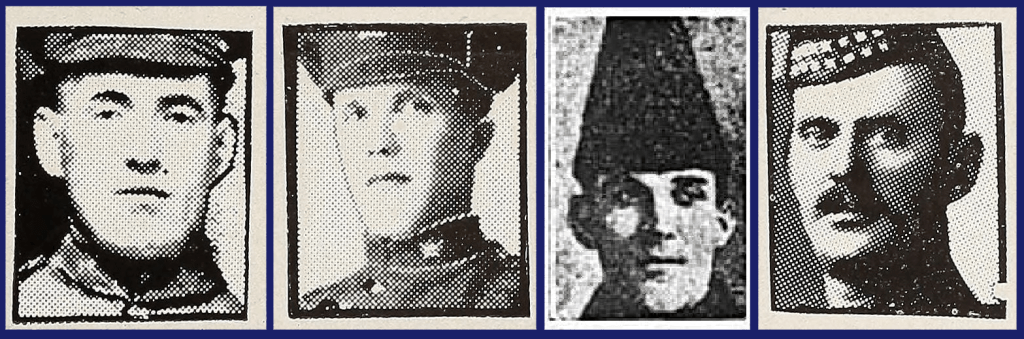
PC 274 Samuel H. MacGowan, PC 374 Andrew Johnson, PC 451 William H. Haynes, and PC 540 Robert C. Clarke
(National Memorial Album of Canadian Heroes and Toronto Evening Telegram)

Canada’s greatest single-day loss in a war that spanned four years would occur on Easter Monday, April 9th, 1917 on that now-legendary escarpment. Over 10,000 Canadians would become casualties in ensuing 48 hours.

At least 156 Toronto Police members fought in the Great War, and four of its 27 members killed in action fell at Vimy Ridge. Their loss remains a poignant reminder of the tragedy of war. This is the story of Toronto Police Constables Robert Cunningham Clarke, William Henry Haynes, Andrew Johnson, and Samuel Henry MacGowan.

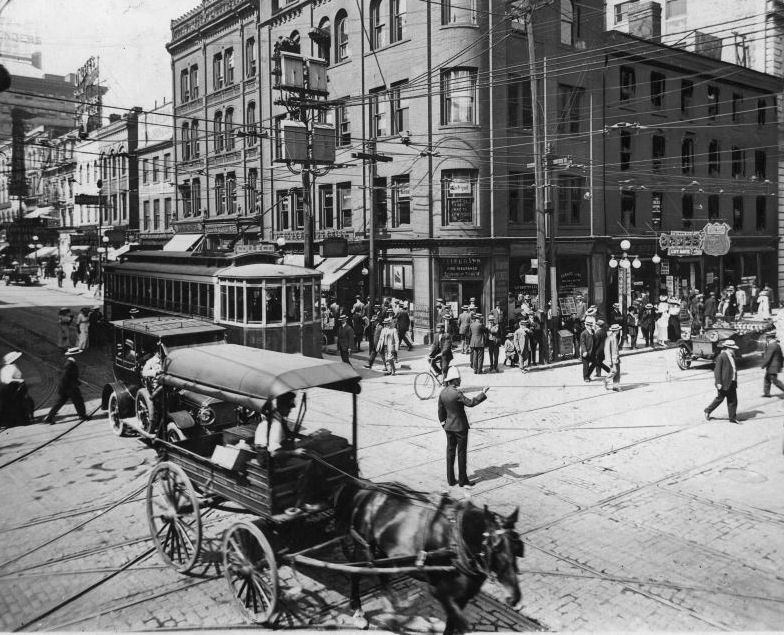
An officer directs traffic at Yonge and King in 1912
(City of Toronto Archives, Fonds 1244 Item 491)

In the early 1910s, Toronto was Canada’s second largest city, with a population of 380,000 souls. The Toronto Police Force, as it was then called, was responsible for keeping the peace with a strength of about 600 police officers and a handful of civilian employees.

The summer of 1914 would see the world change forever. A complex system of competing alliances and empires throughout Europe resulted in the “July Crisis,” unleashing a chain of events in which, among other declarations of war, Germany invaded Belgium and France. Great Britain, bound by friendship and treaties, in turn declared war on Germany. Canada, a Dominion of the British Empire, was automatically at war.

Many Canadians, including many Toronto Police members sworn and civilian, joined the military, eager to defend their values and “do their bit” for King and Country. Even a contingent of Toronto’s police horses were donated for service with the artillery (sadly, only “Bunny” would survive the war). 

Four constables in particular would have their fate permanently intertwined with a significant moment in Canadian history.

  • Police Constable No. 274 Samuel Henry MacGowan, an Irish immigrant, joined the Toronto Police Force in 1911 at 23 years old. His post was the downtown No. 1 Police Station, on Court Street near Church Street. “Sam” lived with his brother Hugh at 733 Markham Street.
  • Police Constable No. 374 Andrew Johnson, also born in Ireland, joined the Force in 1912 when he was just 20 years old. He policed Parkdale from the No. 6 Police Station at Queen Street West and Cowan Avenue.
  • Police Constable No. 451 William Henry Haynes, the only married man in the group, was an English immigrant and also joined the Toronto Police Force in 1912, at 25 years old. He policed the west end of the city from No. 9 Police Station at Keele Street near what is now Dundas Street West. He had a young wife, Lillie Haynes and two young children and lived at 518 Church St.
  • Police Constable No. 540 Robert Cunningham Clarke, another young man from Ireland, lived at 129 Alexander Street. He had previous police experience serving with the Royal Irish Constabulary. At 28 years old, Clarke became a Toronto Police officer.
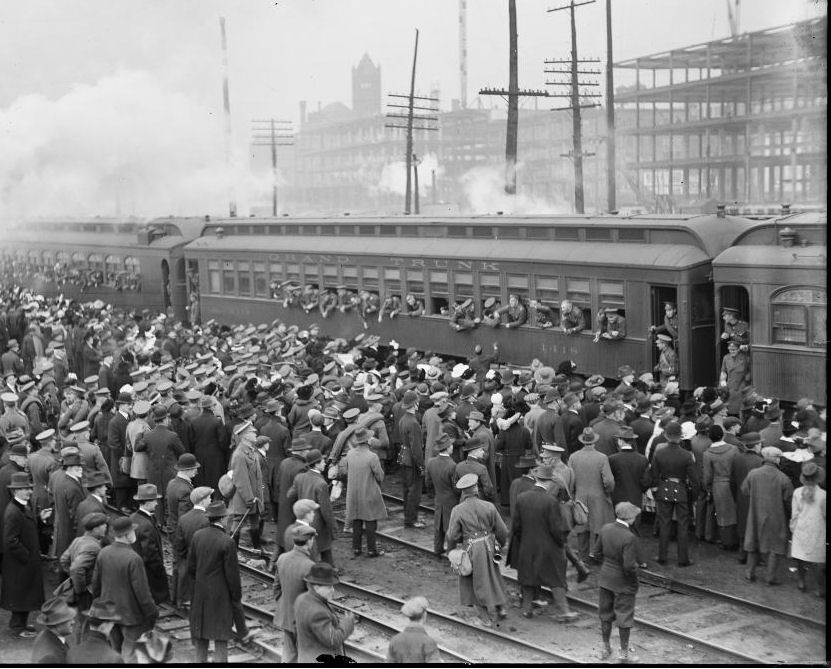
The 180th Battalion leaves for War, Union Station. Toronto Police officers can be seen
in the crowd seeing the men off. (City of Toronto Archives, Fonds 1244 Item 821)

It was now 1914. The newly formed Canadian Expeditionary Force (CEF) was sent, piece by piece, to the battleground known as the Western Front.

When old-fashioned tactics met new battlefield technologies, such as quick-firing artillery, machine guns, and barbed wire, the front lines devolved into a system of trench warfare (the muddy, miserable trench would become the enduring image of the war), where both sides dug in to defensive positions. The barren area between the two sides became known as No-Man’s Land and was littered with shell-holes, debris, and corpses. The trench lines ran through Belgium and France, all the way from the North Sea to neutral Switzerland’s border. Attacks up and down the line would be repeatedly launched and repelled. Even more barbaric weapons such as poison gas and flamethrowers would be invented to try and dislodge the defenders and break the stalemate, yet the stalemate continued.

In August 1915, Constable Andrew Johnson put his career on hold and joined the
83rd (Queen’s Own Rifles of Canada) Battalion. Constable Robert Cunningham
Clarke enlisted with the 92nd (48th Highlanders of Canada) Battalion in September 1915. Both the Queen’s Own Rifles and 48th Highlanders are still active today in Toronto. In the early-winter months of 1916, Constable William Henry Haynes and Constable Samuel Henry MacGowan enlisted in Toronto’s 180th (Sportsmen) Battalion, which recruited local amateur athletes. All the men sailed to England to train for battle. The policemen were natural leaders, and all were promoted up the ranks – Clarke to Corporal and the others to Sergeant.

Clarke’s unit was broken up for reinforcements and he arrived in France, now with the 42nd (Royal Highlanders of Canada) Battalion, 3rd Canadian Division, and reached the front in August 1916. In November, during the Battle of Ancre
Heights, Clarke was hospitalized with a gunshot wound to the head.

In the early winter months of 1917, allied commanders devised a plan to break the inertia in the Arras sector. Canadian forces, who had been fighting for the past few years in separate units and divisions spread throughout the British army, were to be massed as the Canadian Corps, near the enemy strongpoint on Vimy Ridge. The high ground was held by tough Bavarian units of the German army, and the position withstood years of attacks by British and French forces. It’s commanding view of the sector was strategically important.

Meanwhile, in England, Johnson, Haynes, and MacGowan were all eager to join the fight and reverted to the rank of Private in order to be sent to France as replacements. Upon arrival they became members of the 75th (Mississauga) Battalion – today known as the Toronto Scottish Regiment – in the 4th Canadian Division. They reached the front lines in February 1917, where the battalion was positioned near Vimy. On March 1st, they withstood some of the worst horrors of the war when their unit took part in a disastrous reconnaissance raid where, during the attack, Canadian chlorine gas blew back in their own direction while the enemy unleashed devastating fire on the struggling troops.

Clarke, meanwhile discharged from hospital, rejoined his 42nd Battalion which was also positioned near Vimy.

Leading up to the anticipated offensive, the Canadian General Arthur Currie, aside from the reconnaissance raids, introduced innovative new strategy in which his troops would conduct realistic battle rehearsals. In between stints in the trenches, the men drilled constantly on their roles and objectives. Secret mines and subways were built under No Man’s Land to get troops through some of the killing fields, and, for the final week leading up to the attack, Canada unleashed its largest ever artillery bombardment on the defenders of Vimy Ridge. Once the attack was launched the artillery would switch to a “creeping barrage” which moved ahead of the advancing infantry.

In the cold, wet early morning hours of April 9th, the day now at hand, the men were given rum rations and mugs of tea as they nervously waited for zero hour.

Canadians advancing through German entanglements, Vimy Ridge.
(Library and Archives Canada Item O-1158)

At 5:30am, a flare went up, infantry officers blew their whistles, and the men surged “over the top”, advancing forward and uphill. They gripped their rifles and instinctively tucked their chins into their collars as if the flying shrapnel were a hailstorm. PC Clarke was in this first wave of attacking troops. His 42nd Battalion reached and captured its first objectives by 7:00am, where they paused to regroup.

Further north, Constables Johnson, Haynes and MacGowan’s 75th Battalion was following lead elements of the push towards Hill 145 (the high point of the ridge), who were taking heavy casualties. By 8:00am, they had advanced further uphill but their brigade was in trouble – the lead battalions were decimated and the 75th were now in the front line pinned down taking heavy machine gun fire.

While they were held up, Clarke’s unit to the south was further forward, and therefore exposed. They started taking increasingly heavy fire, and were ordered to dig in in order to protect their brigade’s flank. Over the next four hours they suffered 200 casualties.

The battle raged on throughout the day. Clarke’s 3rd Division would be the first to hold their section of the ridge and look out to the plains beyond. Johnson, Haynes, and MacGowan’s 4th Division fought for Hill 145 into the following day where it ultimately succeeded.

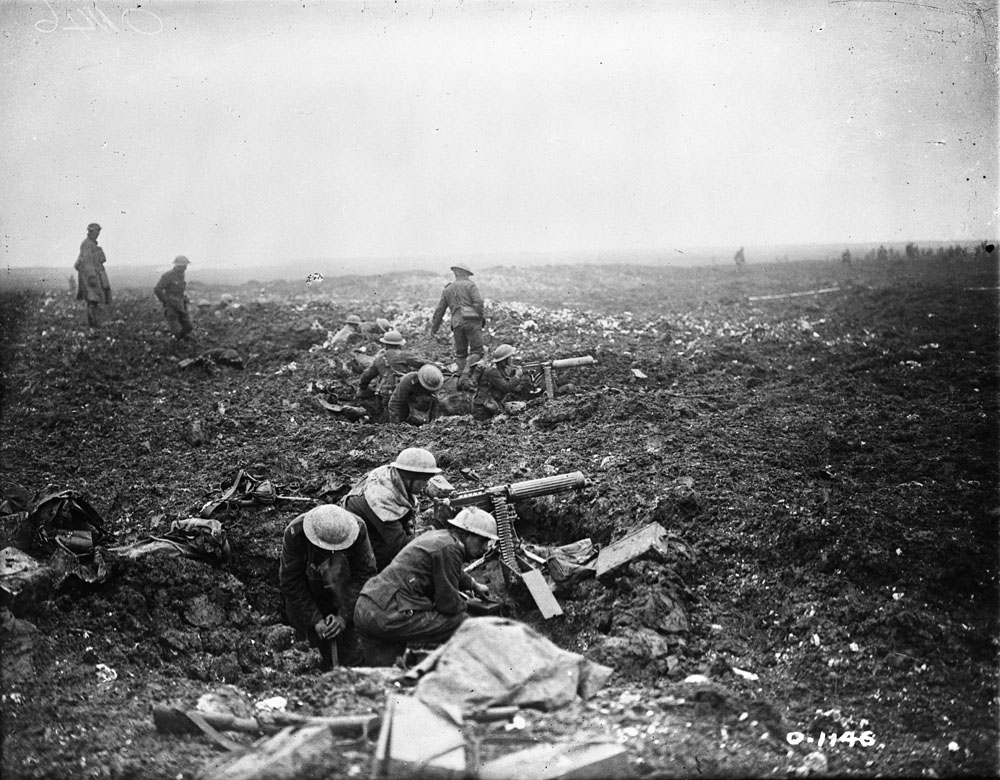
Canadian troops dig in and set up machine guns in case of counter-attack.
(Library and Archives Canada PA-001017)

By the end of the day, “Sam” MacGowan, Andrew Johnson, William Haynes, and Robert C. Clarke were among Canada’s 3,598 men killed at Vimy Ridge. It is not known at which point the four men fell that day, or if any of them ever knew the battle was won.

News of the victory spread throughout the world, and many historians argue it was at this point that Canada came of age – Canadians ceased to think of themselves as a collection of former colonies but a unified nation, capable of achieving great things. The Canadian Corps went on to achieve many more great victories, and when the war was over, Canada had its own seat at the League of Nations (the precursor to today’s United Nations). Canada’s political and diplomatic independence grew from there into the system we are proud of today.

This April 9th, remember the Toronto Police officers whose bravery and ultimate sacrifice one hundred years ago helped make Canadian history and end the Great War. Sadly, the “War to End All Wars” was not the last, and Toronto Police members continue to serve our country overseas pursuing a better world.

Lest We Forget.

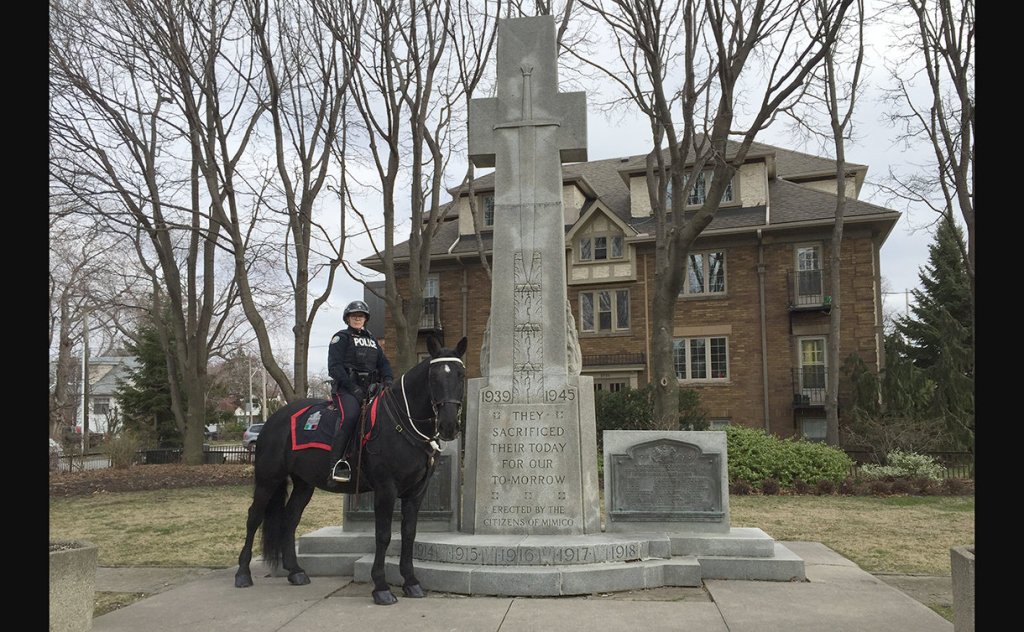
Today, Toronto Police horse “Vimy Ridge” is named in honour of the victory, pictured here at Vimy Ridge Parkette in Etobicoke with Constable Melanie Mathieu. (Toronto Police Service)

Sources and further reading:

  • H. Grasett – Annual Report of the Chief Constable of the City of Toronto, Nominal and Descriptive Roll of the Toronto Police Force. (1914, 1915, 1916, and 1917 editions).
  • Library and Archives Canada – Personnel Records of the First World War
    • Service File of No. 192383 Robert Cunningham Clarke
    • Service File of No. 862010 William Henry Haynes
    • Service File of No. 171257 Andrew Johnson
    • Service File of No. 862344 Samuel Henry MacGowan
  • Library and Archives Canada – War Diaries of the First World War.
    • 75th Canadian Infantry Battalion, 1916/08/11 – 1918/08/31.
    • 42nd Canadian Infantry Battalion, 1915/10/01 – 1918/05/31.
  • Library and Archives Canada – Circumstances of Death Registers. Register Cards of 192383 Robert Cunningham Clarke; 862010 William Henry Haynes; No. 171257 Andrew Johnson; 862344 Samuel Henry MacGowan.
  • Commonwealth War Graves Commission – Casualty Details of of 192383 Robert Cunningham Clarke; 862010 William Henry Haynes; No. 171257 Andrew Johnson; 862344 Samuel Henry MacGowan.
  • Toronto Public Library – Historical Newspapers Database:
    • The Toronto Daily Star (1917, April 17th), Page 7. “Went with Sportsmen”.
    • The Toronto Daily Star (1917, April 30th). “Former Policeman Killed”.
    • The Toronto Daily Star (1917, May 2nd), Page 14. “Sergt Haines Killed”
    • The Toronto Telegram (1917, May). “Sergt W M Haines”.
    • The Toronto Telegram (1917, June). “Buried at Vimy Ridge”.
    • The Toronto Daily Star (1917, June 23rd), Page 2. “Toronto Policeman Killed”.
    • The Toronto Evening Telegram (1918, March 15th). “West Toronto Police Honor Roll”.
  • Veterans Affairs Canada – Canadian Virtual War Memorial. Pages for 192383 Robert Cunningham Clarke; 862010 William Henry Haynes; No. 171257 Andrew Johnson; 862344 Samuel Henry MacGowan.
  • A. Turner – Vimy Ridge 1917: Byng’s Canadians Triumph at Arras. Osprey Publishing 2005.
  • J.L. Granatstein – Hell’s Corner: An Illustrated History of Canada’s Great War 1914-1918. Douglas & McIntyre 2004; Victory at Vimy Ridge. The Vimy Foundation 2017.
  • Veterans Affairs Canada – Historical Fact Sheets – Battle of Vimy Ridge.
  • D. Morton – Significance of Vimy Ridge. The Vimy Foundation 2017.