Warriors’ Day: A Look Back on the First Hundred Years

Written and researched by Matthew Scarlino. Toronto, 2023.

The Warriors’ Day Parade, held annually during the Canadian National Exhibition in Toronto, was established in 1921 as a formal tribute to the veterans of the First World War who had recently returned to the city in triumph. From there it has grown into an ongoing tribute to the servicemen and women of Canada and has become a yearly highlight for many Torontonians. The late summer parade of military formations, veterans’ groups, emergency services, colour parties, military bands, re-enactors and others showcases the pageantry of Toronto’s military organizations.

The Toronto Police Military Veterans Association – originally as the Toronto Police War Veterans Association and latterly the Metropolitan Toronto Police War Veterans Association – has participated in the parade since its inception. It has come to be one of the signature events for the Association, proudly marching under the Princes’ Gates every summer. The only exceptions to this of course were on the rare occasions that the parade was cancelled; from 1942-46 (Second World War and Demobilization), 2003 (Northeast Blackout), and 2020-21 (COVID-19 Pandemic).

In the earliest days of the parade, a Toronto Police contingent of First World War veterans would march south from the Dufferin Gate to the thrill of spectators. The men made quite an impression as they paraded on horseback, on motorcycles and on foot, war medals gleaming on their blue serge uniforms. In this era of minimum height requirements on the force and English-style “bobby” helmets the policemen must have towered over the other contingents. Their annual procession was typically led by Chief Constable Draper, a decorated Brigadier-General during the war.

In 1927, Edward, Prince of Wales and Prince George officially opened the iconic Princes’ Gate, which the parade has passed through ever since.
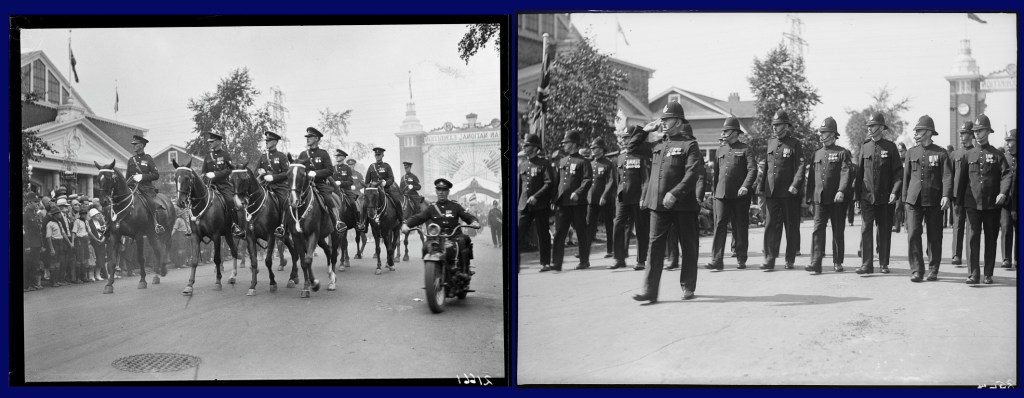
Toronto Police War Veterans parade past the Dufferin Gate at Warriors’ Day in the early 1920’s. (City of Toronto Archives)

A Winning Record

In those early years, the Canadian National Exhibition was in the practice of awarding “diplomas” as award certificates for exhibition categories such as Backyard Garden and Poultry and everything in between. In February 1941, the Warriors’ Day Council presented one such CNE Diploma to Mayor F.J. Conboy and TPWVA President Felix Connolly, won by the 117-strong contingent dubbed the Toronto Police War Veterans Special Squad for their “march discipline and general appearance” on parade during the 1940 Warriors’ Day Parade. It was to be the first Warriors’ Day award of many in years to come for the Association.
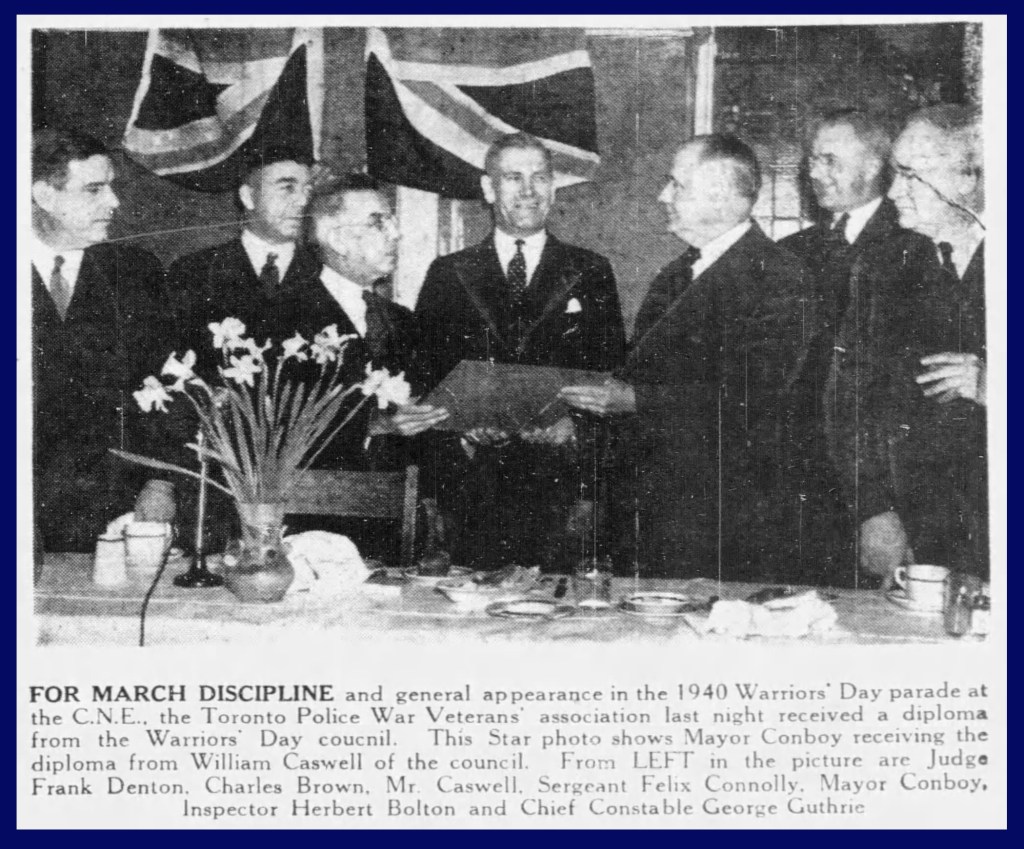
“For March Discipline,” Toronto Daily Star newspaper clipping. (Toronto Public Library)

It’s not clear if the diplomas were commonly awarded for Warriors’ Day, but awards became a mainstay of the event, fostering esprit de corps and ensuring a good showing. Growing from a single trophy donated in 1937, prizes in the form of memorial trophies began to be awarded by the Warriors’ Day Council to marching contingents deemed to be best in a variety of categories. Today, scoring is done by judges along the route and in the grandstands, and trophies are then presented every October at the Warriors’ Day Parade Council’s awards banquet.

During the first 30-year period of these new awards, the trophies were set aside specifically for “Veterans’ Clubs”.  Throughout this period, the Association did not win any trophies, probably due to the fact that they operated in an overlapping “gray area” as they technically paraded as the Toronto Police contingent, in the police uniform of the day, and not specifically as a Veterans Club – though all policemen on parade were war veterans. Other police agencies and fire departments whose personnel were war veterans marched in the parade as well, and also do not figure in the awards of the time (recently, the gap in awards for Emergency Services was addressed – the MWO Leonard Pelletier, CD Memorial Trophy was created in 2018 for First Responder contingents).

This incertitude would last until the 1968 reorganization of the Toronto Police War Veterans Association into the Metropolitan Toronto Police War Veterans Association (MTPWVA) – simply called the “War Vets” among the police department. Not only did this reorganization reflect a long overdue change in name since the 1957 amalgamation of the 13 Toronto-area police services into the Metropolitan Toronto Police force, but this reorganization came with it a new marching uniform.
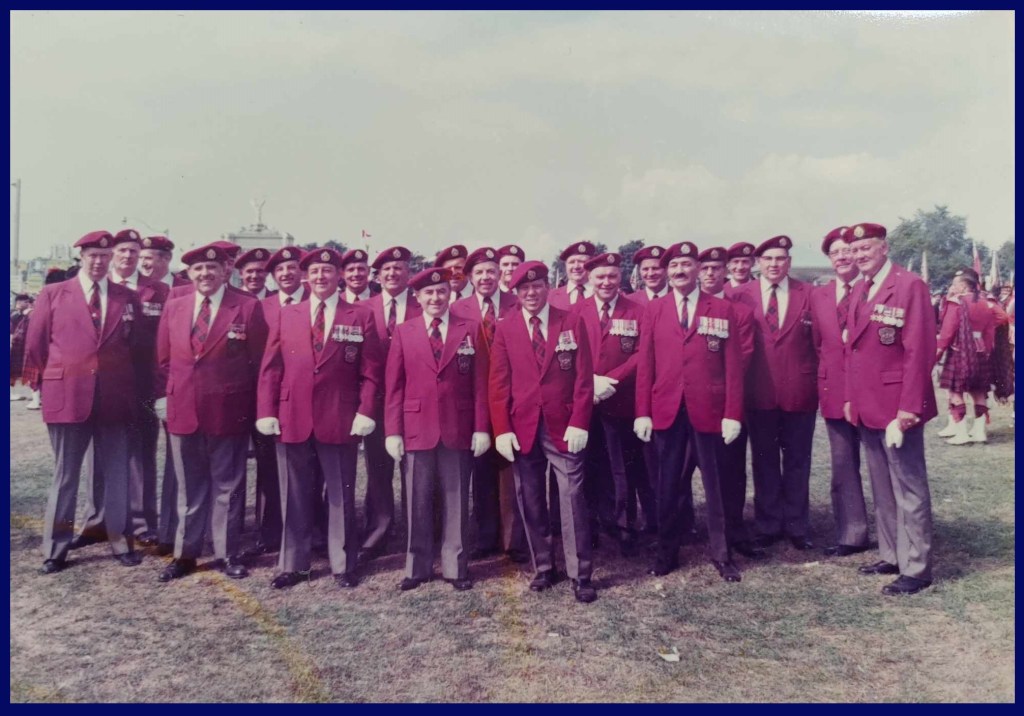
The “War Vets” gather for a photo in the marshalling area prior to the Warrior’s Day Parade, 1970’s. (Hargan Collection)

The uniform is familiar to many of that era and consisted of a brass version of the normally silver MTP cap badge (and marked “WVA” in place of the badge number) on a maroon beret, a maroon blazer with the MTPWVA crest, and a tie – originally Red Ross tartan, later a custom MTPWVA “Regimental” tie – and gray slacks. The colour chosen is believed to be due to the close and friendly association with the 1st Canadian Parachute Battalion Association, of which many prominent MTPWVA members were a part at the time – men like Alex Greenaway, Andy Anderson and formerly, Frederick Topham VC. It appears those who would parade in the Association’s marching uniform were retired members, while active members still paraded in police uniform of the day. The MTPWVA contingent would be so sizeable that there were multiple platoons and a colour party. Adding to this Colour Party was another change – the Association now had its own Association Flag, referred to as its Colours, which would be proudly carried by the left marker.

Together with these changes, ahead of Warriors’ Day the Association would meet weekly at the Downsview air base for drill practice, producing favourable results.
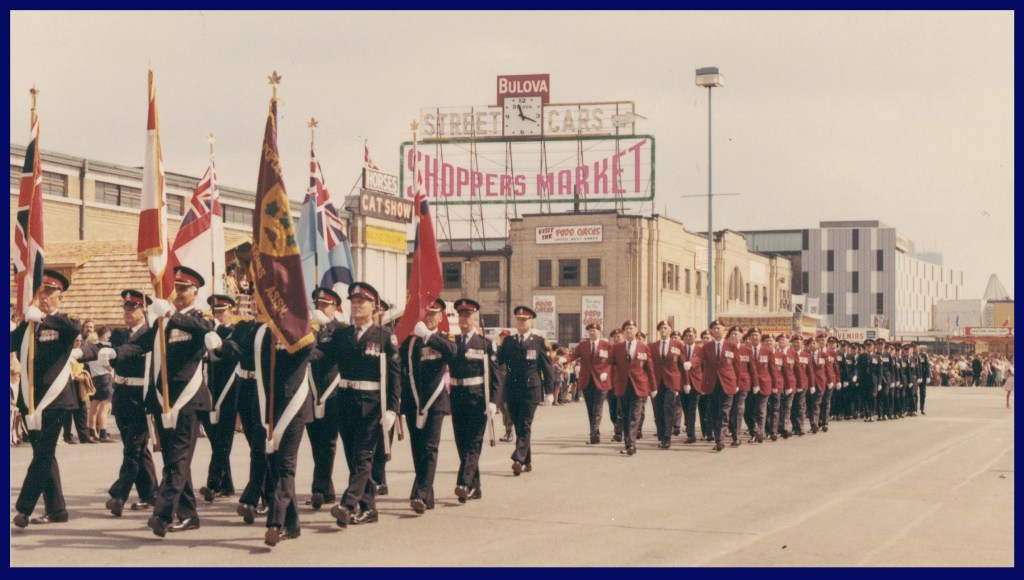
The Colour Party and various platoons of the MTPWVA on Parade in the early 1970’s. (Surphlis Collection)

From 1968 on, now marching as a distinct “Veterans’ Group” and drilling regularly, the Association began winning many trophies, consistently placing in the top rankings of various categories (a full list of which appears following this article). In 1971, The MTPWVA Colour Party won the Frank Jamieson Trophy as overall parade champions – the only time in its history thus far.

The following year, 1972, the Association donated The Metropolitan Toronto Police Veterans Memorial Trophy to the Warriors’ Day Council to be awarded to the best Pipes & Drums on parade with 21 members or more in attendance. Winning it that year was the Metropolitan Toronto Police Pipes & Drums. While this may seem like favouritism, they were the only pipe band to qualify in the category.

Members of the Warriors’ Day Council inspect the newly donated Metropolitan Toronto Police Veterans Memorial Trophy. (To Serve and Protect: A History of the MTP, Vol. I)

Loss and Reunion

Two of the most significant events involving the Association at Warrior’s Day would occur within four years of each other.

Tragedy struck the 1977 Warrior’s Day Parade when Staff Sergeant William Harper collapsed while marching in the MTPWVA contingent as it approached the reviewing stand. He was pronounced dead on arrival at St Joseph’s Hospital.

Staff Sergeant Harper was a 28-year Toronto Police veteran. Affectionately known as “The Hat”, he was the stylish head of the plainclothes Pawn Squad unit, with an uncanny knack for recovering stolen goods. During the Second World War, Harper served in the Royal Canadian Naval Volunteer Reserve as a Cook on shore establishments on both coasts of Canada, the Dominion of Newfoundland, and on the High Seas aboard HMCS Saguenay. He was awarded the 1939-45 Star, The Canadian Volunteer Service Medal with Overseas clasp, and The War Medal 1939-45. The policeman’s last award would be the Canon Scott Trophy his marching contingent won in the Warriors’ Day Parade.

Left: William “The Hat” Harper (McCormack Collection) Right: “Police Veteran Collapses,” Globe and Mail Newspaper Clipping (Toronto Public Library)

The year 1981 saw President Art Turner leading the War Vets on parade. At the head of the parade was a familiar figure marching as the Honorary Parade Marshal. Turner was determined to speak to him.

Born in Swansea, Wales in 1921, Turner joined the British Territorial Army, a reserve force, as a 16-year-old Gunner in the Royal Artillery. By December 1941, he found himself in a coastal artillery unit guarding the British colony of Hong Kong in the face of an expansionist Imperial Japan, whom with they were not yet at war.

Japan struck on the 8th of December in a surprise attack with overwhelming force against the tiny garrison and after several weeks of vicious fighting, the British capitulated on Boxing Day 1941. The survivors, including 20 year old “Art” Turner, were rounded up as Prisoners of War and shifted from camp to camp under atrocious conditions. Turner, “refusing to sign a proclamation not to escape” was transferred to Yokohama, Japan, in the heart of the Japanese Empire. He ended up at Camp X3B – a converted baseball stadium surrounded by barbed wire and sadistic guards. The men were forced to perform back-breaking hard labour in lumberyards, factories, and shipyards while subsisting on meagre rations – a mere two bowls of rice per day. Many were worked to death, died of disease, or were killed by their captors. Tantamount to slave labour, this episode was later condemned as one of many war crimes perpetrated by the regime.

The highest-ranking prisoner at Camp 3XB was a Canadian airman named Leonard “Len” Birchall, known as the Saviour of Ceylon for thwarting a surprise Japanese attack on the British Colony of Ceylon (now Sri Lanka) in 1942. When an Allied prisoner, too sick to work, was being beaten in front of the men by a Japanese medic, Turner watched Birchall intervene by punching the guard in the face, breaking his jaw. Though he saved the life of his subordinate, it was a death sentence for him. Birchall was sent for two weeks of solitary confinement, then blindfolded and marched out to be shot – only for the camp commandant to have a change of heart and allow him to live. This incident was one of many that showed the character and leadership of Birchall and left an impression on Turner and everyone else in the camp, and one of the many reasons he was later awarded the Order of the British Empire for his conduct there. Turner himself withstood physical abuse, though standing at 6’2 he later jokingly recalled that his tormentors had to stand on a soapbox to beat him.

Finally liberated in 1945 after three long years, an emaciated Turner shook Birchall’s hand for all he had done to keep them alive, and he began his journey home. After hospitalization in the Philippines, Turner began his long repatriation to the United Kingdom by ship to Esquimalt, British Columbia. From there he travelled by rail to Halifax, Nova Scotia, and then by sea across the Atlantic until he reached home. Seeing Canada from coast to coast along his voyage, Turner fell in love with the country and afterwards emigrated to Toronto, where he became a policeman. He worked his way up to the rank of Staff Sergeant, and was elected President of the Metropolitan Toronto Police War Veterans Association – which takes us back to the 1981 Warriors’ Day Parade.

Left: 1981 Warriors’ Day Poster (Exhibition Place Archives) Top Right: Air Cdre Birchall (DND Archives, PL-133463) Bottom Right: S/Sgt Turner (1978 MTP Yearbook)

Marching down Princes’ Boulevard and past the CNE Midway, the parade concluded and Turner caught up to the Honourary Parade Marshal by the CNE’s Queen Elizabeth Building. It was none other than Air Commodore (Retired) Leonard J. Birchall, OBE, DSC, CD, the man he had known so well all those years ago.

The men shook hands after 36 years and two lifetimes apart. Birchall immediately recognized Turner. “Seeing you brings back a lot of memories,” he said. Turner asked him if he still played the accordion, to which Birchall replied in the affirmative. The men then explained the inside joke to the audience which had formed, referring to the way they used the instrument to pass messages between sections of the camp.

The men carried on for some time in a touching reunion that was inspiring to all those who saw it.

A New era

Jumping ahead to the early part of the 21st Century, the ageing War Vets’ numbers began to dwindle, yet they still marched as proudly as ever, and kept an immaculate turnout as they transitioned to new parade dress. It was a hybrid of the Toronto Police No. 1 Dress with distinctive shoulder flashes, black striped pants, and retaining the MTPWVA beret.
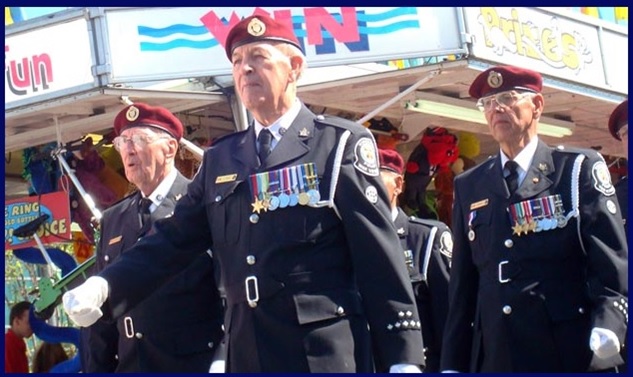
President Jack Reid marching down the CNE Midway on Warriors’ Day, 2007. (Warriors’ Day Council)

In December 2010, The Metropolitan Toronto Police War Veterans Association evolved once again, into today’s Toronto Police Military Veterans Association. Like the last reorganization, an overdue official name change was necessary as the “Metropolitan Toronto Police” had given way to the “Toronto Police Service” in 1998. More significantly, membership to the Association was expanded to include members who had served honourably in the Canadian Armed Forces, Allied forces, or served on International Police Operations, which reinvigorated the Association and boosted the membership.

At the 2011 Warriors’ Day parade, the first as the “TPMVA”, the Association won both the Goodyear Remembrance Trophy and the Lord Mayor’s Cup for having the best marching formation of 16 or more and having the largest formation on parade, respectively.

In 2018, Sgt John Lo Bianco CD, 2nd Vice-President TPMVA was appointed Honorary Parade Marshal for the Warriors’ Day Parade in recognition of his work as the head of the Toronto Police International Peace Operations program, where he oversaw dozens of officers deployed overseas during his tenure.

On August 20th 2022, after a forced two-year hiatus, the men and women of the Toronto Police Military Veterans Association marched in the historic 100th Warriors’ Day Parade, winning the Goodyear Remembrance Trophy for the 35th time in the Association’s history. It was a fitting end to their first century of marching in Toronto’s grandest military parade, and a sign of a strong future ahead.

The 2022 Toronto Police Military Veterans Association Colour Party (John Lo Bianco)

With thanks to Todd Turner, Elizabeth McCormack, Bryan Hargan, Doug Surphlis and Jacqueline Edwards.

Awards

The Warriors’ Day Parade Council awards won by the Association are as follows:

As the Toronto Police War Veterans Association:

  • 1940 – Warriors’ Day Council Diploma

As the Metropolitan Toronto Police War Veterans Association:

  • 1970 – 3rd Place, Canon Scott Trophy (Marching Formations of 15 or less)
  • 1970 – Tied 2nd, John Labatt Limited Trophy (Colour Guard or Party of 3 or more)
  • 1971 – The Frank Jamieson Memorial Trophy (Parade Champions)*
  • 1971 – 1st Place, Goodyear Remembrance Trophy (Marching Formations of 16 or more)
  • 1971 – 1st Place, John Labatt Limited Trophy (Colour Guard or Party of 3 or more)
  • 1972 – 1st Place, Goodyear Remembrance Trophy (Marching Formations of 16 or more)
  • 1973 – 1st Place, Goodyear Remembrance Trophy (Marching Formations of 16 or more)
  • 1974 – 1st Place, Goodyear Remembrance Trophy (Marching Formations of 16 or more)
  • 1975 – 1st Place, Goodyear Remembrance Trophy (Marching Formations of 16 or more)
  • 1976 – 1st Place, Goodyear Remembrance Trophy (Marching Formations of 16 or more)
  • 1977 – 1st Place, Canon Scott Trophy (Marching Formations of 15 or less)
  • 1979 – 1st Place, Goodyear Remembrance Trophy (Marching Formations of 16 or more)
  • 1979 – 2nd Place, John Labatt Limited Trophy (Colour Guard or Party of 3 or more)
  • 1980 – 1st Place, Goodyear Remembrance Trophy (Marching Formations of 16 or more)
  • 1981 – 1st Place, Goodyear Remembrance Trophy (Marching Formations of 16 or more)
  • 1983 – 1st Place, Goodyear Remembrance Trophy (Marching Formations of 16 or more)
  • 1984 – 1st Place, John Labatt Limited Trophy (Colour Guard or Party of 3 or more)
  • 1988 – 1st Place, Canon Scott Trophy (Marching Formations of 15 or less)
  • 1989 – 1st Place, Canon Scott Trophy (Marching Formations of 15 or less)
  • 1992 – 1st Place, Goodyear Remembrance Trophy (Marching Formations of 16 or more)
  • 1993 – 1st Place, Goodyear Remembrance Trophy (Marching Formations of 16 or more)
  • 1995 – 1st Place, Goodyear Remembrance Trophy (Marching Formations of 16 or more)
  • 1996 – 2nd Place, Goodyear Remembrance Trophy (Marching Formations of 16 or more)
  • 1998 – The Lord Mayors’ (London, England) Cup (Largest Marching Unit on Parade)
  • 1998 – 1st Place, Goodyear Remembrance Trophy (Marching Formations of 16 or more)
  • 1999 – 1st Place, Goodyear Remembrance Trophy (Marching Formations of 16 or more)
  • 2000 – 1st Place, Goodyear Remembrance Trophy (Marching Formations of 16 or more)
  • 2001 – The Lord Mayors’ (London, England) Cup (Largest Marching Unit on Parade)
  • 2001 – 1st Place, Goodyear Remembrance Trophy (Marching Formations of 16 or more)
  • 2002 – 1st Place, Goodyear Remembrance Trophy (Marching Formations of 16 or more)
  • 2004 – 1st Place, Goodyear Remembrance Trophy (Marching Formations of 16 or more)
  • 2005 – 1st Place, Goodyear Remembrance Trophy (Marching Formations of 16 or more)
  • 2006 – The Lord Mayors’ (London, England) Cup (Largest Marching Unit on Parade)
  • 2006 – 1st Place, Goodyear Remembrance Trophy (Marching Formations of 16 or more)
  • 2007 – 1st Place, Goodyear Remembrance Trophy (Marching Formations of 16 or more)
  • 2008 – 1st Place, Canon Scott Trophy (Marching Formations of 15 or Less)
  • 2009 – 1st Place, Goodyear Remembrance Trophy (Marching Formations of 16 or more)
  • 2010 – The Lord Mayors’ (London, England) Cup (Largest Marching Unit on Parade)
  • 2010 – 2nd Place, Goodyear Remembrance Trophy (Marching Formations of 16 or more)

*Specifically the MTPWVA Colour Party.

As the Toronto Police Military Veterans Association:

  • 2011 – The Lord Mayors’ (London, England) Cup (Largest Marching Unit on Parade)
  • 2011 – 1st Place, Goodyear Remembrance Trophy (Marching Formations of 16 or more)
  • 2012 – The Lord Mayors’ (London, England) Cup (Largest Marching Unit on Parade)
  • 2012 – 1st Place, Goodyear Remembrance Trophy (Marching Formations of 16 or more)
  • 2013 – 1st Place, Goodyear Remembrance Trophy (Marching Formations of 16 or more)
  • 2014 – 1st Place, Goodyear Remembrance Trophy (Marching Formations of 16 or more)
  • 2015 – 1st Place, Goodyear Remembrance Trophy (Marching Formations of 16 or more)
  • 2016 – 2nd Place, Goodyear Remembrance Trophy (Marching Formations of 16 or more)
  • 2017 – The Lord Mayors’ (London, England) Cup (Largest Marching Unit on Parade)
  • 2017 – 1st Place, Goodyear Remembrance Trophy (Marching Formations of 16 or more)
  • 2018 – 3rd Place, Goodyear Remembrance Trophy (Marching Formations of 16 or more)
  • 2019 – 1st Place, Goodyear Remembrance Trophy (Marching Formations of 16 or more)
  • 2022 – 1st Place, Goodyear Remembrance Trophy (Marching Formations of 16 or more)

Sources and Further Reading:

  • D. Draper. Annual Report of the Chief Constable of the City of Toronto for the Year 1940, Toronto: The Carswell Co Ltd City Printers, 1941.
  • D. A. Brock – Metropolitan Toronto Police: To Serve and Protect, Volume I. and Volume II. D. W. Friesen and Sons Ltd; Altona, 1979.
  • City of Toronto Archives. Fonds 70, Series 2503: News and Views: Newsletters of the Metropolitan Toronto Police, September 1969 – May 1979.
  • The Globe and Mail. 1977, Aug 22nd, Page 5. “Police Veteran Collapses, dies in CNE Parade.”
  • The Toronto Star. 1981, Aug 23rd, Page A3. “Prison Camp and CNE are Two Lifetimes Apart”.
  • Interviews with Jack Reid, Toronto, July 30th, 2021 and July 7th, 2022.
  • Correspondence with T. Turner (2022), E. McCormark (2023), B. Hargan (2022-2023).
  • The Warriors’ Day Parade website. Parade History and Competitions and Trophies.  http://www.thewarriorsdayparade.ca/ Retrieved August 12th 2023.
  • Canadian Aviation Hall of Fame website. Leonard Joseph Birchall. https://cahf.ca/leonard-joseph-birchall/ Retrieved August 12th 2023.
An Everlasting Bond: The Birth of the Toronto Police War Veterans Association.

Written and Researched by Matthew Scarlino. Toronto, 2021. Revised 2022.

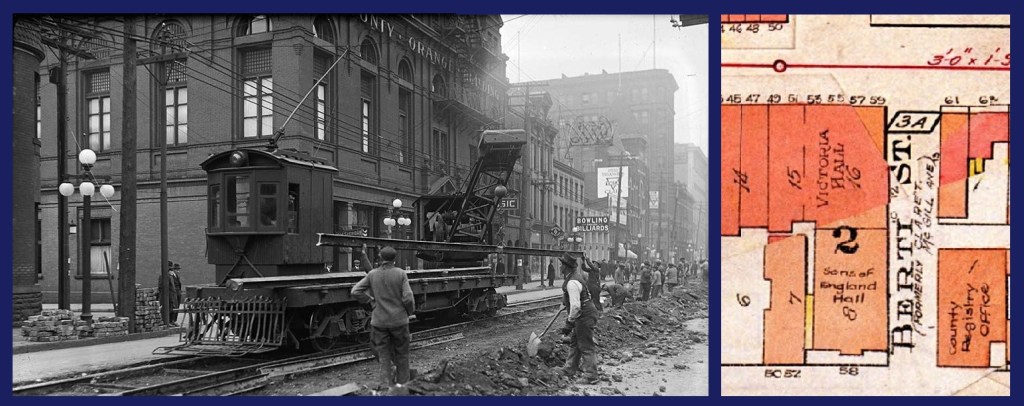
It was on the evening of a mild September 14th, many years ago, that a group of Toronto police officers who had returned from the Great War met downtown at the County Orange Building. That social club, better known as Orange Hall or the Victoria Hall, was already the meeting place of the newly formed Toronto Police Association. Now the site of a drab grey office tower, the red-bricked hall was situated on the southwest corner of Queen Street East at Berti Street, opposite the Metropolitan Church, and just down the street from the old No. 1 (Court St) Police Station.

The Orange Hall, seen behind these workers, was the birthplace of the Toronto Police War Veterans Association.
[City of Toronto Archives Fonds 1231, Item 426; Goad’s Fire Insurance Plan 1924].

These police war veterans met to form an association similar to that of the pre-eminent Great War Veterans Association, the largest such veterans association at the time. Formed in 1917 while the war was still ongoing, the influential “GWVA” was held in high esteem by returned men. Therefore, during the policemen’s meeting one imagines these men adapted their aims similar to those of the GWVA.

  • To preserve the memory of those policemen who suffered and died in war for the nation and the empire; to erect and preserve monuments to their valour and sacrifice; and to establish annual memorial services.
  • To ensure proper care for their fellow police war veterans, their widows and families, and other returned soldiers, facing ill-heath, financial difficulties, or other hardships.
  • To promote pride and loyalty to Canada and the Empire and service in their interests.

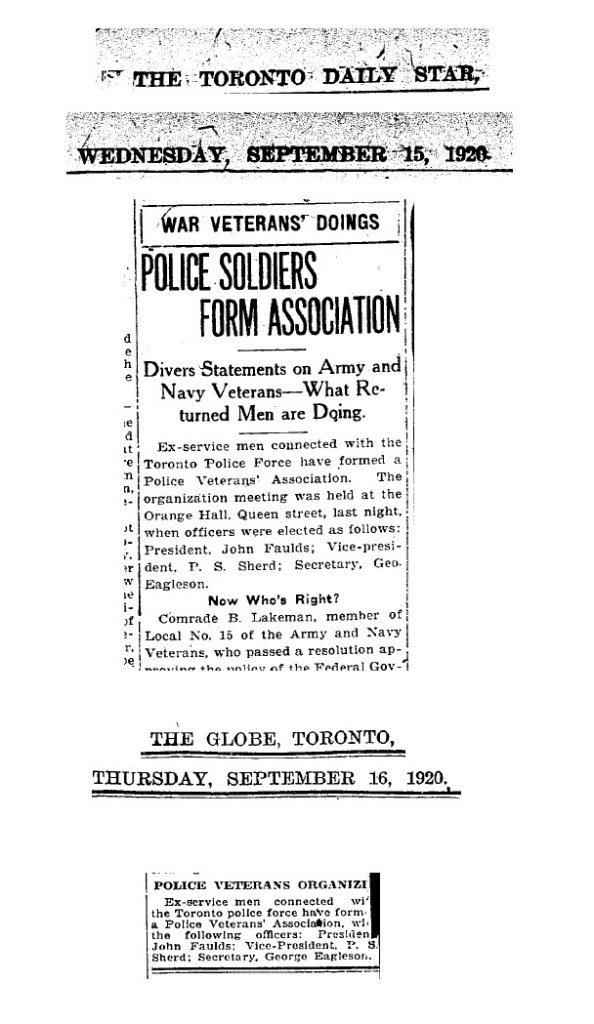
With the objectives settled, the men voted to elect its first officers. The Toronto Daily Star reported the following day:

Police Soldiers Form Association
Ex-service men connected with the Toronto Police Force have formed a Police Veterans’ Association. The organization meeting was held at the Orange Hall, Queen street, last night, when officers were elected as follows: President, John Faulds; Vice-President. P. S. Sherd [sic]; Secretary. Geo. Eagleson.

Toronto Daily Star

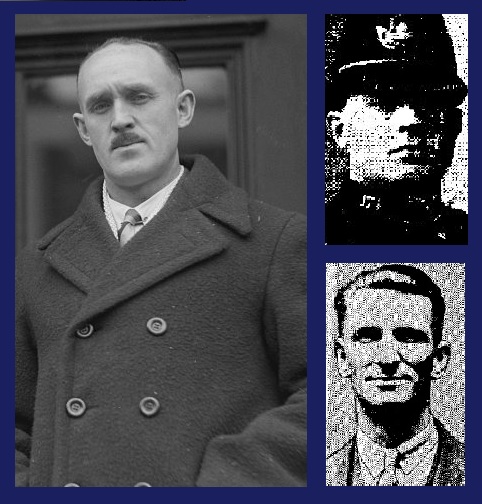
Elected President was Constable John Faulds, a Scot, 6’2, fair skinned with brown hair, blue eyes, and with a tattoo of a woman’s bust on his wrist. He had previously been a police officer in the United Kingdom, and a soldier in the British Army’s 3rd Battalion, Argyll & Sutherland Highlanders. Faulds emigrated to Canada and joined the Toronto Police Force in 1913, assigned to the rough and tumble old No. 4 (Wilton St) Station in Cabbagetown. Later, at 28 years old and married with a 9 month old son, he answered the call to arms and enlisted in Toronto’s 34th Battery, Canadian Field Artillery. Known as the “Aquatic Battery”, it was primarily comprised of men who were also members of the Toronto Canoe Club, the Toronto Rowing Club or the Balmy Beach Canoe Club. Training on 18-pounder guns, the natural leader quickly rose to the rank of Sergeant. He arrived in France in July 1916 as part of the 9th Brigade Canadian Field Artillery, before participating in the Somme offensive. Shortly after arriving at the front, was promoted to Warrant Officer I and appointed Regimental Sergeant-Major. He would lead his men in Canada’s major battles until December 1917 when he was awarded a temporary commission and sent to Witley Camp in England to train recruits. His friend Constable Pover wrote in a
letter to the Star that his commission was due to his bravery in the field. He returned to France in September 1918 as RSM of the 9th Brigade Artillery to fight in the final offensives of the war.

Patrol Sergeant Samuel “Tommy” Third was elected Vice President. Another tall Scotsman standing 6’2, with black hair and blue eyes. Third had been a Toronto Police constable since 1907, and was 33 years old, married and with a 10 year old son when he enlisted in the 180th (Sportsmen) Battalion, Canadian Expeditionary Force in January 1916. The unit was made up of local amateur athletes and was the choice of many TPF officers who joined the army. Third was admitted into the unit despite the medical officer’s note about a previous hernia operation and hammer toes – both ailments related to his police service. In October 1916, during “PT” (physical training) Third seriously re-aggravated his hernia, and had to be fitted with a truss, while his foot problems also worsened. Despite this, Third sailed overseas to England with his unit in November 1916, and was promoted to Sergeant due to his leadership abilities. However, his medical status saw him removed from the drafts headed to France, and he was instead posted to the 3rd Reserve Battalion (Central Ontario) at West Sandling, England in January 1917. There and for the remainder of the war, he engaged in the rigorous training of infantry soldiers destined for the front, despite his painful ailments.

Constable George Eagleson was elected Secretary. Hailing from Belfast, Ireland, Eagleson was freshfaced, tall and slim with grey eyes and had light brown hair. Eagleson joined the Toronto Police barely 20 years old, in the fall of 1914. Prior to becoming a police officer, he served in the Saskatchewan Light Horse and the Mississauga Horse of the Canadian Militia. On 13 January 1916, Eagleson enlisted with the 169th Battalion (109th Regiment), Canadian Expeditionary Force. Eagleson was quickly made acting Sergeant for the duration of their training in Canada, and sailed to England in November 1916 for further preparation. Eagleson landed in France in August 1917 days before the Battle of Hill 70, as a replacement in the 116th Battalion (Ontario County), a unit with ten former Toronto constables under their colours. Just prior to the Battle of Passchendaele, Eagleson was promoted to Corporal and later, during the Hundred Days’ Offensive was promoted to Sergeant. In October 1918, Eagleson was appointed Company Sergeant-Major during the final push.

The First Executive: tough and proven leaders. President John Faulds (left), Vice President Samuel Third (top right), Secretary George Eagleson (bottom right).
[City of Toronto Archives, Fonds 1266 Item 6818; Toronto Daily Star 2 Feb 1916; Toronto Daily Star 26 Mar 1927]

With its aims and objectives settled and its officers elected, the precursor to today’s Toronto Police Military Veterans Association was born. Forgotten over generations, the meeting in that bygone hall actually took place on September 14th, 1920 – two years earlier than it has long been believed to have occurred. The newly formed Toronto Police War Veterans Association (TPWVA) wasted no time in one of its first orders of business – the erection of a monument to the service and sacrifice of members of the Toronto Police Force in the Great War.

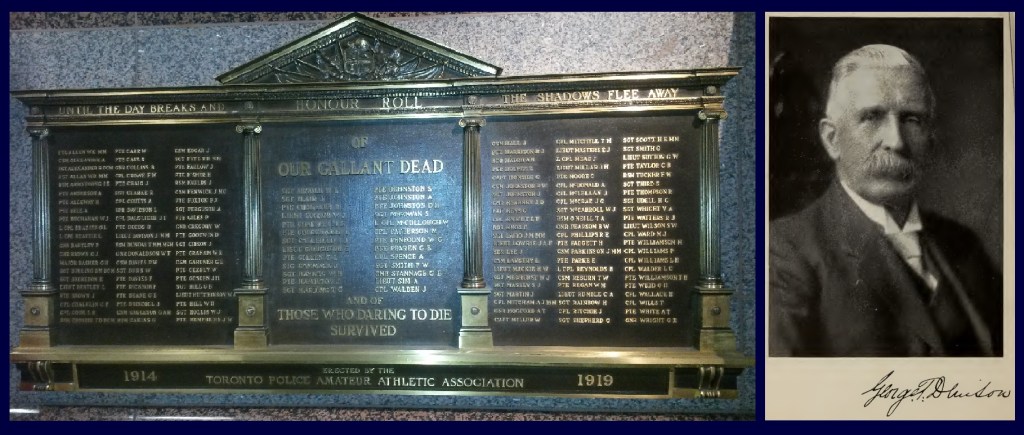
On October 23rd, 1920, five weeks after the Association’s creation, page 9 of The Globe newspaper announced that “members of the Toronto Police Veterans’ Association have purchased a brass tablet containing the names of members of the force who enlisted, and of those killed in action during the war. The tablet will be placed in the City Hall.” Permission for this was granted shortly after Armistice Day 1920, when on November 15th the Civic Property Commission authorized the monument in the portion of City Hall (now Old City Hall) which contained the police headquarters – which occupied the Ground Floor, facing north to Albert Street, from the midsection of the building over to James Street. The next step would be to unveil the monument under suitable and dignified circumstances.

On Friday, January 21st, 1921, the first Toronto Police war memorial service took place, another aim of the TPWVA quickly achieved. It was held under partnership with the Toronto Police Amateur Athletic Association, known as the “T – P – triple A”, the senior-most association in the force. The ceremony was held in the Council Chamber of the City Hall. The Council Chamber was “crowded with relatives and friends of the men whose names were on the tablet” and also had in its audience Toronto’s Mayor Tommy Church, the Reverend Canon Dixon, and several prominent judges. The focus was on the new memorial tablet, which was set up on the Mayor’s dais, surrounded by silken flags, potted ferns and plants. Deputy Chief L.R. Geddes, President of the TPAAA, began the proceedings with a speech acknowledging this “most solemn hour” in the history of the force. The tablet was then unveiled by none other than Col. George Taylor Denison III, the renowned Victorian Age cavalry officer, and one of the most important figures in Toronto’s military history. Denison was the Police Magistrate for the Police Court at City Hall and a member of the Board of Police Commissioners. He remarked his pleasure that a permanent memorial would record the names of the Toronto Police Force’s war dead for all time, and compared the importance of the occasion to the unveiling of Brock’s Monument at Queenston Heights. Of the TPWVA, he said they acquitted themselves heroically and noted many of them had received honours and decorations. More speeches, prayers and song followed. Police Chief Samuel Dickson then spoke describing the men named on the tablet as “splendid men, every one of them,” whom he all knew personally. Deputy Chief Geddes then read aloud the names on the tablet listed under the heading “Our Gallant Dead”, before Last Post was sounded – a tradition that still holds today.

The Memorial Tablet today, in the Grenville Lobby of Toronto Police Headquarters, 40 College Street (left) and the man who unveiled it, Col. George Taylor Denison III (right).
[Toronto Police First World War Memorial Tablet, Author’s Photograph; 1920 Portrait of G.T. Denison – Recollections of a Police Magistrate, The Musson Book Co. Ltd.]

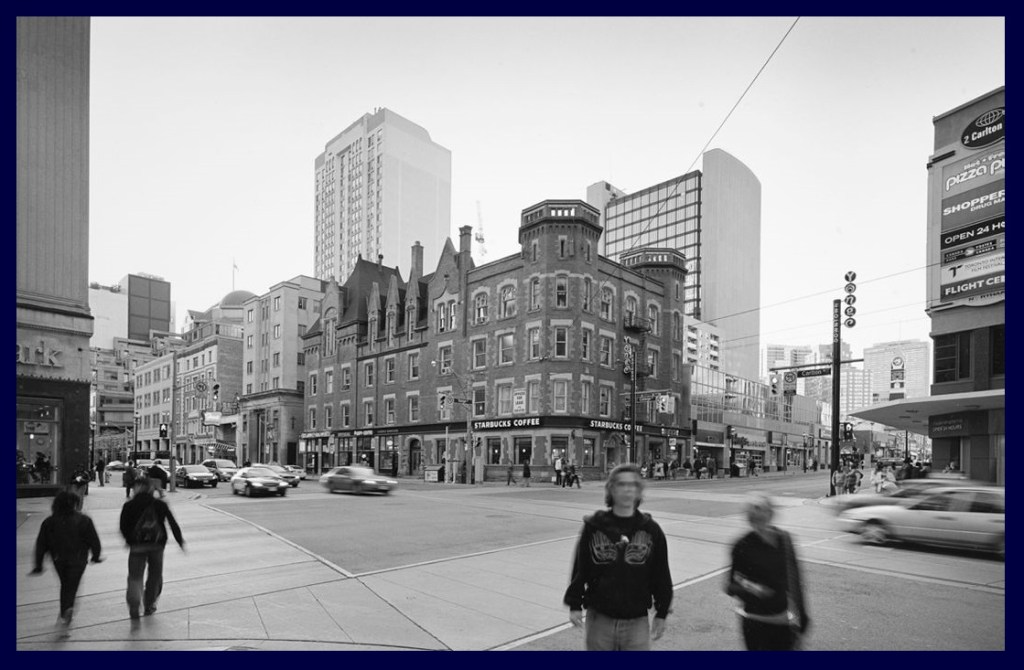
With its aims of a monument and memorial services completed, the Association moved to cement its camaraderie. Two months after the first memorial service, at a meeting of the Board of Police Commissioners held on Wednesday, March 23rd, 1921, the TPWVA was granted permission to hold their first “at-home” (a 1920’s term for a party), to take place the following month. On the evening of Thursday, April 21st, the Association’s soirée took place at Oddfellow’s Hall. A “splendid crowd” enjoyed a night of dance, cocktails, and euchre, held in the adapted Gothic Revival style building, which still stands on the northwest corner of Yonge and College Streets. Perhaps the April timing of the social had some significance. In the coming decade, the TPWVA would host a yearly “Vimy Night” every April which drew large numbers and prominent guests at elaborate ballrooms in the city. These events became a major source of income for the Association’s charitable donations and even war-time fundraising. More recently, the Vimy anniversary has been the setting for mess dinners of the modern Toronto Police Military Veterans Association.

Oddfellows Hall, pictured here in 2008, is the site of the first TPWVA social, steps from the current
Toronto Police Headquarters.
[City of Toronto Archives, Fonds 1581, Series 2196, Item 26]

It is clear now that September 1920 to April 1921 saw the formation of the Toronto Police War Veterans Association and its traditions. Those events – the formation of the association, the election of an executive, the first memorial service, and the first social affair – forged an everlasting bond, to each other and to the fallen, which would last over a hundred years. The centenary is a significant achievement, and marks the Association as one of the oldest continuously serving veterans groups in all of Canada – senior even to the country’s most prominent veterans group, The Royal Canadian Legion (1925). It also marks the Toronto Police Military Veterans Association as the most resilient of City of Toronto’s municipal veterans associations in Toronto, many of which are now defunct – such as the Civic Employees War Veterans Association, the Toronto Board of Education War Veterans Association, the TTC Returned Men, and the Toronto Hydro-Electric System War Veterans Association.

Though the establishment date of the Association had long been obscured, and the actual centenary passed, the global COVID-19 pandemic would have made appropriate celebrations impossible. Therefore, official celebrations of the Centennial Anniversary of the Toronto Police Military Veterans Association continued to be scheduled for 2022.

Centennial Celebrations

In 2022, several letters of congratulation were received by the Toronto Police Military Veterans Association, including those from Chief of Police James Ramer, Mayor of Toronto John Tory, Lieutenant Governor of Ontario Elizabeth Dowdeswell and Governor General of Canada Mary Simon.

On August 20th 2022, the Association marched in its first parade since its centennial, fittingly at the centennial Warrior’s Day Parade. The TPMVA won the Goodyear Remembrance Trophy for best marching formation (with 16 or more members).

On September 14th 2022, an Anniversary Barbecue took place marking the birthday of the Association.

The biggest undertaking was the “MVA22” pilgrimage to the battlefields and war cemeteries of Europe. A delegation of the Toronto Police Military Veterans Association visited thirty-six gravesites spread over six countries and thousands of kilometres. A small Act of Remembrance service was performed at each site and embodied the Toronto Police Military Veterans Associations core values of Service and Remembrance.

MVA22 Delegation at the Canadian National Vimy Memorial (Photo: John Lo Bianco)
Sources and Further Reading:
  • Toronto Daily Star. 1920, Sept. 15th, Page 5: “War Veterans Doings – Police Soldiers Form Association”
  • The Globe. 1920, Sept. 16th, Page 9: “Police Veterans Organize”
  • City of Toronto Archives. James Salmon Collection – Fonds 1231 Item 0426: “April 29 1917 Car Track Reconstruction at Bond Street”
  • City of Toronto Archives – Fire Insurance Plans. “Goad’s Fire Insurance Map – Toronto 1924”.
  • The Great War Veterans’ Association of Canada. Constitutions and By-Laws. Ottawa, 1917.
  • Library and Archives Canada – Personnel Records of the First World War. Service Files of No. 300742 John Faulds; No. 862015 Samuel Third; No. 679253 George Alexander Rennicks Eagleson.
  • The Globe. 1920, Oct. 23rd, Page 9: “Police to Remember Those Fallen in War”
  • Toronto Daily Star. 1920, Nov. 15th, Page 2. “Honor Police Who Fell”
  • The Globe. 1921, Jan. 22nd, Page 21. “Inscribe Names on Honor Roll”
  • Toronto Daily Star. 1921, Jan. 22nd, Page 3. “Police Honor Dead Comrades in Arms”
  • Denison, George T. Recollections of a Police Magistrate. The Musson Book Co. Ltd. Toronto, 1920.
  • The Globe. 1921, Mar. 24th, Page 6. “Board Suspends Four Interpreters”
  • Toronto Daily Star. 1921, Apr. 22nd, Page 30. “Local Briefs – Police Hold Dance”
  • City of Toronto Archives. Peter MacCallum Collection. Fonds 1581, Series 2196, Item 26: “Looking north-west at College Street” 2008.
  • The Globe. 1935, Apr. 10, Page 11. “Celebrate Quarter Century on Police force on ‘Vimy Night’”

In the Beginning…

The Influence of Military Veterans in the Early Toronto Police Force

Victorian-Era Toronto was a town filled with affluent merchants, colleges and universities, cathedrals and parks. It was also home to more unpleasant by-products of the industrial age – slums and poverty. Religious divisions inherited from the British Isles added to instability and civil disorder and riots were a common occurrence. A modern, professional police force was required to meet the challenges of public safety in this environment. Military veterans were instrumental in the formative years of the Toronto Police Service.

The Early Chiefs and the Road to Reform

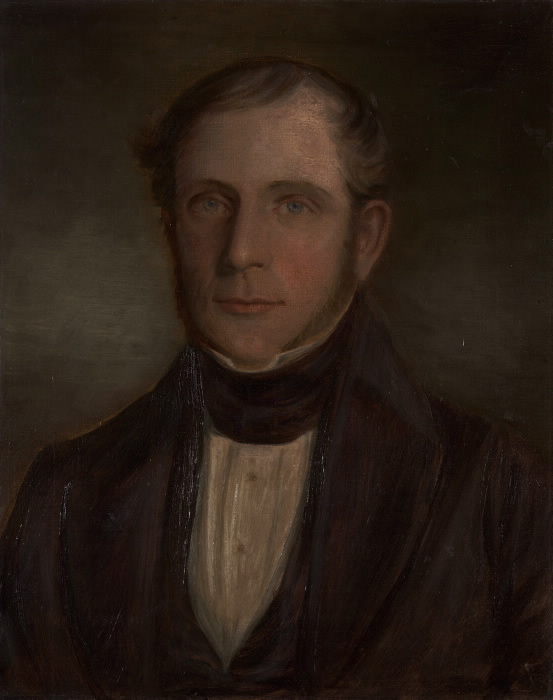
When York, Upper Canada was incorporated as the City of Toronto in 1834, the town’s high bailiff, William Higgins, became the first (and only) constable in the city. The following year, Higgins was replaced and the Toronto Police expanded to have five constables serving under a High Constable – George Kingsmill. Kingsmill, a native Irishman, had been a commissioned officer of the British Army, and is therefore the first known military veteran in the ranks of the Toronto Police.

George Kingsmill, British Army veteran and first Chief of the Toronto Police.
(Toronto Public Library – Digital Archive)

In early years, the Toronto Police Force modelled itself mainly on the Metropolitan Police of London, England, whose police practices drew inspiration from Sir Robert Peel. The British politician now known for the “Peelian Principles” laid the groundwork to create modern civilian policing, which separated the military from law enforcement duties, which had previously been common. His axioms of community policing are irrefutable and still held in high regard today, but they do not mean that military characteristics should be completely done away with from police organizations.

Unfortunately, in practice those high-minded principles did not trickle down to the early Toronto Police Force. The city was tense and divided along religious lines between the majority Protestant and minority Catholic denominations in the city. This frequently led to violence, with police often joining in. High Constable Kingsmill proved to be strongly partisan. New Toronto constables were handpicked by local politicians. Many showed obvious bias while performing their duties. By 1859 there were so many sectarian scandals in the Toronto Police (such as participating in the 1855 Toronto Circus Riot), that a Board of Commissioners was created and its first act was to sack the entire force along with then-Chief Samuel Sherwood. To curb the nepotism, the men were replaced by new constables recruited externally, mostly from the British Isles.

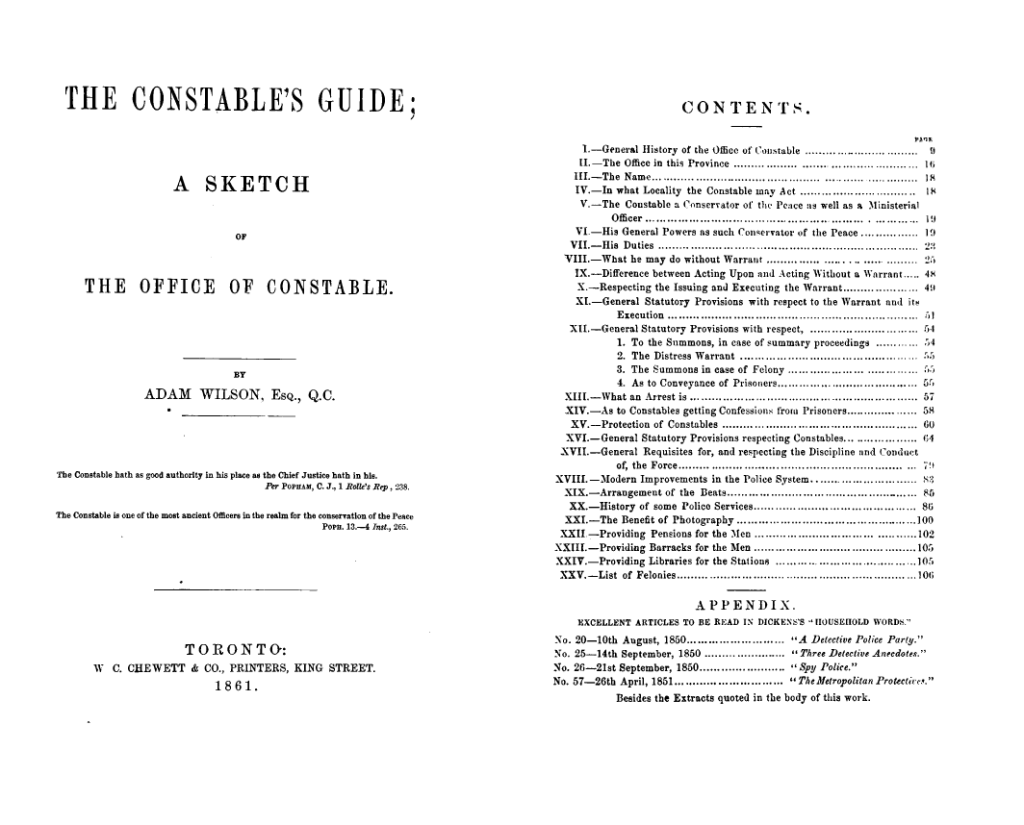
More importantly, the new Chief Constable was also chosen from abroad. Instead of selecting another senior police officer, civic leaders chose William Stratton Prince, a former army Captain of the 71st Highland Light Infantry. They thought a military officer would be better able to control the men and change course. Among reforms was the 1859 Constable’s Guide, which Prince would strictly enforce, bolstered by his subsequent “Orders Books”. These publications, similar to an army regiment’s Standing Orders, laid out the standards, rules and regulations members must adhere to. In them, Peel’s principles would be protected. For example, it limited the use of force: “In the arrest of criminals and disorderly characters, drunkards, especially the latter, men are cautioned against the unnecessary use of the baton when persuasion and a little patience on the part of the policeman would suppress all violence on the part of those arrested.”

This Constable’s Guide and subsequent Orders Books were an important step in accountability and discipline required of a modern police force, and are rooted in Regimental Standing Orders. (Toronto Public Library)

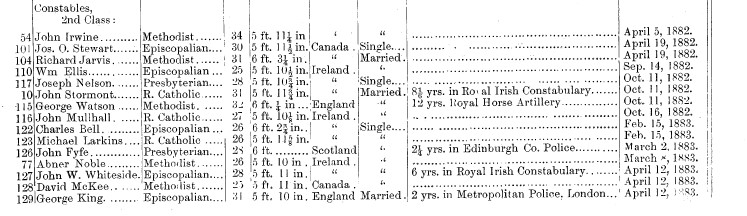
Aside from a recruiting preference for Britons, the Toronto Police Force began hiring more military veterans into its ranks. Having seasoned soldiers bolstering the ranks ensured that police personnel were fit for the challenge of reform as it was predicted that their self-discipline and hardiness would rub off on other members of the force. The 1860 nominal roll shows 14 of 49 constables were ex-servicemen, making up more than a quarter of the force. A further 12 had served in the paramilitary Irish Constabulary (later the Royal Irish Constabulary).

The life of a Victorian Era constable was difficult. Expectations were now higher than ever. With a network of “beats” crisscrossing Toronto, officers fanned out from their stations daily on long foot patrols. They would patrol everything from bustling city streets to the rural outskirts of town. They walked their beats alone day into night, year-round and in all weather conditions. Constables were expected to be ready for everything and uphold the law oftentimes without rapid backup. Prince ensured beats were strictly timed and Patrol Sergeants made regular field inspections to ensure the rules, regulations and standards were being adhered to. Employing military veterans ensured the Force was physically and mentally up to the task. As one reporter from The Globe newspaper later observed: “the number of old soldiers in the corps seemed to infuse their military blood into their less confident confrères”.

The Chief appointed one such Constable, William Ward (late Coldstream Guards, British Army) to be a Drill Instructor for the Force to drill the men regularly Chief Prince saw the value in the “Three D’s” – Drill, Dress and Deportment common to the military.

Drill, the co-ordinated movements used by militaries since antiquity, formed bonds in the men and reinforced the idea of acting as a team and swiftly following orders. Dress, the correct way to wear a uniform, is key in being easily identifiable and looking competent. Deportment, how one carries themselves, aids in being received as competent and professional.

With a former Guardsman teaching the men these “Three D’s”, there would be a significant culture change. This was a necessary change, as the members of the force prior to the 1859 reforms had been described as being “without uniformity, except in one respect—they were uniformly slovenly”. It was also said that those men “might say as to their boots what was generally said to wagons and carriages, that if the mud was taken off they would be just as dirty in a short time again.” This of course was partly due to the fact that then-Chief Sherwood had been seen as soft – “a quiet, good-natured man,” who “did not insist on any strict regulations as to the dress or discipline of the men.”1

Prince placed such importance on Drill that he went so far as to include his expectations of it in Order Book 1861-1862 , such as his instructions for the position of “Attention”:

The heels must be in a line and closed — the knees straight — the toes turned out so that the feet may form an angle of 60 degrees — the arms hanging straight down for the shoulders — the elbows turned in and close to the sides — the thumb kept close to the forefinger — the Head to be bent and in giving evidence the body, arms and hands to be perfectly steady — in fact — exactly the same position as a soldier in the Ranks or parade addressing his Officer.

Prince further required officers stand at attention while in the presence of superiors, and whenever addressing the Bench while testifying in court. According to police historian the late Superintendent Jack Webster, testifying at attention was a tradition which continued at least into the 1950’s.

More than just looking good however, the Three D’s have an officer safety benefit. To this day in Ontario, police officers are taught that “Officer Presence” is the first step in de-escalation. According to the Ontario Police College, studies show that if an offender views an officer as competent, the offender is less likely to attempt violence during a police encounter. Similarly, if a member of the public views an officer as competent, they are more agreeable to an officer’s lawful authority, reducing conflict.

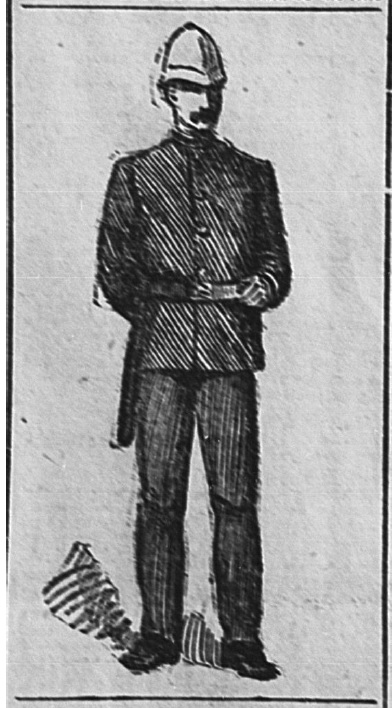
A sketch of a smart “Blue Coat” , The Globe Newspaper.

As the Force became skilled at Drill through weekly practice, Prince introduced “extension drill” and “revolver drill” – infantry-style movements of massed policemen conducting fire and manoeuvre. It should be remembered that at the time, Southern Ontario and other parts of Canada were periodically invaded by Fenian rebels in a bid to overthrow the Canadian Government.

The “Blue Coats” into the 20th Century

After 15 years of service, Prince gave way to a new Chief, Francis Collier Draper in 1874. Local government opted to again choose a military veteran to helm the Toronto Police Force. Draper had been a Major in the Queen’s Own Rifles of Canada.

One of Draper’s innovations was the creation of a Mounted Police unit, in 1886. These horse-mounted officers could patrol the city’s more rural areas, as well as for “escort duty during the passing of processions through the streets and the recapture of prisoners who may occasionally effect their escape from Gaol or the Central Prison,” as noted in his Annual Report. Draper would select a small corps of constables with military backgrounds to pioneer the unit, such as PC George Watson who had 12 years service with the Royal Horse Artillery, as well as Sergeant Charles Seymour and Constable George Goulding who had 10 years and 4 and a half years under Her Majesty’s Service respectively. The Mounted Unit proved extremely useful in crowd management and community policing and survives to this day.

Draper continued the emphasis on drill, and annual inspections of the Force were held publicly, reviewed by dignitaries and watched by enthusiastic spectators. He also emphasized skill-at-arms and ended inspections with revolver displays and the awarding of prizes. This improved officers’ firearms proficiency and safe weapons handling, which in turn enhanced both officer and public safety. Draper’s annual reports to the mayor included subsections on Drill, Discipline and Pistol Practice to monitor the men’s progress.

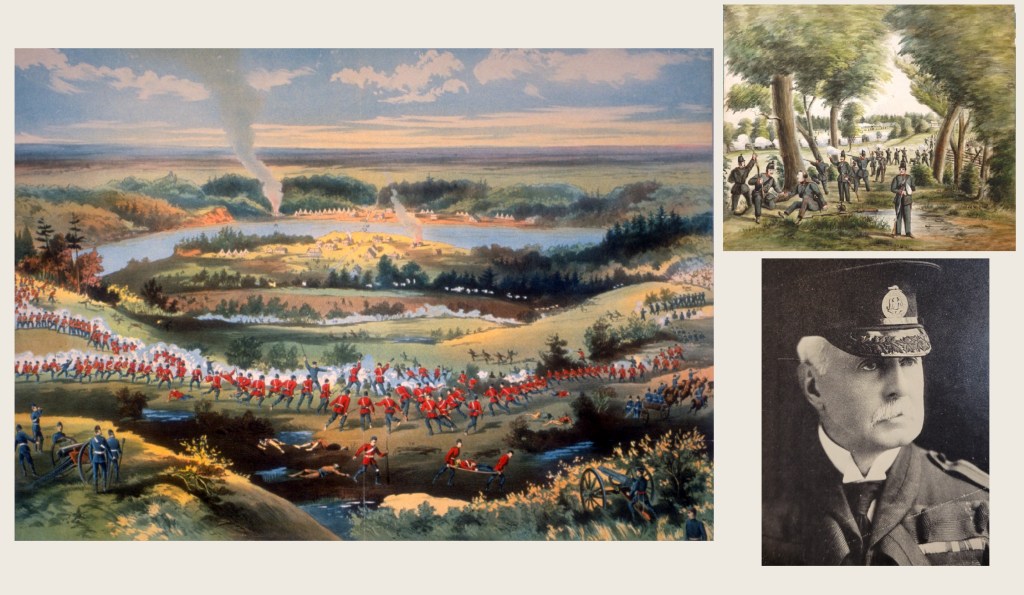
Seventh Chief Constable of the Toronto Police Force, Henry James Grasett (bottom right) was a veteran of the Battle of Ridgeway (top right) and the Battle of Batoche (left).

Closing out the 19th Century, another accomplished military officer was selected to take over the professionalized force – Chief Constable Henry James Grasett.

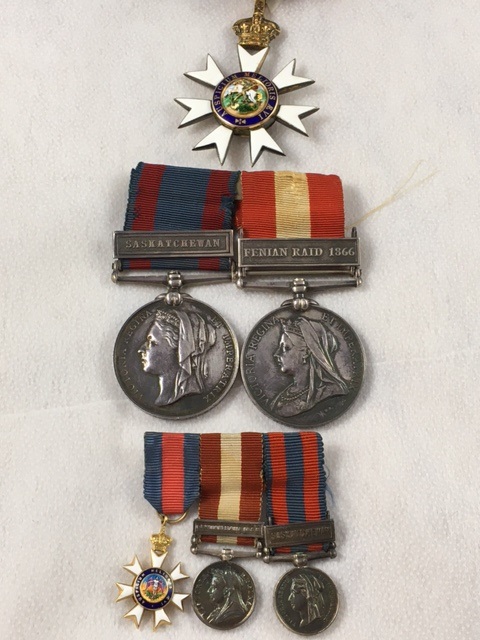
Born to the rector of St. James Cathedral in Toronto, a young Henry Grasett joined the Canadian Militia as a Rifleman in the 2nd Battalion, Volunteer Militia Rifles of Toronto, also known as the Queen’s Own Rifles of Canada. He would fight at Canada’s earliest modern battle – the Battle of Ridgeway near Fort Erie, Ontario, during the 1866 Fenian Raids. The 19-year-old Grasett’s regiment would sustain the highest casualties of the day in the face of sustained Fenian musket volleys. While the Canadians lost the battle, the Irish-American rebels ultimately fled back to the United States. Afterwards, Grasett entered imperial service, commissioning as an officer with the British Army’s 100th Regiment of Foot (Prince of Wales’ Royal Canadians). Completing his term in England, he would return to Toronto as Commanding Officer of the 10th Battalion, Royal Grenadiers, today The Royal Regiment of Canada. Grasett would again see combat during the 1885 Northwest Rebellion. After leading his men on a cold and grueling overland expedition from Toronto to Saskatchewan, Grasett would successfully command his troops in battle, facing down the Métis rifle pits at Fish Creek and Batoche, helping to end Riel’s Rebellion.

Medals of H.J. Grasett CMG. (Courtesy of Steven Green)

Returning to the city with praise, Grasett was appointed Chief Constable of Toronto in December 1886. He would serve 34 years in office, becoming Toronto’s longest serving police chief. Grasett continued the practice of hiring military veterans into the ranks, recognizing that this policy had favourable results. It also provided stability in the rapidly growing department. Grasett inherited a 174 member force, which would grow to 265 in just three years, and 300 by the end of the century.

An excerpt from the 1889 Nominal Roll, showing a high proportion of military veterans in the ranks.

Grassett, like his predecessors, expected strict adherence to procedure, and in 1890 released a 121-page revision of the Constable’s Guide titled Rules and Regulations of the Toronto Police Force. Dissidents would face court-martial style discipline.

The old soldier also kept up the annual inspections of the Force, and he continued to evolve the skirmishing drills started by Prince. Following the march-past in the 1889 Annual Inspection, The Globe reported: “After again extending into the line, the Battalion was drawn up for revolver-firing exercises […] with the front rank kneeling and the second standing. There was a pardonable gleam of pride on the face of Chief Grasett as he stood in front of his soldier-policemen as they fired volleys of blank cartridges. It would be a rough experience for a mob to stand in front of such a line of magnificent fellows and defy the authority of the law. Volley-firing by companies and then individual firing by the men completed that part of the display.” The reviewing party was “frequent in their praise of the admirable discipline of the force.”

While this may seem like an escalation in force, it actually served to reduce dependence on using the military to “Aid the Civil Power” when municipalities couldn’t cope with an emergency. Due to the upheaval caused by industrialization, the Canadian Militia had been called out to several disturbances of the peace in the late 19th century, causing soldiers to face off with citizens. One such disturbance, the 1877 Belleville Riots, required the military to enforce the peace. In the scuffle, troops from Toronto’s Queen’s Own Rifles were swarmed, pelted with projectiles and injured. In return, rioters were also hurt, with at least one rioter received a sword wound.2

These new police tactics were merely a deterrent however, and it should be noted that volley-firing by police lines would never actually occur on the streets of Toronto. Relying on community police instead of soldiers to keep the peace under all circumstances has become a cornerstone of our democracy, and these rudimentary tactics were the beginnings of this independence from martial law.

One final militaristic addition to the force in this period, would be the introduction of group physical training (or “PT”) in 1898. The force’s Chief surgeon, Dr. Edward Spragge, spoke of the obvious benefits in that years Annual Report: “introduction of the gymnastic exercises cannot fail to produce improved condition of the men, and consequently of their general health.”

By the end of the Victorian Era, Toronto’s police service had come a long way, from un-uniformed, partisan and undisciplined officers to orderly, regulated and meticulous officers dedicated to principled policing and the rule of law. This was achieved through the influence of military men joining the police department and infusing the positive elements of military axioms into the force, all while keeping with Peel’s Principles. Their establishment of standing orders, rules and regulations to codify progressive police practices, and developing high standards of drill, dress and deportment had greatly improved the force and benefited the citizens of Toronto for generations.

Postscript: Drill Instructor William Ward

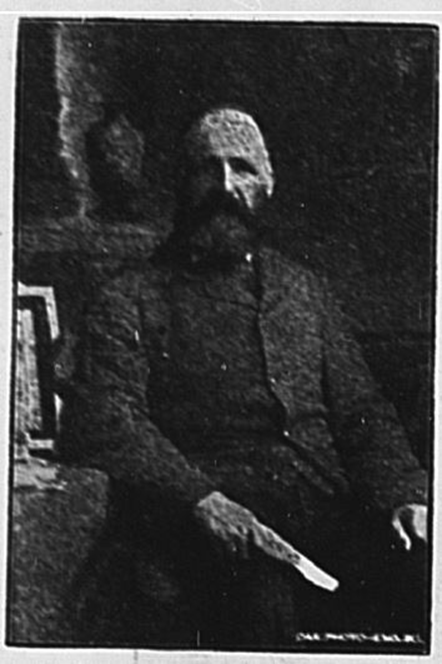
William Ward upon retirement, 1891. (The Globe)

In 1864, a newly appointed constable and military veteran, William Ward, would be the main driver of Chief Prince’s reforms of the force and shaped its culture for the rest of the century.

Born in Devonshire, England in 1837, Ward enlisted in the British Army in his teenage years. Briefly serving in the territorial militia, Ward went on to join the Coldstream Guards. World-famous for their bearskin hats and red tunics, the Coldstreams have guarded the Sovereign for centuries and still mount the King’s Guard at Buckingham Palace today.

Around 1855, the now 18-year-old Ward was posted to the regiment’s 2nd Battalion in London. Six months later, he was called to active service in the Crimean War – where Britain and her Allies were fighting a war over that Black Sea peninsula against an expansionist Imperial Russia. Arriving as a replacement after his unit’s heavy fighting at Inkerman, he would serve with them throughout the Siege of Sebastopol. The siege is considered one of the last classic sieges in history, and one of the first instances of modern trench warfare. The year long-siege involved tens of thousands of men, and culminated in fierce attacks on entrenched Russian positions. Ward’s Guards Brigade endured miserable conditions and heavy losses – 425 killed in action and four times that number died of illness. Their eventual success at Sebastopol won the war.

The Rifle Screen” depicts a British trench scene at Sebastopol. Watercolour by Henry John Wilkinson, 1855.

The unit, known for their excellence as the Queen’s body guard, shocked Queen Victoria when the returned men paraded in front of her, a parade in which Ward is known to have taken part. Her Majesty remarked afterwards that the men on parade seemed ‘quite broken down’ since she had last seen them3.

As a mark of his admirable conduct as a soldier, Ward was chosen as a member of the 40-man honour guard who received the allied Napoleon III on the Isle of Wight during the French leader’s state visit of 1857. Ward continued climbing the ranks, to Sergeant. In 1861, when the American Civil War caused a military crisis in Canada, the veteran Guardsman answered the call for seasoned British Army regulars to train the Canadian Militia. He trained units all over Southern Ontario for three years – troops that would later face the invading Fenian rebels.

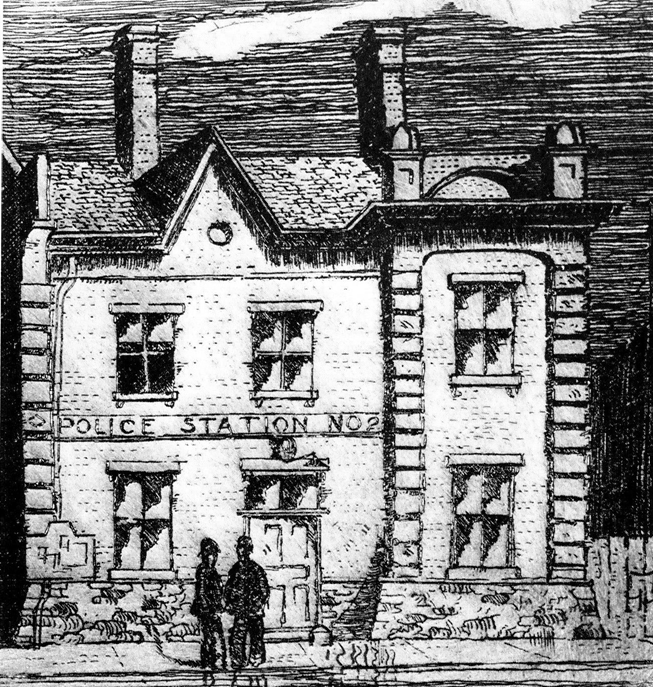
With the end of his military service approaching, Ward decided to make the new country his home. To this end, he joined the Toronto Police Force at the end of 1864. Ward was posted to the scrappy No. 2 Division downtown. There, he would learn his new trade while walking the beat in St John’s Ward, a slum near present-day Old City Hall described at the time as a place “looken upon as the most notorious part of Toronto”.

Old No. 2 Police Station (To Serve and Protect: Volume I)

Due to Ward’s impeccable credentials, Chief Prince saw to it that he was “immediately placed in the capacity of drill instructor,” where he would begin instilling his high standards of the Drill, Dress and Deportment into the Toronto Police Force.

Ward would begin drilling his fellow policemen to a Guardsman’s standards. His leadership abilities saw him promoted to Patrol Sergeant in just two short years. In 1871, Ward was again promoted to Senior Sergeant, and in 1876 promoted again to Sergeant-Major – a rank which was restructured to Inspector in 1878. 

Despite his advancement and added responsibility, Ward still found extra time to instruct drill classes.  These were held weekly on Thursdays from April to September at Queen’s Park, where, coincidentally, two Russian cannons captured at the Siege of Sebastopol overlooked the entrance to the park. Gifted by Queen Victoria in recognition of the Canadians who fought there, they still stand in the park (though since moved to in front of the legislature).

One witness described a typical scene of the constables drilling in the park: “Inspector Ward took command, and exercised the men in marching, extension drill, and revolver drill. The precision with which they executed the various movements in marching” drew praise from the Chief, who credited both the men themselves and their instructor.

The classes were held in anticipation of Annual Inspections of the Force4.

On 28 August 1879, while the rest of the force was on duty 84 officers gathered on parade, boots polished, buttons and handcuffs gleaming. With the Band of the Queen’s Own Rifles of Canada leading, the contingent marched a spectator-lined route from the Armoury at the foot of Jarvis Street to the Cricket Grounds in the Annex. Once there, Chief Draper commenced his annual inspection of the Force. Mayor James Beaty commended the officers present for their discipline, expressing his belief that in this regard, “the Force was unequalled on this continent.” Lieutenant Governor William Ross MacDonald acknowledged the advancements the force had made in the last twenty years, remarking that the men had “discharged their duty faithfully, conducted themselves creditably” and that they should strive to maintain “the good reputation which they have won”. Ward’s efforts over the past fifteen years had bore fruit.

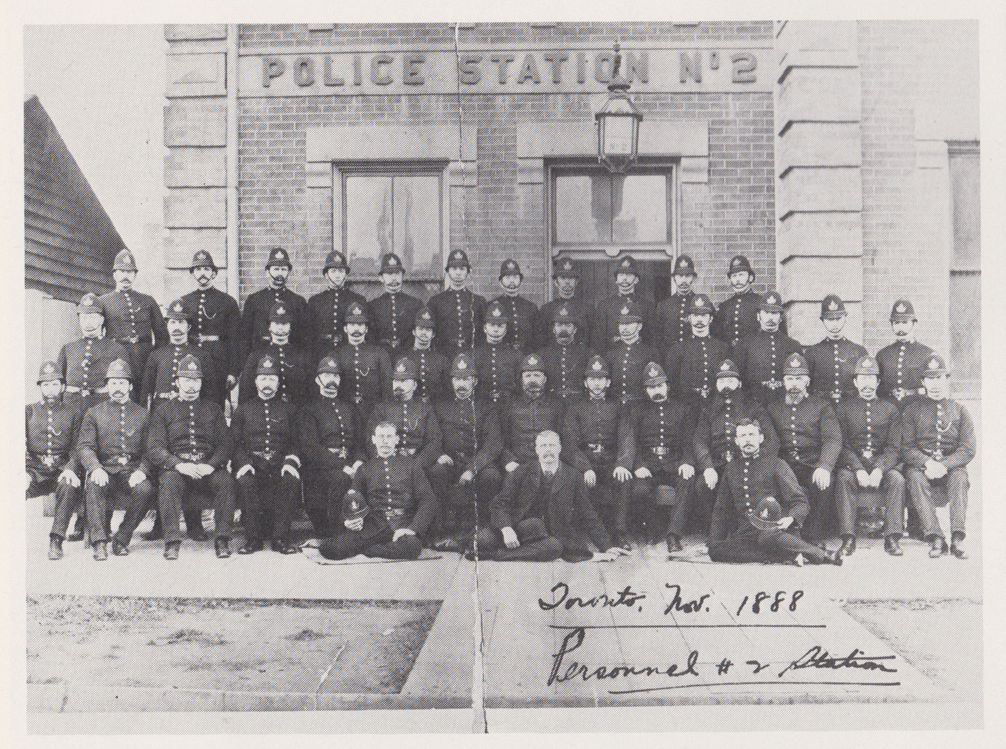
The progress continued as the Force grew. A decade later, 220 members of the Force gathered on parade for the 1889 Annual Inspection. Inspector Ward led a company of his men from No. 2 Station on a march past and review by Sir Adolphe Caron, the Minister of Militia and Defence, and local dignitaries. The parade was a success and the following day, a reporter beamed “…to the strains of the ‘British Grenadiers’ the six companies marched past the saluting point. The movement of the men was of wonderful steadiness, and would have reflected credit on even the best drilled companies of the crack city regiments.”

Orange Lodge Parade

Aside from his managerial and instructional duties, the old soldier continued to share the risks of his men, and led from the front. “During his fifteen-years inspectorship he was called upon to encounter many dangers, but he was never known to ask his men to undertake perilous duty without being in the lead.” During the 1875 Pilgrimage Procession Riots, notable for the police being fired upon, Ward and his “small section of twenty men stood bravely between the passionate crowds, and although they were bruised and beaten succeeded in preventing bloodshed”5. In another example from 1890, Ward was again leading a line of police during sectarian rioting where the Inspector was “struck on the head by a well-aimed missile” receiving a severe scalp wound6.

In 1891, Inspector Ward retired after many years serving at No 2 Station, took up farming in Calgary with his sons.  By the time of his retirement, the 40-member Toronto Police Force he had joined had grown exponentially to 300 men – “every one of whom have passed under the drill instruction of Inspector Ward,” noted The Globe.

Inspector Ward (plainclothes, front center) poses with his well turned-out men. (To Serve and Protect, Vol I)

Sources and Further Reading

  • A. Wilson – A Constable’s Guide; A Sketch of the Office of Constable. W.C. Chewett & Co., Printers; Toronto, 1859.
  • Toronto Police Force – Toronto Police Force: A Brief Account of the Force Since Its Re-Organization In 1859 Up To The Present Date. E. F. Clarke, Printer; Toronto, 1886.
  • [1] C.C. Taylor. The Queen’s Jubilee and Toronto “Called Back” From 1887 to 1847. William Briggs, Printer; Toronto, 1887.
  • H.J. Grassett. Rules and Regulations of the Toronto Police Force. Finish
  • F. C. Draper – Annual Report of the Chief Constable of the City of Toronto For the Year[s] 1879; 1881; 1884; 1885.
  • H. J. Grassett – Annual Report of the Chief Constable of the City of Toronto For the Year[s] 1886; 1887; 1889.
  • D. A. Brock – Metropolitan Toronto Police: To Serve and Protect, Volume I. D. W. Friesen and Sons Ltd; Altona, 1979.
  • B. Wardle – The Mounted Squad : An Illustrated History of the Toronto Mounted Police 1886-2000. Fitzhenry & Whiteside Ltd; Markham 2002.
  • [2] W. T. Barnard. The Queen’s Own Rifles of Canada, 1860-1960: One Hundred Years of Canada. Ontario Publishing Company; Toronto, 1960. pp.41-43
  • D. J. Goodspeed. Battle Royal: A History of the The Royal Regiment of Canada 1862-1962. The Royal Regiment of Canada Association; Toronto 1962.
  • D. Ross & G. Tyler. Canadian Campaigns 1860-70. Osprey Publishing Ltd.; Long Island City, 2005.
  • J. Webster. Copper Jack: My Life on the Force. Dundurn Press; Toronto 1991.
  • City of Toronto Archives – Journals of the Common Council of the City of Toronto. Fonds 200, Series 1080.
  • Minutes of Proceedings for the Council Corporation of the City of Toronto, 1863.
  • Minutes of Proceedings for the Council Corporation of the City of Toronto 1866.
  • Toronto Public Library. Historical Newspaper Database.
  • The Globe. 1879-08-29 “Toronto Police Force – Annual Inspection Yesterday on the Cricket Ground,” Page 4.
  • The Globe. 1881-07-16 “Policemen at Drill,” Page 14.
  • [1]The Globe. 1882-08-11 “The Finest In The World,” Page 9.
  • [4]The Globe. 1883-04-28 “The Police Drill,” Page 14.
  • The Globe. 1886-10-13 “The Police Force,” Page 9.
  • The Globe. 1889-11-11 “The Blue Coats,” Page 4.
  • [6]The Globe. 1890-08-07 “Policeman’s Baton,” Page 4.
  • [5]The Globe. 1891-05-16 “Inspector William Ward,” Page 2.

Coppers and Gunners

The links between Toronto Police and Toronto Artillery

Note: The following is a prepared speech from Matthew Scarlino, Historian – Toronto Police Military Veterans Association on occasion of a charitable donation to the Toronto Artillery Foundation, 9 May 2022. Unfortunately, a COVID-19 infection kept the author from delivering the speech, though it was ably presented by Lt. Col. (Ret’d) Dana Gidlow, CD.

Good evening distinguished guests, Ladies and Gentlemen.

The intertwined history of the Toronto Artillery and the Toronto Police is a rich one. Forged over a century, including two world wars, other conflicts and domestic service, our two organizations have shared members and values for a long time.

I’m going to speak to our closeness by looking at our service in conflict and key individuals that unite our organizations and our associations.

Gunners have served in the Toronto Police from the earliest days. A look at our Nominal Roll from 1886 shows that our Deputy Chief, William Stewart, was himself an artillery veteran. As for the regular beat constables, the nominal rolls simply marked prior military service as being with the “Canadian Volunteers”. Undoubtedly, there were gunners among them.

PC George Watson, late The Royal Horse Artillery, listed on the 1886 Nominal Roll.

One key figure was Constable George Watson, who had served twelve years in the Royal Horse Artillery. PC Watson was an important figure in the foundation of the Toronto Police Mounted Unit, that same year. Selected for his police talents and his expertise riding the tough draft horses of the RHA, he was promoted to Sergeant and was instrumental in the early success of the Mounted Unit, which continues to serve the citizens of Toronto to this day.

It was during the First War that our two organizations really forged their bonds. The guns still being horse-driven, four mounted policemen joined Toronto’s 9th Battery when the war broke out in the autumn of 1914. They escorted the police force’s donation of 19 police horses to the Battery.

Of our men in 9 Battery, there was:

Constable Thomas Hugh Dundas, atop police horse Bunny, who rose to the rank of Battery Sergeant-Major. He would be wounded repeatedly and was the most decorated Toronto Police officer serving in the First World War. He won the Military Medal, the Meritorious Service Medal, and was Mentioned-in-Despatches.

Constable Ernest Masters, was commissioned from the ranks due to bravery in the field.

And Constable Charlie Chalkin, atop police-horse Mischief, served in the battery until halfway through the war, when he served as a Mounted military policeman patrolling the streets of France, no doubt keeping gunners out of trouble.

Constable William Connor, atop police-horse Charlie, served in the battery until being commissioned from the ranks. As a “FOO” [Forward Observation Officer], he was wounded severely by a trench mortar while directing fire onto the enemy in the Ypres Salient. He was evacuated and died shortly afterwards.

Of the 19 police mounts in the Battery, St Patrick, or “Paddy” was among the first to fall, killed in action during the fierce fighting at St Julien in 1915. Mistake and Juryman, Vanguard and Crusader and thirteen others would perish by war’s end. The only horse to survive the war was Bunny. A popular letter-writing campaign erupted in Toronto for the safe return of Bunny – but since Bunny wasn’t an officer’s mount he was sold off with the others to Belgian farmers rebuilding their country.

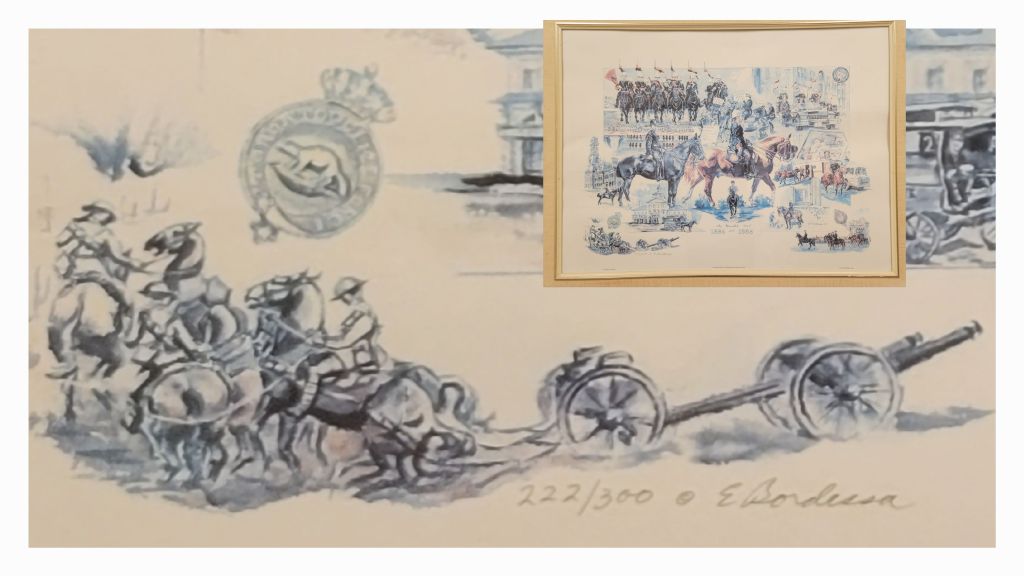
Police Mounts on the Western Front with the 9th Battery, CFA, from the painting Toronto Police Mounted Unit 1886-1986 (inset) by Eileen Bordessa.

Aside from the 9th Battery, 44 Toronto police officers served in various Artillery units, including subsequent Toronto batteries, and as far afield as the British Army. This number constitutes 28% of the Toronto Police contribution in the First World War. Three of these gunners made the ultimate sacrifice and many more were wounded. For Gallantry, they accounted for one Distinguished Conduct Medal, Two Military Medals, a Meritorious Service Medal and Mention in Despatches.

It was shortly after the war that Constable John Faulds, who had served as a gunner in France, was elected first President of the Toronto Police War Veterans Association. Faulds served with Toronto’s 34th Battery. It was known as the “Aquatic Battery” as membership was made up of members of the Toronto Argonaut Club, The Toronto Canoe Club or the Balmy Beach Club. Faulds had risen to the rank of Regimental Sergeant-Major of the the 9th Brigade Canadian Field Artillery. He was awarded a temporary commission that the Toronto Daily Star reported was for bravery in the field.

This gunner, John Faulds was instrumental in founding of our association, in the summer of 1920. He was instrumental in the erection of our memorial tablets at police headquarters; the creation of our annual memorial service; and the establishment of our yearly socials.

John Faulds (right), former RSM of 9th Brigade, Canadian Field Artillery and first President of the Toronto Police War Veterans Association.
City of Toronto Archives Fonds 1266, Item 6818.

During the interwar period policemen who had served as gunners swelled the ranks of our association, and many were members of the Toronto Artillery associations in existence at that time. Men such as Charles Hainer MM who would later die in the line of duty while serving in the Motorcycle Squad.

Unfortunately for a historian, personnel records of the Second World War remain largely private and undigitized, so our records from that time are less detailed. Our contribution to the Artillery this time would be smaller, with many policemen joining the Air Force and Navy unlike in the last war.

At least 10 of our officers are known to have served in the Royal Canadian Artillery. It was a small but solid contingent where half held leadership positions – with a Captain, two Battery Sergeants-Major, and two Sergeants among them.

While their exact contributions during the war still largely unknown, they would serve the city with distinction after the war.

One gunner, Constable Roy Soplet, led a daring rescue during the SS Noronic disaster. In 1949, the pleasure cruise burst into flames overnight in Toronto Harbour with 524 souls on board. Soplet was one of the first officers on scene and without hesitation jumped into the lake and rescued countless panicked swimmers in the darkness. While over a hundred people died in the disaster, not a single one was lost to drowning thanks to Soplet and a few other rescuers.

“Noronic Burns”. City of Toronto Archives Fonds 1244, Item 1518.

Another gunner, Constable David Cowan, was celebrated in newspapers for a daring fire rescue in February 1951. Cowan came upon a building engulfed in flames and charged into the upper floor apartments kicking in doors and rescued an elderly woman. When reaching the street with her, he was overcome by smoke and collapsed, spraining the poor woman’s ankle after saving her life.

Later that year, former Battery-Sergeant Major and Acting Patrol Sergeant Joseph Battersby, would be killed in the line of duty. The survivor of two world wars died while trying to secure a downed hydro wire scene.

The soldiers of 7th Toronto Regiment, additionally tasked with Light Urban Search and Rescue, would do well to remember these men.

Postwar, many gunners again joined the ranks of the Toronto Police, including two big personalities that would be active in the Toronto Police War Veterans and Toronto Artillery Associations.

Captain Francis Burtram “Bert” Saul CD was one such character. He was a veteran of the Royal Artillery and the Royal Canadian Artillery. He survived the Dunkirk evacuation, and was wounded during the Normandy Campaign. Starting as a police officer in Forest Hill after the war, he retired as the Staff Inspector of Metro Toronto Police’s Internal Affairs Unit. Bert had also continued service in the militia and was known as the no-nonsense RSM of 42nd Medium Regiment. He was firm, but fair, with a unique sense of humour. He used that experience while drilling cadets at the Police College as a Staff Sergeant in the 1960’s. One now-retired member can still remember a dressing down he got from Saul on the parade square. “Craine!” he barked, “You will be s*** upon from a great height … with incredible accuracy!”

Captain Burtram Francis “Bert” Saul, CD.
RCAA Annual Report 2001.

Bert was a founding member of the Toronto Artillery Ex-Sergeants Association and an active member of the Toronto Police War Veterans, who often led our Warrior’s Day Parade contingent. Bert passed in 2001.

Also active in both of our organizations at this time was John Bremner. John served in the Korean War driving ammunition for the guns. After the war he joined the North York Police and was later amalgamated into Metro Toronto Police where he rose to the rank of Staff Sergeant at downtown’s 52 Division. John was involved with the Toronto Artillery Ex-Sergeants association and a was a key member of the Limber Gunners, where he drove his beloved FAT (or Field Artillery Tractor). John passed in 2016.

Bringing us to today, we have in our organizations Dieter Lorenz, who served with the guns in Germany during the Cold War – or should I say the “First” Cold War? Also among us is young officer Kelvin Chu who represents the next generation of police gunners.

I’m now going to close with an excerpt from a letter written by Constable Hugh Banks, a fellow mounted officer who was serving with the 53rd Battery, RCA in England in that tense summer of 1940.

… I gave up my position to enlist and was finally sent overseas. I left behind my wife and three children. While overseas I received the sad intelligence that my wife had died. I shall never forget as long as I live the kindness bestowed to me by the Officer Commanding and the Chaplain of my unit.

Captain Rae McCleary, the chaplain, has linked himself to me for life by his great understanding sympathy. When he told the lads of my battery of my loss, a movement was started among the troops to raise money to send to Canada for the erection of a headstone on my wife’s grave […] and the stone was carved as directed by a veteran of the last war.

When it appeared that the right thing for me to do was to come home on compassionate grounds to my motherless children, I was eventually paraded before Major-General Victor Odlum. He extended to me a very manly sympathy. His words of counsel and advice I shall never forget. He told me to sit down for a moment or two; he turned to his desk and taking his pen, began to write. In a moment or two he came toward me, evidently touched by my great sorrow, and said, “you will have extra expense when you get home, and I want you to accept this little gift from me,” and he handed me a cheque for $25”.

One thing missing from the letter however, is that back home in Toronto, the head of the Battery’s Welfare Committee, a Mrs. Medland, cared for the three young children herself until Banks returned. It is clear from this letter that all members of the Artillery family – including officers and other ranks and auxiliary associations – come together to take care of one another in times of need.

It is in the spirit of this letter, that the Toronto Police Military Veterans Association makes our donation to the Toronto Artillery Foundation. May your soldiers and their families always be taken care of, and their memories never die.

Thank you, and “Thank Gawd the Guns”.

Postscript

After writing this, a few more details came to light of one Toronto Police Officer, PC Geoffrey Rumble, who joined the Royal Canadian Artillery in the summer of 1940. He would fight in the Italian Campaign and Northwest Europe. By April 1945, Rumble was now a Captain serving as a Forward Observation Officer in the 8th Canadian Infantry Brigade. After tough fighting against paratroopers and Hitler Youth in the Dutch town of Zutphen, Captain Rumble was briefly interviewed by war correspondent Douglas Amaron.

Amaron wrote that Rumble had sent a man forward during this fighting to see what was happening. He heard a shout which he interpreted as meaning that it was all right for him to move up, but when he arrived he found the Canadian wrestling with a German in a slit trench.

“I dealt with the German: then we all got into the trench,” Rumble said. “Did you kill him?” asked his Colonel. “I don’t know” Rumble replied “…he was underneath.”

After the war, Rumble rejoined the Toronto Police Department and was promoted to Sergeant. By the end of the 1950s, Rumble was in charge of Drill and Deportment at the Toronto Police College, a role he would turn over to none other than Bert Saul.

Major (Ret’d.) G. A. Rumble ED.
Rumble served a total of 42 years with the Toronto Police and died in 2008.
Dignity Memorial, 2008.

Research Sources and Further Reading:

  • F. Draper – Annual Report of the Chief Constable of the City of Toronto For the Year 1886.
  • H. Grassett – Annual Report of the Chief Constable of the City of Toronto For the Year 1918.
  • D. Draper – Annual Report of the Chief Constable of the City of Toronto For the Year 1945.

  • B. Wardle – The Mounted Squad : An Illustrated History of the Toronto Mounted Police 1886-2000. Fitzhenry & Whiteside Ltd; Markham 2002.
  • C. Mouatt et al. – The 155 year History of the 7th Toronto Regiment, Royal Regiment of Canadian Artillery 1866-2021.

  • The Royal Canadian Artillery Association. Annual Report 2000-2001. Pages 20-22.
  • E. Beno [Ed.]. “Take Post”: The Journal of The Toronto Gunner Community. Edition 10, 11 March 2016. Pages 28-30.

  • Library and Archives Canada – Personnel Records of the First World War
    • Service File of No. 42459 Charles Chalkin.
    • Service File of No. 42480 Thomas Hugh Dundas.
    • Service File of No. 42619 William Joseph Sanderson Connor
    • Service File of No. 42691 Charles Hainer
    • Service File of No. 42538 Ernest John Masters
    • Service File of No. 300742 John Faulds
  • Library and Archives Canada – Personnel Records of the Second World War
    • Service File of No. B9174 Hugh James McKay Banks
  • Library and Archives Canada – Military Honours and Awards Citation Cards 1900-1961
    • No. 311373 T.D. Crosbie
    • No. 42480 T.H. Dundas.
    • No. 316952 A.J. Mitcham.
  • Library and Archives Canada. Circumstances of Death Registers Card s
    • No. 42619 William Connor
    • No. 83763 David Hammond Johnson.
    • No. 304442 George Brewin Stannage.

  • Toronto Public Library. Historical Newspapers Database.
    • Toronto Telegram. 1916-06-?? “Death of Lieut. WJS Connor”
    • The Globe. 1917-06-30 Page 20. “Policeman’s Bravery.”
    • Toronto Daily Star. 1920-09-15 Page 5. “Policemen Form Association.”
    • The Globe and Mail. 1941-11-18 Page 6. “Glowing Tribute Paid to Splendid Officer”.
    • The Globe and Mail. 1944-10-11 Page 4. “Two Sons Manning Guns Wounded Like Father.”
    • Toronto Daily Star. 1945-04-09 Page 1. “Hitler Baby Soldiers Worse Than SS, Canadians Learn.”
    • Toronto Daily Star. 1951-02-26 Page 2. “Four Carried to Street, 21 Flee from $4,000 Fire”.
    • The Toronto Star 1987-12-15 Page D5 “Policeman Hero of Ship Disaster Ends 45-Year Career.”
    • The Globe and Mail 1989-09-16 Page D5. “The Fiery Death”.
    • Toronto Star. 2012-02-10. “Untold Story of Toronto’s Real Canadian War Horse.”
  • Toronto Police Association – Honour Roll. [https://tpa.ca/honour-roll/] Retrieved 6 May 2022.
    • Constable Charles F. Hainer, Badge No. 4457
    • Sergeant Joseph R. Battersby, Badge No. 860

Special thanks to the members of the MTP Retirees and MTPF Photographs Facebook groups for their added insight.