The Lucky Canuck

Motorcycle Cop turned D-Day Landing Craft Commander

Written and Researched by Matthew Scarlino, June 2024.

This year marks the Eightieth anniversary of the famed D-Day Landings of the Second World War. Dwindling in number, it is the last major milestone that veterans of the event will attend in significant numbers.

As 29-year-old Naval Lieutenant Charles Bond looked out from the bridge toward the bloody invasion beaches he didn’t have much time to reflect on his life to that point. Would he ever come back to his Rusholme Road home? Would he see his wife Virginia and their two darling girls ever again? Would he return to patrol the streets of Toronto on his Triumph motorcycle? No, he was too busy directing his ship to its landing point amid the shellfire and fog of war, analyzing the obstacles and wrecks all around him. Juno Beach, the 10-km stretch of Normandy coastline assigned to Canada in the joint Anglo-American invasion of Nazi-Occupied Europe lay ahead. It was D-Day.

As Commanding Officer of Landing Craft Infantry (Large) Ship 118 or LCI(L) 118, Bond was not only responsible for the lives of his 27 crew, but also the lives of roughly 200 men of the North Nova Scotia Highlanders on board whose job it was to press on the attack in-land, secure the beachhead, and repel expected German counterattacks.

His ship was quite larger than the Landing Craft Assault (LCA) boats that brought in the first waves of troops in smaller batches, etched into the minds of today’s generation through films like Saving Private Ryan. The LCI could disembark greater numbers of troops and equipment down large ramps onto the landing beaches.
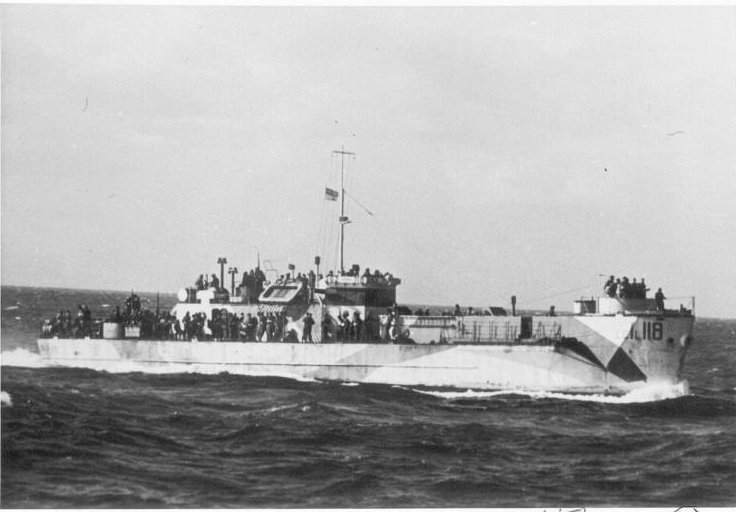
LCI(L)118 en route to Normandy. (Bill Brinkley, USS LSM-LSMR Association/NavSource Online)

Hours earlier, Bond had made the channel crossing from England, his LCI a mere speck among the thousands of ships and airplanes that comprised the greatest seaborne invasion fleet in history. Bond and 11 other LCIs were part of the 262nd LCI Flotilla, carrying the 9th Canadian Infantry Brigade, and arrived in the assault area in time to watch the massive pre-dawn naval and aerial bombardment of the coast. The enemy awakened and began returning fire. The flotilla stood by and waited. Around 6:35am, their escort ship, HMS VERSATILE, struck one of many naval mines littering the area. As Bond and his men bobbed in the choppy mine-infested seas, the tension was palpable – they were not scheduled to make their own landing until 10:15.

Assigned to Nan Red Sector of Juno Beach, at St-Aubin-Sur-Mer, all they could do was wait as assault troops finally made their landing behind schedule in chest-deep water, now 8:10am. The entrenched Germans poured fire onto those first waves of Canadian troops. Their artillery and mortars, though by now mostly destroyed, still managed to lob shells toward the ships off the coast.
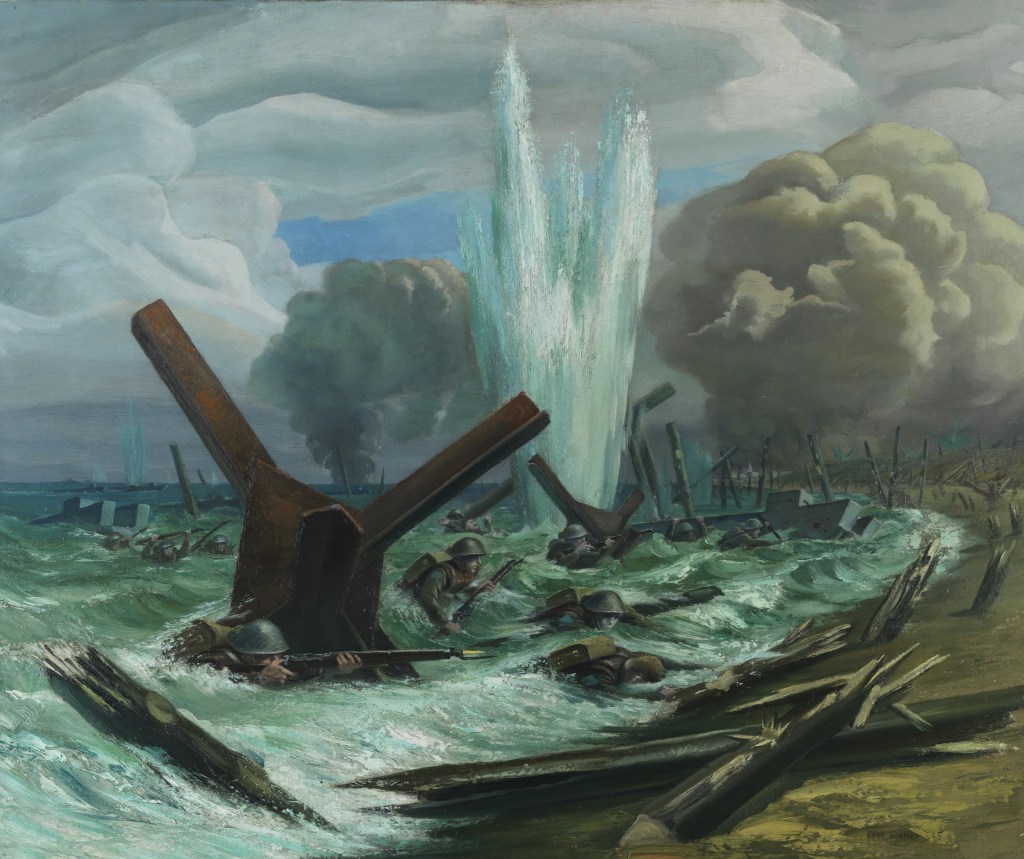
The Assault by Captain Orville Norman Fisher depicts the first wave attackers and the obstacles on the beach.
The Assault by Captain Orville Norman Fisher depicts the first wave attackers and the obstacles on the beach. (Canadian War Museum 19710261-6231)

While the fighting raged and confused reports came in from the shore, the 262nd Flotilla was now circling, about a mile out to sea, awaiting orders. Though the North Shore New Brunswick Regiment reported they were “proceeding according to plan,” La Régiment de la Chaudière advised they were “making progress slowly”. Timelines were being pushed back, and with added reports of sniping, mortar fire and heavy mining still on the beach, Bond’s flotilla was redirected over to Nan White Sector, and circled again off of Bernières-Sur-Mer. Despite Toronto’s Queen’s Own Rifles of Canada having seen some of the heaviest opposition against the Canadians there that morning, it was now deemed the more secure landing zone.

At 11:28, the control frigate HMS WAVENEY gave the long-awaited signal, and it was now time for Bond to make his run in to shore. He had practiced this time and again in England, but training could have hardly replicated what lay ahead. Corpses bobbed in the water. Several LCAs lay wrecked in the landing zones. And even though some engineers had cleared gaps in the approach lanes, the remaining mines and obstacles were now covered from view by high tide. To further complicate matters, there was only 180 yards of available beachfront between groins.

“The LCI’s operation orders,” recorded Naval Historians, “emphasized that it would probably be necessary for the LCI’s to break their way through the obstacles by charging them at full speed so as to disembark their troops well up on the low gradient beach.” They continued: “Had the craft tried to pick their way slowly through the lines of obstacles it is very doubtful that they could have avoided the mines and quite certain that they could not have got far enough up the beach, which had a very flat gradient of about one in a hundred, to give their troops a dry landing. The only course under the circumstances, as had been impressed on all commanding officers in the briefing for the operation, was to think only of landing their troops safely and disregard the safety of their craft. Like the LCAs, the LCIs were expendable.”

After receiving WAVENEY’s signal, “the Flotilla unwound from its circle in the waiting position, formed up in line abreast, [and] worked up to their full 16 knots maximum speed.”

Fanning out, the 12 ships charged through the surf, jockeying and jostling for position around obstacles. A great degree of skill and coordination was required by Bond – all talents well honed during his stint on the Toronto Police Motor Squad. Suddenly, LCI 270 – two ships over from Bond’s, struck a mine in her forward No. 1 Troop Space. Fortunately, that ship’s commander had ordered the troops up on deck, calculating that the mine risk outweighed the risk from enemy fire, and escaped without casualties. One by one other ships of the Flotilla were being holed by obstacles. So far though, LCI 118’s luck held.
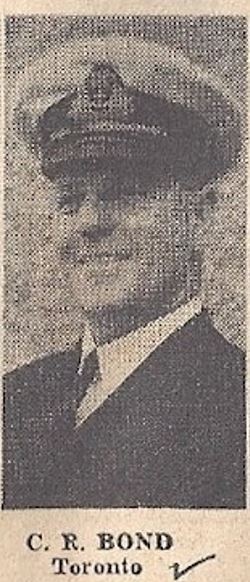
Naval Lieutenant Charles Ralph Bond pictured in the Toronto Daily Star upon graduating Royal Roads Naval Officer Training Centre, 1942. (For Posterity’s Sake)v
Naval Lieutenant Charles Ralph Bond pictured in the Toronto Daily Star upon graduating Royal Roads Naval Officer Training Centre, 1942. (For Posterity’s Sake)

At full speed ahead, Bond saw the beach rapidly approaching. LCI 250, with shark’s teeth painted on her bow, could be seen on Bond’s port side, while LCI 252 was off starboard. Seamen on deck watched over the sights of their heavy machineguns, ready to cover the disembarking troops. Soldiers on board clutched their gear, preparing to exit. Bond picked a clear spot of beach and fixated on it.

Suddenly, a blast. LCI 250 struck a mine, exploding near 118’s bridge peppering Bond with shrapnel in his neck and shoulder. His injuries were serious, and his Signalman and Leading Sick Berth Attendant were also wounded in the blast. In the ensuing confusion LCI 250 rammed into 118’s side damaging the port ramp. Obstacles punched holes in its hull.

Mission above all else, the well trained LCI crew leapt into damage control while others ensured an orderly disembarkation as the ship beached. After their rough landing, The North Novas on board descended the ramps and onto the beach. More heavily laden and supplied than the earlier waves of assault troops, it took between 20 and 30 minutes for all troops aboard the LCIs of the 262nd Flotilla to fully disembark. Despite mine and obstacle strikes, and fire from shore, not a single soldier transported by the flotilla was lost in transit.
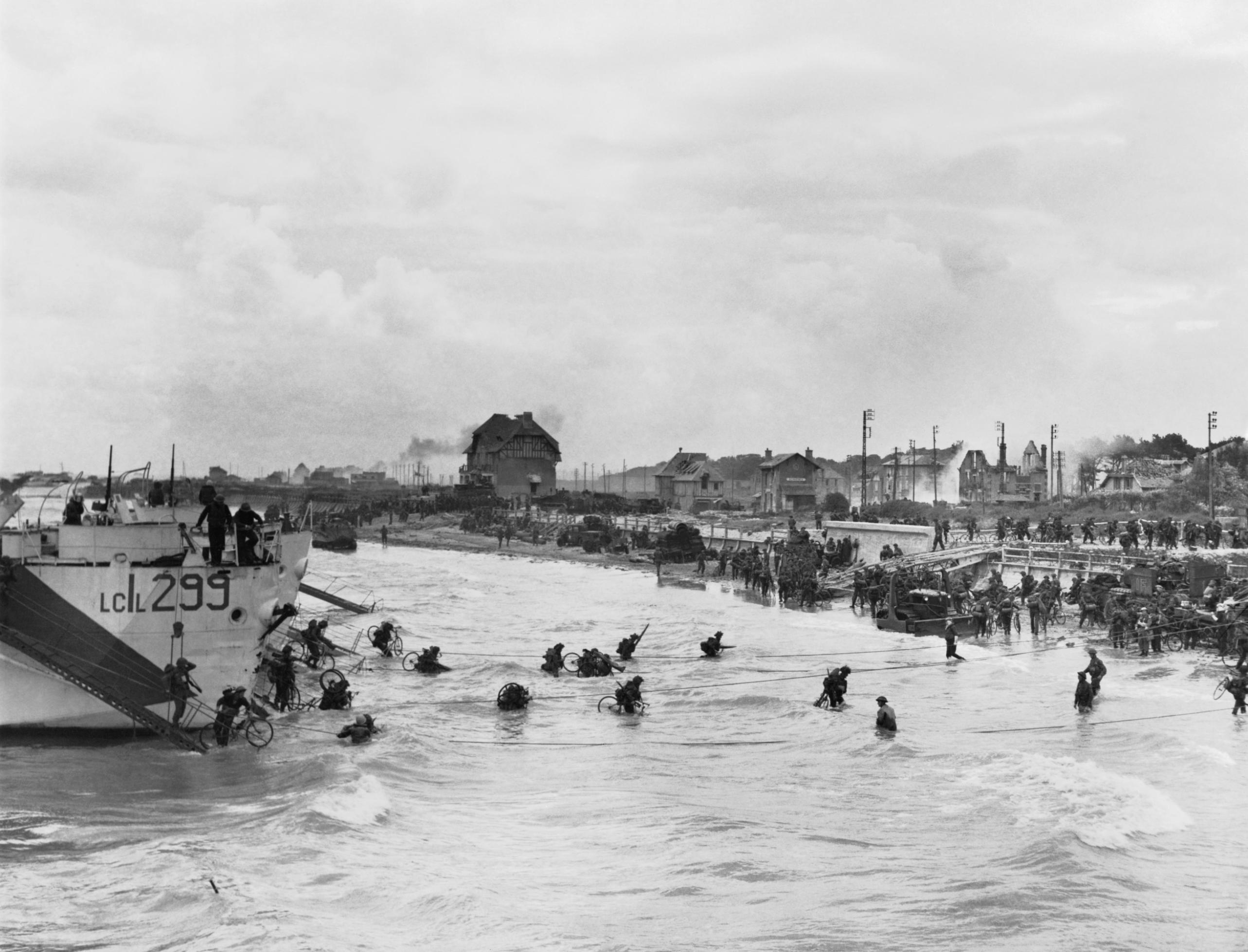
LCIs of the 262nd Flotilla disembark second wave troops of the 9th Canadian Infantry Brigade shortly before mid-day, 6 June 1944. (Imperial War Museum A23938)

Bond’s job was not done, however. Treated by a Sick Berth Attendant, he still had to bring LCI 118 back home to port on the Solent, on Britain’s southern coast. One by one the LCIs of the 262nd Flotilla began unbeaching. Due to the cramped conditions there, more yet were damaged. 262 struck two mines flooding her engine room. Kedges were fouled and cut. As Bond’s ship scraped off the beach, she struck a mine somewhere off the starboard quarter, but was still serviceable.

With only seven craft able to sail, the survivors formed up, and at 1:45pm this sorry convoy limped home, LCI 118 leading.

Back in Blighty

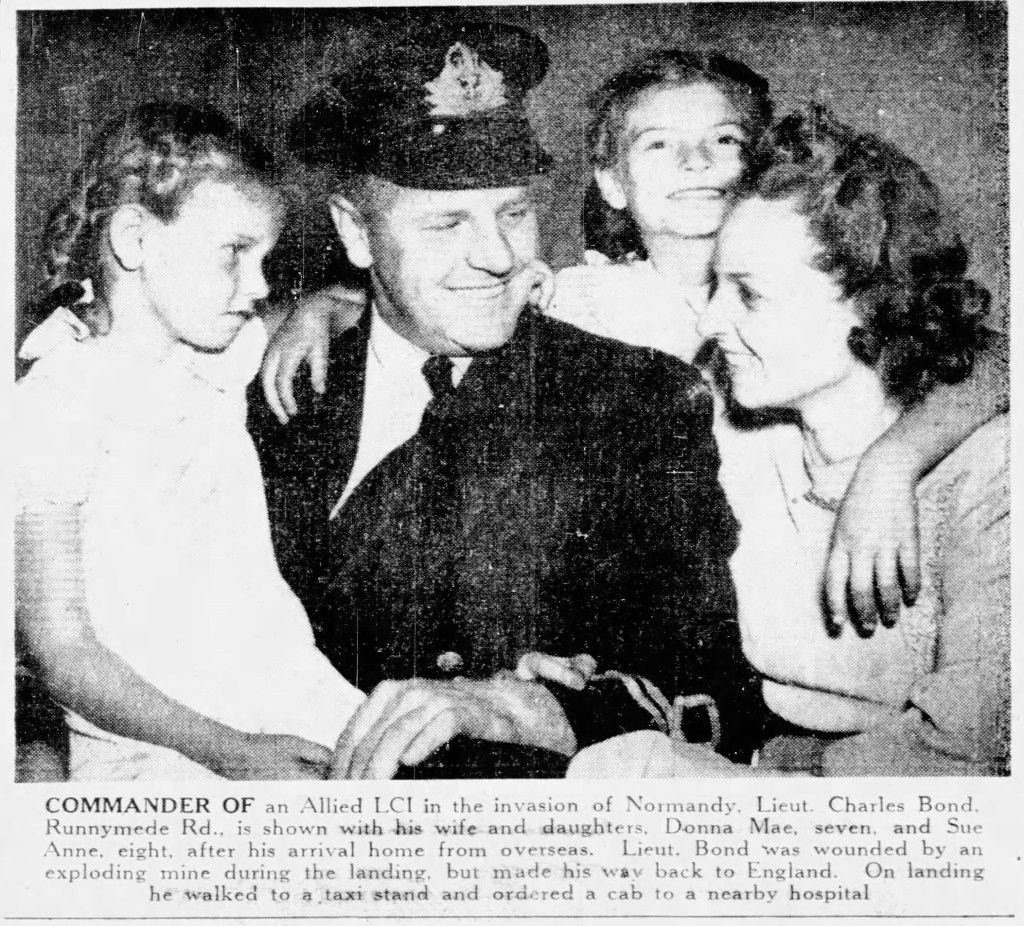
Upon landing at the frenzied port, Bond turned over his ship and gathered his injured men. Holding his neck, he walked to a taxi stand and hailed a cab. “We’re just back from France,” he calmly stated, and “we were wounded a little.” Away they went to hospital. Upon arrival, a startled hospital attendant hurriedly admitted the men, thus ending for them what came to be known as “The Longest Day”.

Back in port, naval authorities recorded the damage to LCI(L)-118 thusly: “Damaged by the mine set off by 250; port ramp had to be jettisoned after being rammed by 250; kedge had to be cut after being fouled by 252; starboard screw sheered off by mine while unbeaching and three holes pushed through the ship’s bottom, two of them into engine room.”

It was no small miracle that LCI 118 survived, along with her commander. The superstitious among the crew were not surprised, however. After all, they had named her “The Lucky Canuck”.
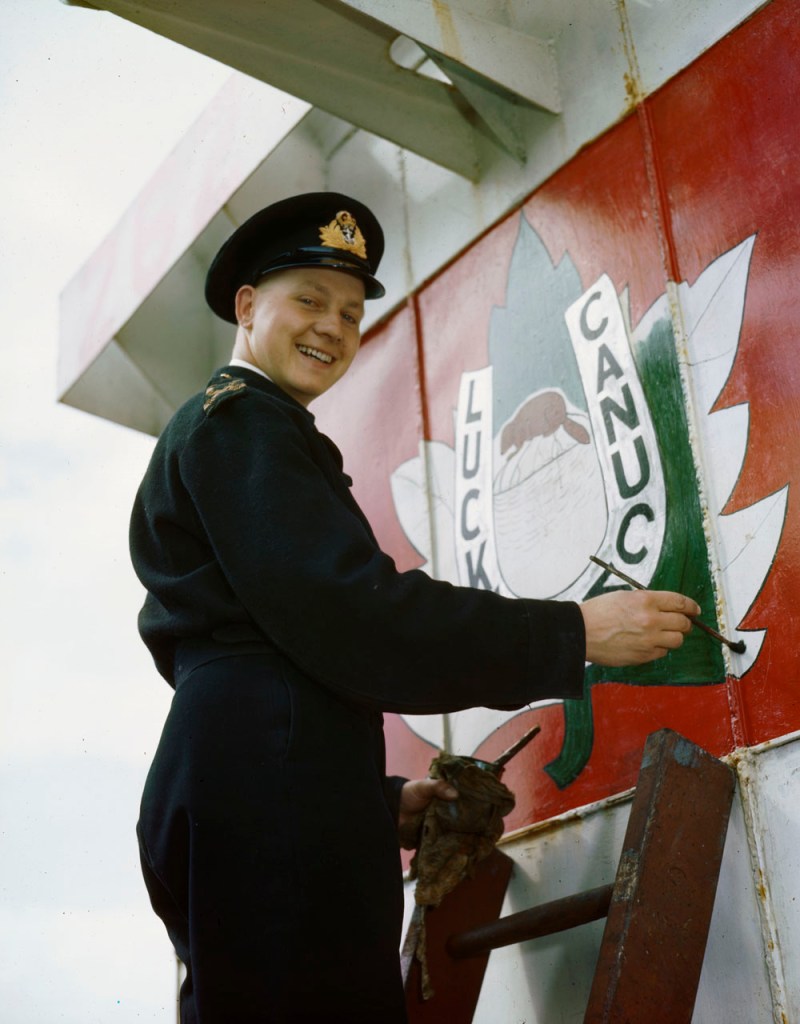
Sub-Lieutenant E.D. Rushbrook painting "Lucky Canuck" bridge art on the superstructure of LCI 118. (Library and Archives Canada, Item 4950840)
Sub-Lieutenant E.D. Rushbrook painting “Lucky Canuck” bridge art on the superstructure of LCI 118, prior to the invasion. (Library and Archives Canada, Item 4950840)
A happy family reunion appeared on the front page of the Toronto Daily Star on August 21st, 1944. (Toronto Public Library Historical Newspapers Database)
Postscript

Charles Bond joined the Toronto Police Force on December 15th, 1936. Sworn in as Police Constable 152, he served out of No. 4 (Dundas East) Police Station, first walking the beat, and then on the motorcycle squad. He stood 6’2 and weighed 230lbs, a large man in his time. Bond’s first brush with death came a few minutes after midnight on April 2nd, 1939. While on his beat the keen-eyed policeman observed a stolen vehicle whose license plate he had memorized. Parked on the east side of Mutual Street north of Dundas, Bond waited until car thief Thomas Martin returned to the scene. “I shouted for him to stop, but he only kept going.” The suspect entered the vehicle while Bond jumped onto the running boards, moments too late. Speeding off, the driver began swerving into telephone and hydro poles attempting to scrape the officer off the car. His commands unheeded and fearing the man would kill him, Bond fired a warning shot through the door. It was ineffective. Bond fired another round, grazing Martin in the arm. “I did not want to fire the shot, but I began to think I might get seriously hurt if I didn’t stop him.” Martin bailed out of the vehicle and was promptly apprehended. He was recognized as a local break-in artist. This arrest impressed Bond’s superiors who promoted him to First Class Constable six months early.
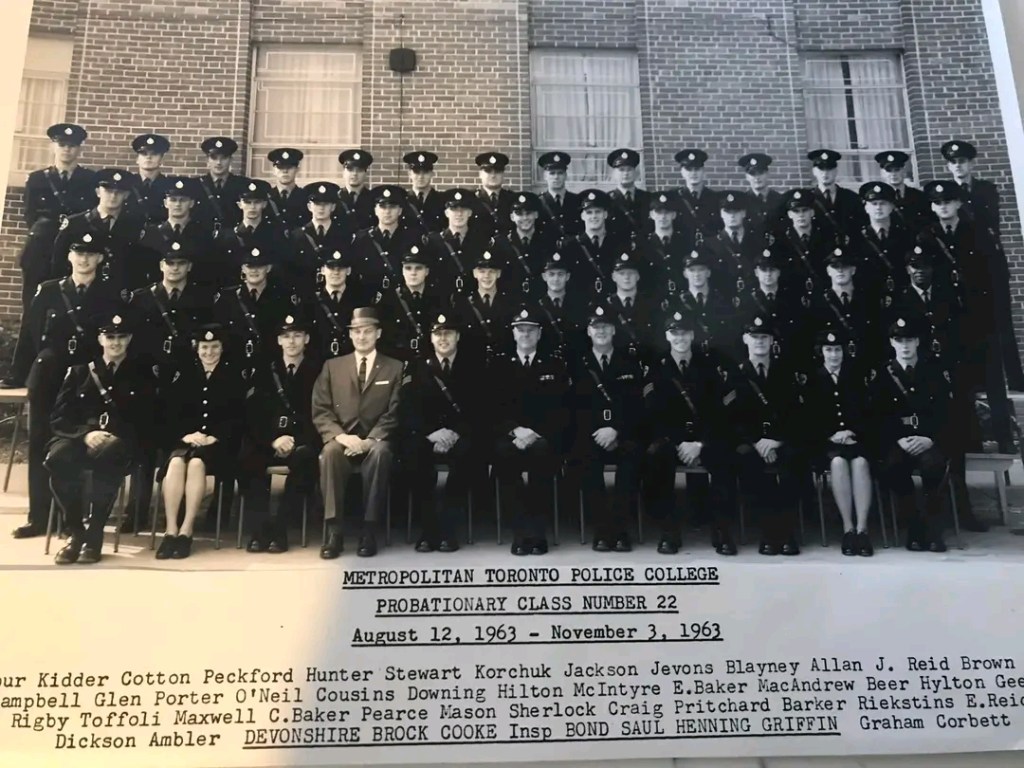
1963 Metropolitan Toronto Police graduating class photo. Inspector Bond, seated, front row centre. (Author’s Collection)

After Bond’s wartime service (1940-45), Charlie Bond, as he was known by then, continued to climb the ranks, serving in various roles. His seven years as head of the Metro Police College were remembered as his fondest. After 35 years in uniform, the incident in 1939 remained the only time he had to fire his gun. Bond capped his career as Superintendent in charge of all operations in the borough of North York. He retired to his farm in 1971 with his loving wife Violet.

Charles Ralph Bond died in 1991.


Dedicated to the brave crews of the Royal Canadian Navy’s LCI Flotillas.


Sources and Further Reading:

  • Toronto Police Force. Chief’s Annual Reports for the Years 1939-46. Carswell Ltd Printers, Toronto.
  • RCN Historical Section. The RCN’s Part in the Invasion of France – The 262nd Flotilla Beaches. Pages 103-107. London, 1944-45.
  • WAB Douglas et al. A Blue Water Navy: The Official Operational History of the Royal Canadian Navy in the Second World War, 1943 – 1945, Volume II Part 2. Chapter Seventeen, pages 263-266. Vanwell Publishing Ltd, St Catherines.
  • R. Foot. The Canadian Encyclopedia. Article: Canada on D-Day: Juno Beach. https://www.thecanadianencyclopedia.ca/en/article/juno-beach (Retrieved 5 June 2024.)
  • For Posterity’s Sake: A Royal Canadian Navy Historical Project. Charles Ralph Bond, Lieutenant O-7440, RCNVR. http://www.forposterityssake.ca/CTB-BIO/MEM001356.htm (Retrieved 5 June 2024.)
  • For Posterity’s Sake: A Royal Canadian Navy Historical Project.LCI(L) 118.http://www.forposterityssake.ca/Navy/LCIL118.htm (Retrieved 5 June 2024.)
  • NavSource Online: Amphibious Photo Archive. HMC LCI(L)-118. https://www.navsource.org/archives/10/15/150118.htm (Retrieved 5 June 2024.)
  • The Globe and Mail (1939 April 3rd) Page 5. “Driver is Shot by PC Hanging to Side of Car”.
  • The Toronto Daily Star (1942, October 3rd) Page 2. Toronto Men Among Graduates from Royal Roads”.
  • The Toronto Daily Star (1944, June 9th) Page 3. “Wounded Back in Blighty, 2 Take Taxi to Hospital”.
  • The Globe and Mail (1944, June 9th) Page 4. “Wounded in Landing, 3 Take Cab to Hospital”.
  • The Toronto Daily Star (1944, August 21st) Page 1. “Commander of an Allied LCI”.
  • The Toronto Daily Star (1945, September 8th) Page 3. “Police War Veterans Given Promotions”.

Victory at a Cost: Toronto Police’s World War 2 Fallen

Written and researched by Matthew Scarlino

Seventy-seven years ago, Nazi Germany was defeated after almost six long years of war.

PC Harry Connall celebrates the end of the war with citizens on Bay Street.

On May 8th 1945, Torontonians of all backgrounds came together in this city to celebrate “Victory in Europe Day”. The Fourth Reich who had invaded and occupied large swaths of the globe and committed unspeakable atrocities was no longer a threat. We owe a debt of gratitude to those who ended the menace, including the 236 members of the Toronto Police Service who took leave to serve overseas.

The Second World War Memorial Tablet which hangs in the Grenville Lobby of Toronto Police Headquarters.

They served aboard Corvettes crossing the deadly Atlantic; flew on murderous missions over the skies of Europe; and fought up the hills of Italy, through the bocage of Normandy, and slogged through the polders of the Low Countries and into the Rhineland. Many were wounded, and nine members of the Toronto City Police and two members of York Township Police would make the ultimate sacrifice.

We must never forget the debt we owe for our freedom. We will remember them.

Please click the link below to learn more about our Second World War fallen.

Alvin Sproule: Black Devil

Researched and Written by Matthew Scarlino.

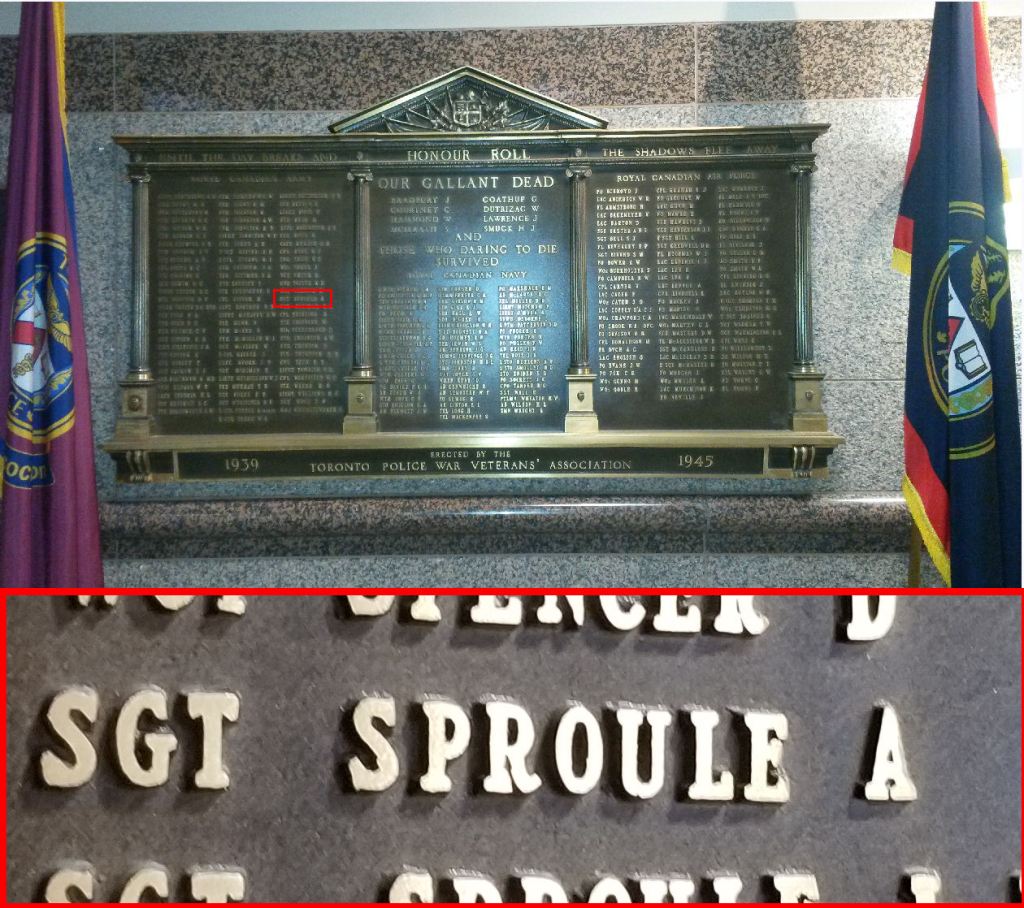
Sergeant of Detectives Alvin Sproule’s name on the Second World War memorial tablet at Toronto Police Headquarters.

The Black Devils, officially the First Special Service Force, was a unit that struck fear into the hearts of the enemy during the Second World War. One of the original members of this elite unit was a Toronto Police constable.

Alvin Armstrong Sproule joined the Toronto Police Department in 1939 as an 18-year old Police Cadet. Once reaching the minimum age requirement of 21 years, Sproule was sworn in as Police Constable #333, but in May 1942 he took leave to enlist in the Canadian Army, joining The Royal Canadian Army Service Corps. Sproule went on to pass selection into the First Special Service Force, an elite joint American-Canadian commando unit with specialist training in hand-to-hand fighting, parachuting and mountain warfare.

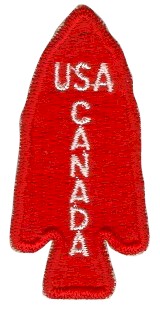
Iconic arrowhead shoulder flash of the FSSF.
(Photo Credit: Bill Ellis and canadiansoldiers.com)

Sproule served in the 5th Company, 2nd Regiment of the FSSF. While exact details of Sproule’s service are still classified, one could look at the unit’s history to know what kind of finding he was involved in.

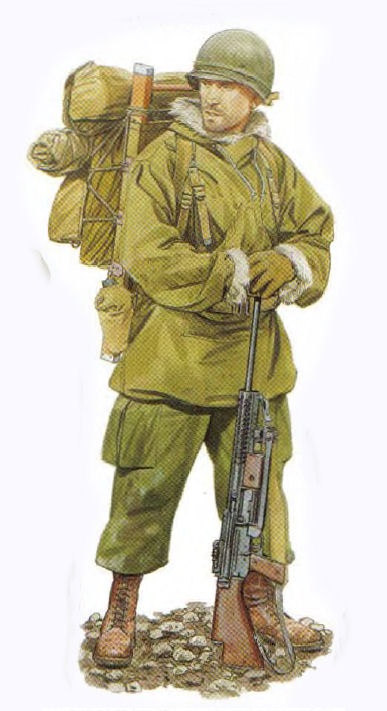
Private, First Special Service Force; Anzio, Italy 1944 by Ron Volstad.
(Photo Credit: Osprey Publishing)

The FSSF first saw action during Aleutian Campaign of 1943 in the Pacific theatre, and were then used extensively in the Mediterranean Theatre, fighting throughout Italy and Southern France. Their assault on the German-held Monte La Difesa was made into a Hollywood film The Devil’s Brigade (1968). During the infamous Anzio campaign, where they were in combat for 99 continuous days, the enemy nicknamed them “The Black Devils” due to the commandos’ tenacity and use of boot polish as face paint. After the fierce fighting in Italy, they would make a combat jump into Southern France, during a lesser-known seaborne invasion dubbed “Operation Dragoon”. They fought on in the south of France towards the Axis-held Alps, and after suffering an irreplaceable attrition rate of over 600%, were eventually disbanded. Sproule was wounded in action, but it is unclear when. The remaining Canadians were mostly dispersed to the 1st Canadian Parachute Battalion as replacements.

The First Special Service Force is perpetuated today by the Canadian Special Operations Regiment and the United States Army’s 1st Special Forces Command (Airborne).

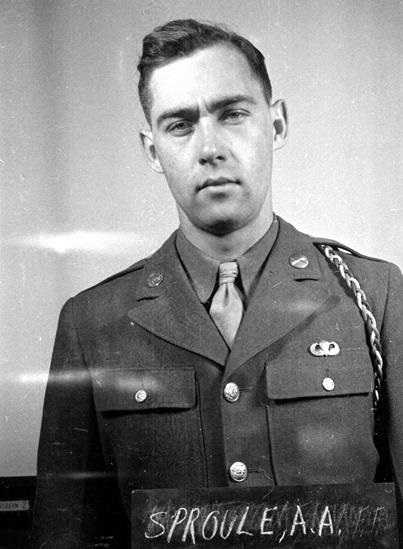
Sproule picture in the American-style FSSF uniform, where he wears US jump wings.
(Photo Credit: First Special Service Force Association)

Sproule would end the war as a Staff Sergeant.

After the war, Sproule returned to the Toronto Police Department, and would soon be “wounded” again, according to The Globe and Mail newspaper. “Annoyed at having his premises searched,” they wrote, a 43 year-old John D’Angelo “became enraged and bit the constable’s right hand”. Assaulting a former commando in such a way could not have ended well for the man.

In 1949, Sproule earned his first Good Conduct badge, earlier than the usual 7 years of good police conduct, due to merit. It carried with it an extra 10 cents pay a day. Sproule soon moved to plainclothes investigations, and in 1952, was made an Acting Detective. In 1954 he received another Good Conduct Badge.

Fellow plainclothesman Jack Webster, who would later author a memoir and establish the Toronto Police Museum, described Sproule as a “fearless police officer with a reputation for bravery.” Webster also shared an anecdote demonstrating Sproule’s fearlessness and proficiency at arms.

On the evening of October 26th, 1955 the pair were partnered together when each other’s regular partners were on leave. As they were making their way back to headquarters at the end of their shift, the police dispatcher broadcast that an armed man was firing shots through his hotel door near Bay and Dundas streets. Webster and Sproule were first on scene at the Ford Hotel (demolished in 1974). Terrified staff reported that the man was still barricaded inside Room 411 after shooting at an employee. Sproule called for reinforcements while Webster made unsuccessful negotiations with the male over the room phone. The gunman continued to fire his shotgun sporadically through his door.

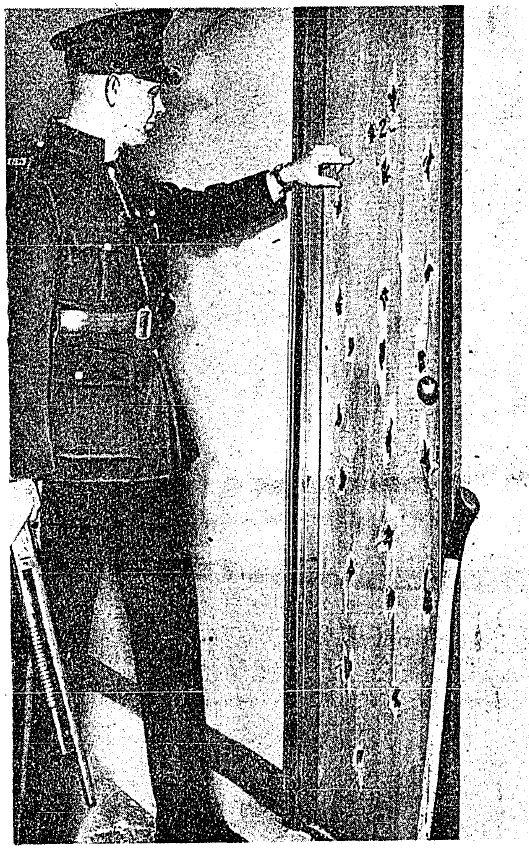
PC Lister, also a war veteran, shows Room 411’s bullet-riddled door to photographers. (Toronto Daily Star)

After uniformed officers arrived, “Detective Sproule volunteered to go along the hallway armed with a machine gun that had been brought to the scene, and kick the door in, while spraying the room with gunfire.” Sproule, however, was overruled by Detective Inspector William Matthews, who had arrived and taken charge of the scene. Matthews was concerned that their could be hostages hidden inside.

While waiting for further direction, Sproule and Webster periodically exchanged gun fire with the man while they contained the hallway. “After one of these gunfire exchanges, the man screamed and re-entered his room. We were sure that one of us had wounded him…” The gunman, however, continued to fire through the door – “all the time shouting unintelligible words”.

Suddenly a lone shot rang out, followed by complete silence.

Suspicious of a trap, the officer-in-charge called for tear gas (new at the time at the police department) be brought to the scene. When the “large, artillery-shell-like gas canisters […] designed to be fired from a short stubby-barreled rifle” arrived, there was no one there with the experience to use them. Alvin Sproule volunteered, and re-positioned himself in the courtyard of the hotel, with a clear view to the shooter’s window. This also left him exposed.

While covering the window, contemporary newspapers reported that Inspector Matthews threw a gas grenade from an adjoining room’s window into the gunman’s. Webster however, in his eye-witness account remembers it this way: “This detective [Sproule], who was an experienced infantry soldier from the war, took careful aim and fired the canister. It was an accurate shot and went directly through the window into the room.” In any event, smoke poured out of the room within seconds.

A breaching team of Sproule, Webster and two other detectives “wearing Second World War gas masks” entered the gassed out room only to find the shooter dead from a self-inflicted gunshot wound to the stomach.

“Experienced tear gas handlers later explained to [us] that a single tear gas bullet, about the size of a .38 calibre shell, would have been sufficient to accomplish our task, and that the canister used was large enough to clear that famous ice hockey arena, Maple Leaf Gardens,” said Webster.

The gunman was identified as Zorano Borg of Malta. He had been described as a “usually quiet, friendly twenty-two-year-old European immigrant, who had become despondent with his new life in Canada.” Thanks to Sproule and his colleagues’ swift action, no one else was hurt, though the hotel was a little worse for wear.

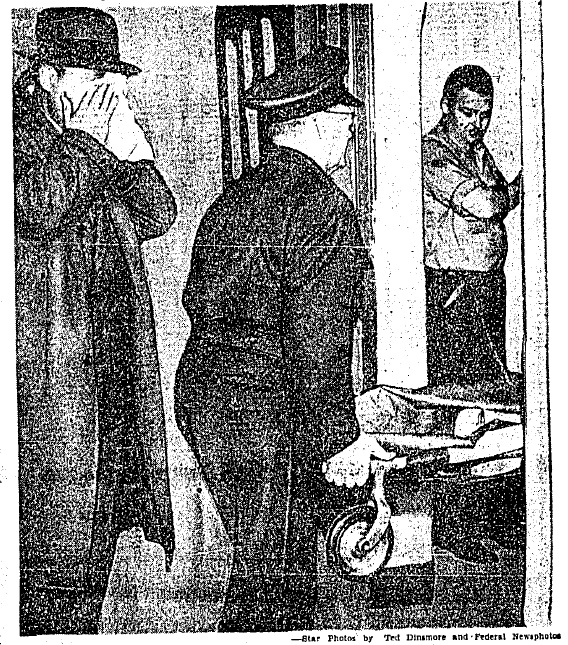
Borg’s body is taken away, as Inspector Matthews wipes his eyes with a handkerchief due to the tear gas. (Toronto Daily Star)

Sproule excelled in the Detective branch, and eventually rose to the rank of Sergeant of Detectives, a bygone rank forgotten by most officers today. “The Sergeant [of Detectives] was a rank between Detective Sergeant and Inspector. Like an Army Sergeant-Major his job was never really spelled out in hard and fast terms, but he was the senior Detective, the guy who knew and had done it all and got extra pay for it.” explains retired member Mike Holland.

In 1966, Sproule had the distinction as serving as the liaison to the RCMP during the 1966 House of Commons bombing attempt by Toronto resident Paul Joseph Chartier. Sergeant of Detectives Sproule would last serve at the old 21 Division in the Keele St & Eglinton Ave W area.

The following year, on the 13th of January, 1967, Sproule collapsed and died suddenly at his home on Balaclava Avenue in Scarborough. Just 45 years old, Alvin Sproule left a wife and six children.

Sources and further reading:

  • D. Draper. Annual Report of the Chief Constable of the City of Toronto for the Year 1944, Toronto: The Carswell Co Ltd City Printers, 1945.
  • J. Webster. Copper Jack: My Life on the Force. Pages 103-105. Toronto: Dundurn Press, 1991.
  • R. Chartrand and R. Volstad. Canadian Forces in World War II. Oxford: Osprey Publishing, 2001.
  • RD Burhans. The First Special Service Force. A Canadian-American Wartime Alliance: The Devil’s Brigade. Ed Conroy Books Ltd, 1948.
  • First Special Service Force Association website. History. http://www.firstspecialserviceforce.net/history.html 2022.
  • Canadiansoldiers.com. First Special Service Force. http://canadiansoldiers.com/organization/specialforces/1ssf.htm 2022.
  • Toronto Public Library – Historical Newspapers Database. The Globe and Mail 1946-08-12, p.5 “Toronto Public Library – Historical Newspapers Database. The Globe and Mail 1946-08-12, p.5 “Man Bites Police, Police Arrest Man“; The Globe and Mail 1952-12-19, p.1 “Worked on Boyd Case Two Toronto Detectives Get Higher Positions”; The Globe and Mail 1955-10-27 p.1“Hotel Shooting Battle Ends With Crazed Gunner’s Suicide” p.3 “Tense Fearful Crowd Gathered Near Scene”; Toronto Daily Star 1955-10-27 p.1 “Buckshot Barrage Keeps Tear-Gas Police at Bay Man Kills Self in Hotel,” p.3  “Defies Tear Gas, Riot Guns, Dies in Shot-riddled Room”; The Globe and Mail 1962-02-24, p. 1 “Slapped Rabbi to Stop Hysterics Sergeant Declares at Inquiry“; The Globe and Mail 1967-01-14, p. 2 “Alvin Sproule: Sergeant, 45, Joined Police as Cadet in 1939″.

A Whirlwind Week: A Toronto Policeman in the Battle of France

Researched and written by Matthew Scarlino.

This article was originally written in June 2020 for the Toronto Police Military Veterans Association.

Police Constable (709) James “Tiny” Small, Acting R.S.M. 48th Highlanders of Canada

Eighty years ago this week, a small number of Canadian soldiers landed at Brest to participate in the Battle of France, in what is now an obscure and little-known operation that took place in June 1940.

Just days before the Canadians landed, the nearly-destroyed British Expeditionary Force was miraculously evacuated from Dunkirk. The German army then pressed their attack against the remaining French Army south of the Seine and Marne rivers.
In a desperate bid to keep up a foothold in France, Britain committed its last two fully-equipped infantry divisions, the 1st Canadian and 52nd Lowland, as well as the 1st Armoured Division in a force now known as the “Second” British Expeditionary Force (BEF). The mission was to be kept secret to avoid detection by German forces. The 1st Canadian Infantry Brigade would spearhead their division, and advance parties landed at the French port city of Brest, on 12 June 1940. The orders for the operation, somewhat unclear, were to drive toward and reinforce the new French defensive position dubbed the Weygand Line. Or, “failing that, to join in the defence of the Breton Redoubt as a last fortified foothold on the continent” [Copp].

As could be expected, owing to the Toronto Police Department’s large and widespread contribution to the war, Toronto policemen were among the contingent. One such officer kept a brief diary during the campaign, which offers a rare first-hand look. Police Constable (709) James “Tiny” Small, joined the Toronto Police Force in 1921, walking the beat out of the old No. 6 Police Station (Queen & Cowan Ave) and later, motorcycle patrol. Small was also the Drum Major of the Toronto Police Pipe Band, which is still active today.

Small left the force for military service at the outbreak of war in Autumn 1939. Now, the 6’6” “Tiny” Small was a Warrant Officer and Acting Regimental Sergeant-Major of the 48th Highlanders of Canada. Small and his fellow Canadian soldiers stood by helplessly in Britain while Germany’s Blitzkrieg rolled over the British and Western European allies in France and the Low Countries in May and June of 1940. The men were elated when they received orders to proceed to France. Small’s 48th Highlanders of Canada were inspected by King George VI and then moved from Camp Aldershot to the embarkation point at Plymouth. On the way, they found out that the 51st Highland Division (which contained their allied regiment, the Gordon Highlanders) had just been encircled and destroyed near St Valéry, France. With happy memories of last winter’s snowball fights with the Gordons still fresh in their minds, the gravity of their situation must have started to sink in.

Let us look to his diary.

11 June 1940 1p.m. entrained for Plymouth. Stayed under canvas – sailed on Ville D’Alger – shores of Plymouth packed with people. Wonderful send off – 2 troopships & good escort. First Canadians to land in France.

Small’s journey begins on a “scruffy French channel craft”, the Ville d’Alger. It appears he was a member of the battalion’s Transport Section, which along with the (Bren Gun) Carrier Section led the way to the continent ahead of their regiment’s main body.

12 June 1940 Landed at Brest at 10a.m. – good trip. Looked the town over – got paid (French Francs).

Small’s advance party landed in France. It must have been an emotional feeling for him, as Small had fought in France as a 17-year-old rifleman with the 19th Battalion during Canada’s Hundred Days Offensive of 1918. There would be little fanfare however. Upon arrival the men found a “dismaying atmosphere” at Brest. There was no official welcome. French soldiers indifferently lounged around while civilian refugees carrying all they could crammed the streets. Small went to work unloading his section’s trucks and motorcycles in the busy port. It would be exhausting non-stop work as thousands of men, vehicles and equipment would be disembarking behind them.

13 June 1940 Left Brest about 1p.m. after unloading transport – slept in bush at Mur-de-Bretagne – tired out

Small’s party set off toward the planned Rennes-Laval-Le Mans assembly area (headquarters being established at the city of Le Mans). The 1st Canadian Infantry Brigade’s Carrier and Transport Sections took the roads, while the main force traveled by rail. The route was clogged with refugees, whom local authorities had given the right-of-way, causing the convoys to move fitfully. At the end of the day Small would camp at Mûr-De-Bretagne, having moved 130km inland from Brest.

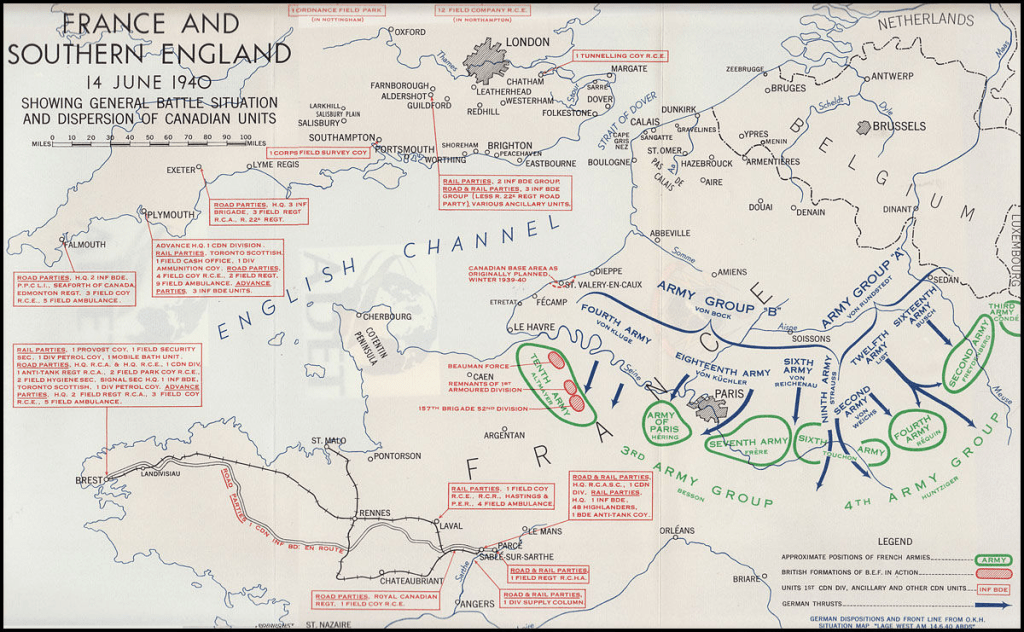
14 June 1940 Started on road again – rode all day – stopped in bush for the night at Bouessay. Havent seen the Regt. yet,

After a long day’s drive, Small would camp at the small town of Bouessay, outside of Sablé-sur-Sarthe, now about 360km inland from Brest, and 60km from Le Mans.

While on the road, the situation had changed drastically – that morning German troops reached Paris, and to save the historic city from destruction, the French would not defend it. German soldiers marched down the Champs Elysées under a swastika-covered Arc de Triomphe. They would not stop for long. The French armies were now cut off from each other and unable to put up a coherent defence.

The British War Office, fearing total collapse in France, issued orders to recall the BEF. They would be needed for the next battleground – Britain.

The situation on 14 June 1940. (Official History of the Canadian Army in the Second World War, Vol 1.)

15 June 1940 4:30a.m. British Retiring – also us. Got back as far as Landesvous(?). Walking in circles – what a life! Still haven’t found the Regt.

In the confusion, the 48th‘s Transport and Carrier Sections were not able to rendezvous with the main force. They began their withdrawal to the port among fears of aerial attack and rumours of a sweeping German advance.

Small’s party managed to drive 325km to the town of Landivisiau, about 40km outside of Brest.

“None of us will forget that drive. We passed thousands of refugees, in fact most of the roads were choked with them, poor devils. I don’t know where they wanted to go; anywhere away from the Germans, I supposed. They were all ages, and all were carrying bundles… The only greetings we received now were black scowls…” – Basil Smith, Transport Sergeant, Hastings and Prince Edward Regiment. Part of the same brigade, the “Hasty P’s” Carrier and Transport Sections also came to France on the Ville d’Alger, and would have traveled in conjunction with Small’s party.

16 June 1940 Took up positions in bush outside Londesvous(?). Extra ammunition. Hiley(?) shot through hand – Resneven(?)

Things are becoming chaotic. An edgy night was spent in defensive positions, on high alert for attacks from the air or by land. The man shot would have been from friendly fire or a negligent discharge, for the German army, unbeknownst to the men, were still hundreds of kilometres away.

Small’s section was now paused at the town of Lesneven, outside of Brest. That afternoon, a German reconnaissance plane appeared over the port at Brest – flying low and observing the withdrawing Allied forces. Canadians on board the Canterbury Belle let loose with their deck-mounted Bren Guns, joined almost instantly with “every rifle, pistol, anti-tank rifle, or other weapon upon which three thousand men could lay their hands on” [Mowat]. The plane retreated, smoke trailing from one engine.

Any secrecy the men thought they may have had was now gone.

17 June 1940 Ordered to wreck transport – took 4 trucks & Bren Guns, bombs & ammunition (?). On Brigitte at Brest – 4:30p.m.

Basil Smith continued: “We arrived on the outskirts of Brest … and there must have been a solid mile of British vehicles ahead of us, bumper to bumper. We joined them, and in a little while there was a mile of them behind us too. What the Luftwaffe was doing on that day I’ll never know, but we sure expected the same treatment the boys got at Dunkirk.”

Vehicle convoys were arranged in makeshift parking lots on the outskirts of the town, and it appears the Carrier and Transport Sections were now split up as they awaited space on ships. Small and his party settled in and waited. According to Smith it was “some of the most nervous hours I can recall. The tension was worse than being under shell-fire later in the war. We were momentarily expecting a Panzer column to come sweeping down the road.”
Their fears were valid. A week ago the entire 51st Highland Division had been wiped out at St Valery before they could evacuate, by Rommel’s 7th Panzer Division.

The 7th Panzer Division had now turned their attention to Cherbourg, where other components of the Second BEF were now evacuating (as it was not practical for all units to go back to Brest – others went to St Malo). The Germans penetrated to within 3 miles of Cherbourg’s harbour as the last Allied troopship left there.

At Brest the enemy was not actually in the vicinity, but anxious British authorities at the port ordered the Canadians to destroy their vehicles and other equipment. They wanted to evacuate as many men as possible, as quickly as possible, and the hardware took up too much space. Lest it fall into enemy hands, they were ordered to destroy their equipment by fire.

Upon receiving the order, a disappointed Small went to work wrecking his lorries which he had shepherded through France. Once again Basil Smith’s account shows how this was done: “we couldn’t burn the trucks because it would have […] drawn every German plane for a hundred miles, so we did the next best. We went to work on all those lovely new trucks with pickaxes; punctured the tires, gas tanks and radiators; jammed up the bodies, sheared off engine parts and cracked the blocks. Then we destroyed the equipment in them…”

By late afternoon Small’s party had found space on a ship bound for England.

18 June 1940 Landed at Plymouth at 7a.m. – off boat 6p.m. Slept on Swan Pool Beach all night.

The Brigitte carried the men “back to England in style” as the Transport Officer, Lieutenant Don MacKenzie put it. It was “a crowded little pleasure launch which would have looked home on Toronto Bay.”

After stopping at Plymouth, where the main force was disembarking, the Brigitte continued on to Falmouth (about 90 minutes away by road) for reasons unknown.

An exhausted Small disembarked and then slept on Swanpool Beach.

He still had not seen the rest of the Regiment.

An exhausted Highlander catches up on sleep at sea after evacuation from France, June 1940. (© IWM F 4878 )

19 June 1940 Left beach & left Falmouth for Aldershot. Arrived at 8:30p.m. – dead tired.

As it happened, the scattered sub-units of the 48th Highlanders had all returned to the Canadian Camp at Aldershot by June 18th, save for the Transport Section. Worry grew among the regiment, and the outstanding men’s names were being entered into a list titled “The following are SOS, missing believed prisoner’s of war” to be published in Orders. When Small and his party returned arrived late on the 19th, they were “greeted like men escaped from a prisoners’ cage”.

The dead tired Small would have little time to rest. As Winston Churchill put it the day before in a rousing speech: “The Battle of France is over. The Battle of Britain is about to begin.”

Postscript

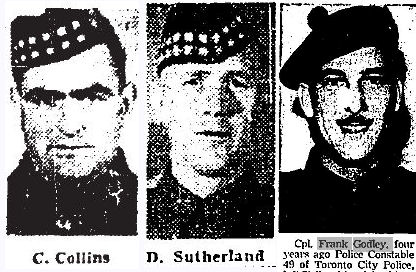
Small would learn of the journey of the main force of the 48th Highlanders who had traveled by rail. They had been in the lead train with Brigade Headquarters. This group likely included other Toronto policemen who had joined the 48th in the early days of the war. Constable Frank Godley (49), was now serving as a Sergeant in the Battalion HQ. Also with the 48th were Constables “Army” Armstrong (9), Clarence Collins (332), William McMillan (237), and David Sutherland (507). The 48th train penetrated the furthest of any Canadians, reaching Sablé-sur-Sarthe. Once there they received the order to reverse from a British Railway Transport Officer (RTO). The seemingly nervous RTO insisted they flee but could not produce the order to do so nor his credentials. The Canadians thought he was a German Agent and quizzed him on his name, “Oates”. A man of the same name was famous at the time as a member of Scott’s Antarctic Expedition of 1910-13. The RTO knew enough about this bit of trivia to pass as a true Brit and the Canadians were satisfied the order was genuine.

A few of the Toronto Police constables serving with the 48th Highlanders (Toronto Daily Star & The Globe)

However they now had an issue with the trains French engineer. “Finie la guerre!” he cried, refusing to move his train in the opposite direction. He happened to live in Sablé and wanted to go home. He became irate and would only comply at gunpoint. The trains crew had mostly managed to leave. Luckily, Platoon Sergeant-Major Jack Laurie had been a railwayman before the war and said he could run the train back, and pressed other soldiers into service as stokers. The men posted Bren gunners at the doors, smashed out windows to reduce potential shrapnel, and placed an AA gun on a flatbed car. “The entire battalion was aboard, crowded at the windows and staring at the early sky, nervously watching for Stukas”. Before setting off the “recalcitrant engineer” again tried to get off the train, supposedly to have breakfast. “Someone tell the goddamn Frog he’ll eat here or else!” Laurie shouted.

The train then took off for Brest with a “defiant little toot” of its horn. But at some point in the journey, the French engineer outwitted the Canadians and switched course for St Malo, a port closer to his home. When the 48th arrived at the harbour, there was just one ship left with orders to evacuate British troops, the SS Biarritz. It was already loaded but stuck in low tide. Room was made aboard for the Canadians and they spent a long night waiting for the tide to come in. “Enemy air attack was expected all night long; several other French ports were being heavily bombed, and there was no reason why St. Malo should be immune, but the night passed undisturbed.”

The Biarritz carried them off just as Royal Navy demolition parties blew the outer locks. France would surrender days later.

For their part in the Battle of France, Canadians were awarded the 1939-1945 Star. It would be years before they would return to French soil. All in all, the men acquitted themselves well in the chaotic campaign. Though 216 vehicles and much equipment were lost, Canada’s human losses for the operation were incredibly light, with only 1 killed, and 5 missing – taken prisoner. The fatality was due to a motorcycle collision on the frenzied roads; and of the 5 men captured only one would remain a prisoner at the end of the war – the other four escaping back to England (notably, one of the escapees would account for the war’s first Military Medal awarded to a member of the Canadian Army).

The 1st Canadian Division’s ability to make it back to Britain almost entirely intact (minus the scrapped equipment) was necessary for any planned defence of the British Isles.

They would soon be under attack from the air, and Small’s diary again provides a glimpse into that time. To be continued…

Sources and further reading:

  • J. Sarjeant. The Secrets in the Chest: The Life of James Edward “Tiny” Small. Rose Printing, Orillia. 2016.
  • K. Beattie. Dileas. History of the 48th Highlanders of Canada 1929-1956. The 48th Highlanders of Canada, Toronto. 1957.
  • F. Mowat. The Regiment. Dundurn, Toronto. 1955.
  • T. Copp. Legion Magazine – The Fall of France Part 2. October 1995.
  • C.P. Stacey. Official History of the Canadian Army in the Second World War, Vol. I Six Years of War. Queen’s Printer for Canada, Ottawa. 1955.
  • D.C. Draper. Annual Report of the Chief Constable of the City of Toronto for the Year 1940. Toronto, 1941.

A note on quotations: Diary entries are duplicated from Sarjeant’s “The Secrets in the Chest” with permission from the author. All uncredited quotations are taken from Beattie’s “Dileas”, except for Basil Smith’s account, which appears from Mowat’s “The Regiment”.

Profiles in Courage: Toronto Police on D-Day

Researched and Written by Matthew Scarlino.

This article was originally written in June 2019 and versions were published in Blue Line Magazine and featured on TPS News.

It was spring 1944. The Second World War had been raging for four and a half years. Most of Europe lived under the dictatorship of Adolf Hitler.

Canadian troops headed toward Juno Beach on June 6, 1944. (Library and Archives Canada MIKAN No. 3205254)

Millions of Jews, visible minorities, queer people, political dissenters, and people with disabilities were being rounded up and sent to death camps. Rights and freedoms disappeared and occupied peoples were forced to work towards the Nazi war effort. The Western Allied armies of Great Britain (including Canada and other Commonwealth nations), France, Belgium, The Netherlands, and other European nations, had been pushed out of mainland Europe since 1940 when Nazi Germany invaded in their blitzkrieg – “lightning war”. The Western Allies escaped to Britain, where they remained under attack from the air, but persevered. When the Americans joined the war, they too would sail to England and prepare to fight.

Meanwhile, the Nazis fortified Europe using slave labour to build the Atlantic Wall, coastal defences made of concrete bunkers, weapons pits, landmines and other defences to make re-invasion impossible. The Western Allies instead invaded through Italy in 1943, but the narrow and mountainous terrain heavily favoured the defenders – casualties were high and progress was slow. In the east, the Soviet Union was also taking heavy losses pushing Nazi forces out of Eastern Europe. The situation was bleak and there needed to be a breakthrough elsewhere.

A plan was made to form a massive armada of ships, planes, and troops and invade Occupied France across the English Channel at Normandy. Five beaches would be assaulted, the Americans and British responsible for two beaches each, and the Canadians responsible for the last beach – code-named “Juno”. It wasn’t clear if the plan would work and casualties were expected to be extremely high. After bad weather postponed the attack, it was finally settled that it would take place on June 6, 1944, code-named “D-Day”.

On June 6, 2019, Canadians across the country are commemorating the 75th anniversary of the daring invasion, which marked the beginning of the end of World War II. The successful Normandy Campaign commenced a drive to Germany that would see the war end in less than a year. And just like the many Toronto policemen who fought in the First World War, 235 members (men and women) of the Toronto City Police Force, would leave to serve in the Second World War(1). Many of them took part in the D-Day invasion.

This is the story of a half-dozen police officers, just a small sample of the many Toronto Police members who contributed to victory in the Normandy Campaign at sea, on land, and in the air.

At Sea

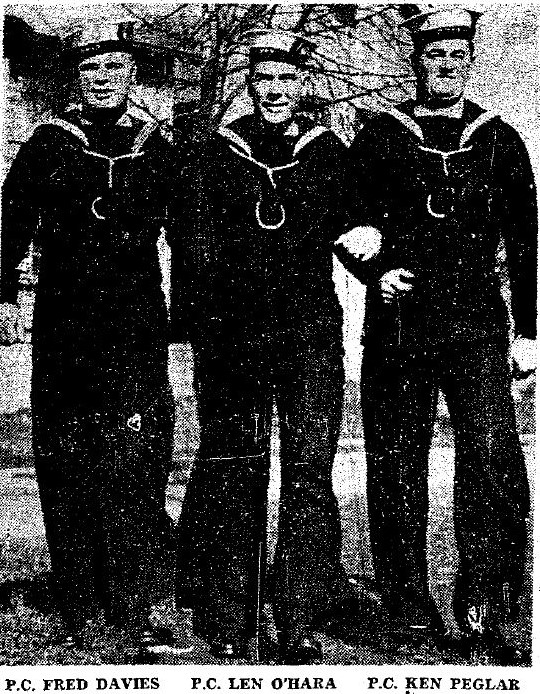
Some of the first Toronto Police members in action on D-Day were three burly constables aboard the HMCS Skeena. Fred Davies, Len O’Hara and Ken Peglar were all towering policemen who had joined the Royal Canadian Navy together as stokers – whose main duties were to feed coal into the ship’s boilers – in 1940. Deputy Chief Charles Scott described them as “outstanding” track and field athletes in the Toronto Police Force Amateur Athletic Association, who would be “an asset to any ship.”(2)

Constables Frederick Davies (#284), Leonard O’Hara (#55) and Kenneth Peglar (#108) in their Royal Canadian Navy uniforms, as they appeared in a 1942 edition of the Toronto Daily Star

The men had survived terrifying sea battles in the years leading up to this momentous day, including being involved in the first sinking of an enemy submarine by Canadian forces. While on convoy duty, on the night of September 8 & 9, 1941, the ships they were protecting were attacked by a “wolfpack” of German submarines known as U-Boats. In the epic 66-hour battle that ensued, the Skeena launched depth charge after depth charge in chaotic fighting in which Constable Peglar was wounded by a powerful blast that launched the 6’4”, 245-pound policeman through the air into a bulkhead. (3) When the smoke settled two U-Boats were sunk at a loss of 16 merchant ships. 

Now veteran seamen, they were on board one of the 63 Canadian warships participating in the greatest sea-borne assault in history. In the hours leading up to the D-Day invasion, the trio toiled below-deck stoking the steam engines in the sweltering boiler rooms of the Skeena. Their destroyer was paving the way for the invasion force by clearing the sea lanes of enemy ships, and starting at 5:45 a.m., bombarding the coastal defences where enemy machine guns and artillery were laying in wait, zeroed-in on the landing beaches. (4)

About two hours later, Canadian assault troops landed at Juno Beach into murderous fire from the entrenched enemy who by now were expecting an attack.

While the first waves of Canadian infantry and tanks fought through the beaches and into the town, the SS Sambut was just sailing out of England’s River Thames, carrying reinforcements for the blood-stained sands of Normandy. It was taking an indirect route to avoid detection. Among the vehicles, munitions, and troops on board was a 28-year-old Lance Sergeant in the Royal Canadian Army Service Corps (RCASC) named Clarence Verdun Courtney. (5) Following in the footsteps of his father, Courtney joined the Toronto Police Department, graduating as a constable in 1938. After three years of service, he put his career on hold and answered the call to arms to defeat tyranny. He rose quickly up the military ranks and passed specialized training including advanced infantry training, platoon support weapons, mine detection and clearing and military motorcycle riding. He was posted to No. 84 Company RCASC, part of the 2nd Armoured Brigade, and was tasked with providing logistical support to tanks in battle.

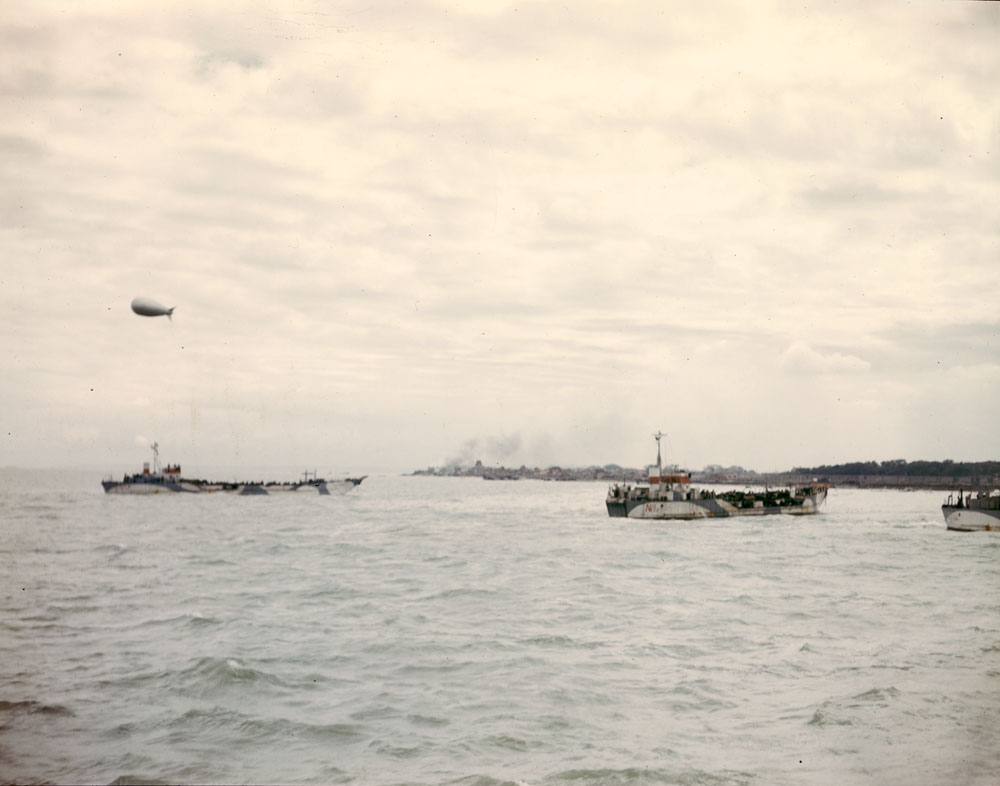
A rare colour photo of special Tank Landing Craft moving toward Juno Beach on D-Day. Patrol Sergeant H.L. Smuck came ashore aboard these ships (Library and Archives Canada)

While crossing the Straits of Dover, the Sambut encountered fire from German coastal batteries in the nearby French city of Calais, and at 12:15 p.m. she was hit in the side by 15-inch shells. Shrapnel tore into Courtney’s abdomen, and the fuel and trucks on deck around him were set ablaze, shortly followed by the explosion of an ammunition cache in the ship’s hold. In a chaotic scene, soldiers began throwing ammunition off the side of the ship, while secondary explosions sent shrapnel flying around them. (6) A British medical officer found Courtney and began dressing his wounds. Within 15 minutes, however, the order was given to abandon ship.

While thoughts surely flashed through Courtney’s mind of his wife Margaret and their peaceful home on Glendonwynne Road, he was helped to life rafts by his comrades. He then clung to the side of a crowded raft as long as he could, but the young Lance Sergeant succumbed to his wounds and slipped into the sea,(7) robbed of any chance to fight back.

Courtney was one of the hundreds of Canadians who died that day. He is commemorated on the Bayeux Memorial in France.

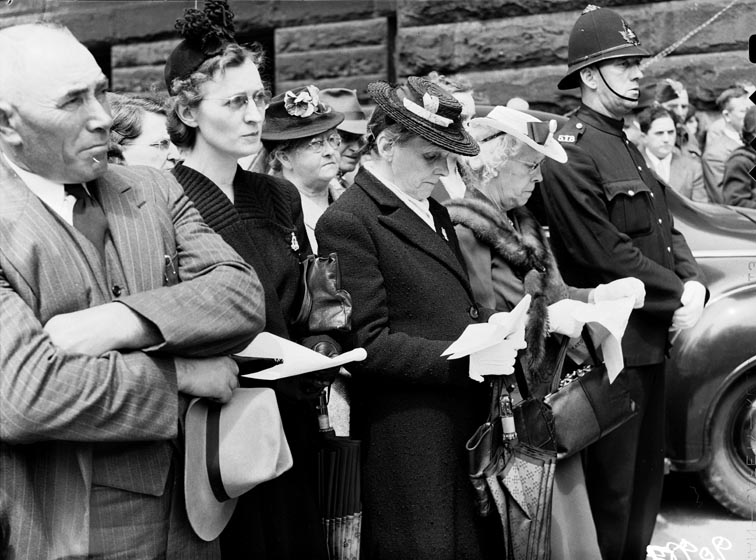
A Toronto Police constable stands with citizens during an impromptu D-Day prayer service at Old City Hall (City of Toronto Archives, Fonds 1266 Item 90982)

ON LAND

In the following days, the Allied soldiers established their toe-hold into occupied France and pushed out from the beaches, fighting through the towns, fields and hedgerows of Normandy. The weaker German coastal defence troops were being reinforced by crack tank divisions from further inland. 

Amidst the Canadian forces fighting their way inland was Harry Lee Smuck, a captain in the 6th Canadian Armoured Regiment (1st Hussars) – a tank unit. The 41-year-old was a Patrol Sergeant in the Toronto City Police Force, who joined back in 1926 and served at the Belmont Street and Claremont Street stations as well as the Mounted Unit. At 5’10 and ¾”, the fair-haired blue-eyed policeman was short compared to his colleagues in an age of height requirements on the force. (8)

To ‘do his bit’, Smuck enlisted in the 1st Hussars soon after the war broke out, and said goodbye to his wife Hettie, and children William and June. As a young man, Smuck had served seven years in the Canadian militia with the Royal Canadian Dragoons, another armoured outfit. Due to his police service and prior military service, he rose quickly through the ranks and was commissioned as an officer.

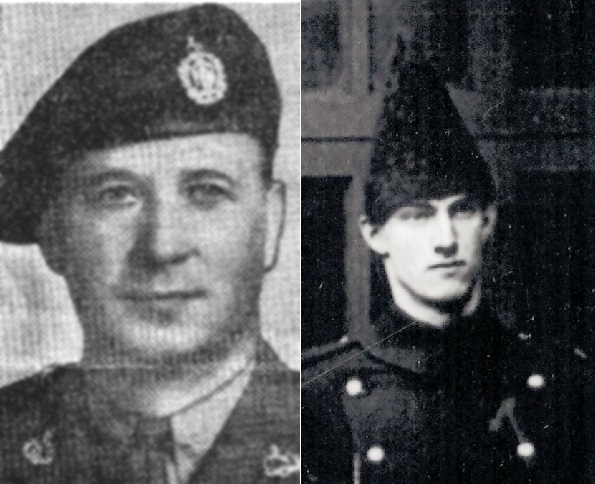
Patrol Sergeant Harry Lee Smuck, in military uniform (Canadian Virtual War Memorial), and Constable (#302) Clarence Verdun Courtney in winter dress (1938 Toronto Police Recruit Class Photo– Author’s Collection).

Harry Smuck and his troops had made the hellish assault on Juno Beach, in specially equipped Sherman tanks that could operate while partially submerged underwater. Landing near Courseulles-sur-Mer in the second wave of the attack, he and his “C” Squadron tanks put their 75mm cannons and machine-guns into action to the relief of the battered infantrymen on the shore. They fought hard breaking out from the beach, through intense street battles in town and into the fields beyond. (9) The 1st Hussars, through skilful deployment of tanks led in part by Smuck, were the only element of the entire Allied invasion force to meet their final D-Day objective. But there would be no time to rest.

After five days of fighting, Smuck received orders on the morning of June 11, 1944, that his tanks would support the Queen’s Own Rifles in an assault on German troops occupying the town of Le Mesnil-Patry. Unbeknownst to them, their radio codes had been captured some days earlier and the enemy was listening. When the attack set off in the afternoon, the Germans held their fire until the Canadians were halfway into the town. (10) The Hussars and Queen’s Own were suddenly met by tremendous machine-gun and mortar fire from a great number of troops lying in wait in the hedgerows, haystacks and buildings of the town. In response, Smuck’s tanks unleashed devastating fire (11)on the enemy and the survivors were beginning to flee. The tanks pressed on toward the village, where they found another trap waiting. As they approached, “B” Squadron started taking fire from 7.5cm anti-tank guns, which were knocking out the Canadian tanks. Then, powerful German Panzer IV tanks took the field and engaged them – the 2nd Battalion, 12th SS Panzer Division Hitlerjugend, a fanatical Nazi unit made up of experienced fighters and members of the Hitler Youth, was counter-attacking. A fierce tank battle ensued. Smuck and his ‘C’ Squadron tanks were ordered forward into a field of burning tanks,(12) and continued the fight.

Canadian tanks fighting in a Normandy field June 1944 (Library and Archives Canada MIKAN No. 3524524)

In the chaos that followed, the Canadians were ordered to withdraw. Of the over 50 tanks from the 1st Hussars that went into action, only 13 made it back. Many men were killed, wounded, or taken prisoner. Some, like Harry Smuck, were simply listed as missing. In the first six days of the Normandy campaign, over 1,000 Canadians would be killed, and over 2,000 wounded. (13)

IN the air

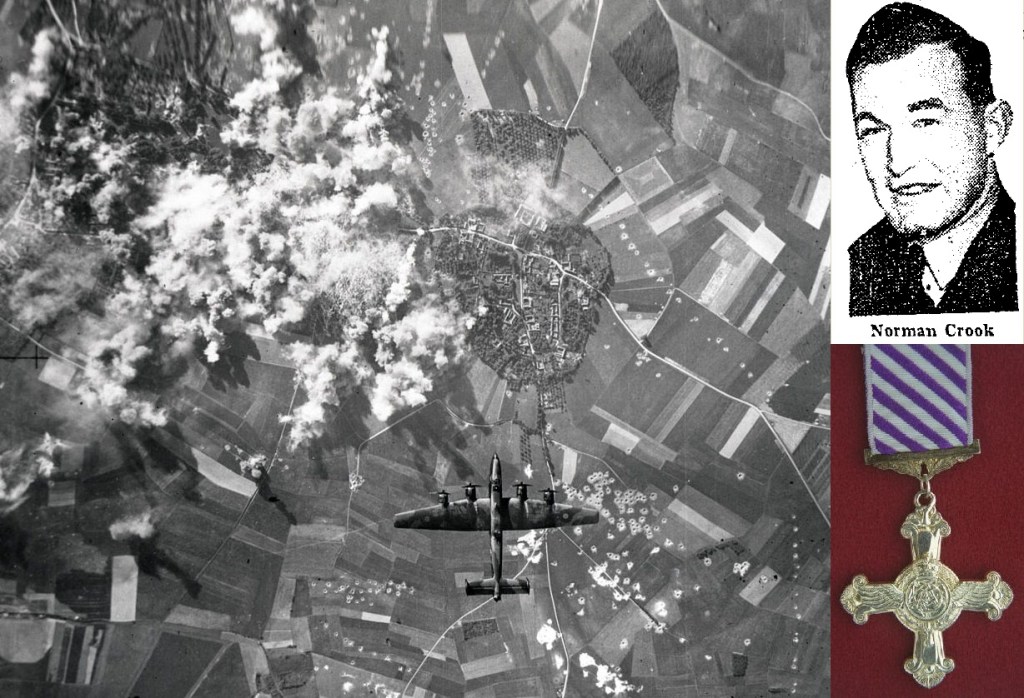
Pressing on the attack in the air was a motorcycle cop from East York,(14) Constable Norman Crook, flying with No. 433 “Porcupine” Squadron of the Royal Canadian Air Force. Crook joined the air force in the summer of 1942 and by D-Day, was a navigator on a Halifax bomber plane on an overnight mission to drop sea mines into the English Channel to protect the invasion fleet. 

After the Allies established a foothold in France, Crook’s squadron went to work bombing enemy troops, positions, railways and other infrastructure that could be used to send reinforcements against the Canadians.

One such mission took place on the night of June 28, 1944. Crook’s Halifax Bomber, tail number LV-839, took off on a bombing run to Metz, France, piloted by Hamilton McVeigh of Port Arthur, Ontario. En route to the fortified city, Crook and his crew suddenly encountered tracer fire coming out of the darkness – three German Ju-88 night fighters were attacking the slower bomber plane. After evading three waves of attacks from the fighter planes, the bomber was finally hit while flying in an evasive corkscrew manoeuvre. “The one shooting at us was just a decoy,” recounted Crook, “we were too busy watching him to see the guy behind. All of a sudden we got walloped. The first shell missed the rear gunner by inches and lopped off one of the rudders. Another shell went through the wing – then another, and finally one wing tip was chipped off.”(15)

The crippled aircraft, with its massive bomb load still on board, went into a tight spin at 13,000 feet in the air. The engines were failing and the pilot ordered the crew to bail out of the aircraft, which some started to do. Crook, however, made his way to the pilot, McVeigh, wanting to say goodbye to his friend before parachuting out. At that point he changed his mind and decided to stay on board – meanwhile McVeigh levelled off the aircraft at 6,000 feet. Crook, the plane’s navigator, set a course for England, to an alternate airfield with long dirt runways suitable for a crash landing. Two minutes after midnight, the aircraft made a hard 155-mph landing at Woodbridge, England, the remaining crew safe and their ordeal over. (16)

Crook’s action that night would later be recognized by the second highest award of bravery an airman could receive. His recommendation read, in part: “ …when attacking Metz his aircraft was attacked three times by fighters and was very severely damaged. So much so that two members of the crew abandoned on order of the Captain, and the aircraft lost 7,000 feet before control was regained. At that time the port outer engine cut so the bomb load was jettisoned and a course set for England. Pilot Officer Crook cooly and skilfully navigated his damaged aircraft back to a diversion base, avoiding the heavily defended areas en route, and a high-speed landing was made at an emergency landing field.” For this action and his overall flying record, he would receive the Distinguished Flying Cross.

Halifax bomber on a raid. (Library and Archive Canada MIKAN No. 4002568) Top Right: Toronto Daily Star newspaper photo of Constable Norman Crook (Toronto Public Library – Historical Newspaper Database). Bottom right: The Distinguished Flying Cross

towards freedom and justice

The fighting in Normandy, France would go on until the end of August 1944. It marked the turning point in the war and from there Canadians pushed on through Belgium, the Netherlands and finally into Germany. The Nazis would surrender unconditionally in May 1945, and the true extent of their evil deeds became known – concentration camps were discovered, liberated and their victims freed. Millions who had lived under oppression would start to rebuild. The rule of law was re-established and war criminals were put on trial.

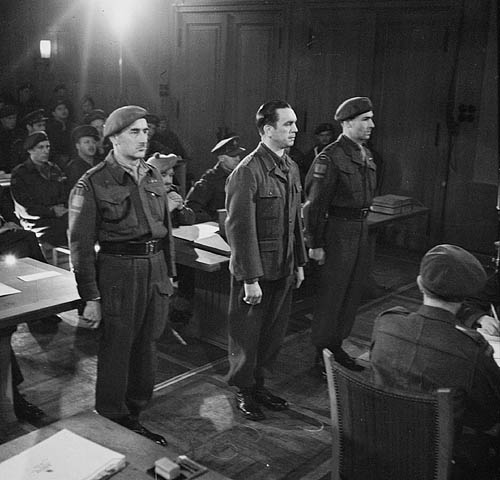
SS General Kurt Meyer on trial for war crimes in a Canadian military court. (Library and Archives Canada MIKAN No. 3191556)

One such war criminal was the Nazi General Kurt Meyer, who was tried by a Canadian War Crimes court. It was during these proceedings that the fate of Patrol Sergeant Harry Lee Smuck was discovered, thanks to the Canadian War Crimes Investigation Unit. During the battle for Le Mesnil-Patry, Smuck’s tank had been knocked out by enemy fire and he and his crew, some wounded, managed to bail out and make a break for their lines. They became separated in a firefight and Smuck and one of his men hid under another destroyed Canadian tank to re-group. 

Suddenly, the pair were swarmed by enemy troops and they decided to each make a run for it. Captain Smuck was captured and marched off to a secluded area with other Canadian prisoners of war, including some of his own tank crew, also captured in the chaotic battle. Once there, Smuck and the other men were lined up, callously shot, and buried in a shallow grave. (17) It was an unjust end for a brave man.

General Meyer was found guilty of ordering the killings, and other atrocities. Though sentenced to death, another unjust turn of events would see him only serve five years in a Canadian prison before returning to Germany, and ultimately being freed by 1954. Smuck’s remains were re-interred at the peaceful Ryes War Cemetery in Bazenville, France.

The sacrifices that many Toronto Police members made during the Normandy Campaign should never slip from our memory. On this 75th anniversary of the D-Day landings on June 6, 1944, let us pause to remember those who came before us and risked it all so that we could be free.

Sources and further reading:

(1) D. Draper. Annual Report of the Chief Constable of the City of Toronto for the Year 1939, Toronto: The Carswell Co Ltd City Printers, 1940.

(2) Toronto Daily Star 1940-09-14, p.15 “Policemen Join Up and Stick to Blue

(3) R.H. Gimblett. The Naval Service of Canada p.90-91; Toronto Daily Star 1942-01-10, p.9 “Many Toronto Men Helped Skeena Beat Off Wolk Pack”; Toronto Daily Star 1942-01-03, p.7 “PC Fred Davies, et al”; Toronto Daily Star 1942-01-03, p.3 “Says 20 U-Boats in Pack of Which Skeena Sinks 3

(4) Cobourghistory.ca/stories/hmcs-skeena; The Naval Service of Canada p.71-72

(5) Library and Archives Canada. Personnel File of B80413 Clarence Verdun Courtney.

(6) T. McCarthy. True Loyals – A history of 7th Battalion, The Loyal Regiment (North Lancashire) / 92nd (Loyals) Light Anti-Aircraft Regiment, Royal Artillery 1940-1946. Regimental History, Chapter 8: Disaster on the Sambut (Trueloyals.com/new-page-18)

(7) Library and Archives Canada. Personnel File of B80413 Clarence Verdun Courtney; Statement of Pte. J.S. Poulton, No 84 Coy, RCASC

(8) City of Toronto Archives. 1926 Nominal and Descriptive Roll of the Toronto Police Department.

(9) J. Marteinson & M.R. McNorgan. The Royal Canadian Armoured Corps – An Illustrated History. D-Day: The 1st Hussars and 7 Infantry Brigade. p.232-236.

(10) T. Copp. A Well Entrenched Enemy: Army Part 92 (Legion Magazine). Kanata: Canvet Publications Ltd, 2011.

(11) Library and Archives Canada. War Diary of the 6th Canadian Armoured Regiment(1H), June 1944.

(12) J. Marteinson & M.R. McNorgan. The Royal Canadian Armoured Corps – An Illustrated History. The Hussars at Le Mesnil-Patry. p.245-248.

(13) Veterans Affairs Canada – Normandy 1944 (veterans.gc.ca/eng/remembrance/history/second-world-war/normandy-1944)

(14) Toronto Daily Star 1944-11-28, p.13 “4 for a Fight, 3 for a Trip, Need 120 Points for Leave”

(15) Toronto Daily Star 1944-11-28, p.13 “4 for a Fight, 3 for a Trip, Need 120 Points for Leave”

(16) Collections Canada. Operations Record Book of No 433 Squadron RCAF – June 1944 Summary of Events, p.6

(17) H. Margolian. Conduct Unbecoming: The Story of the Murder of Canadian Prisoners of War in Normandy. Pages 111-115, 235-237. Toronto: University of Toronto Press, 1998.