The Line of Duty Death of Toronto Police Constable Charles Franklin Hainer MM
Researched and written by Matthew Scarlino, September 2024.

As an 18-year-old plumber from Niagara-on-the Lake, Ontario, Charles Franklin Hainer was one of the first men of his town to enlist in the Canadian Expeditionary Force at the outbreak of the First World War.
He would serve 26 months on the Western Front with the 9th Battery, Canadian Field Artillery – the military unit in which horses and men from the Toronto Police Mounted Unit had served during the war. With them he was twice wounded at Ypres.
In April 1916, both of his legs were fractured by the blast of an enemy shell. He never lost consciousness and his description of being carried off amid bursting shells, of being dropped many times by his bearers as they rolled into holes for safety, then the arrival at an aid station only to find it shelled out, was a vivid portrayal of what was endured.
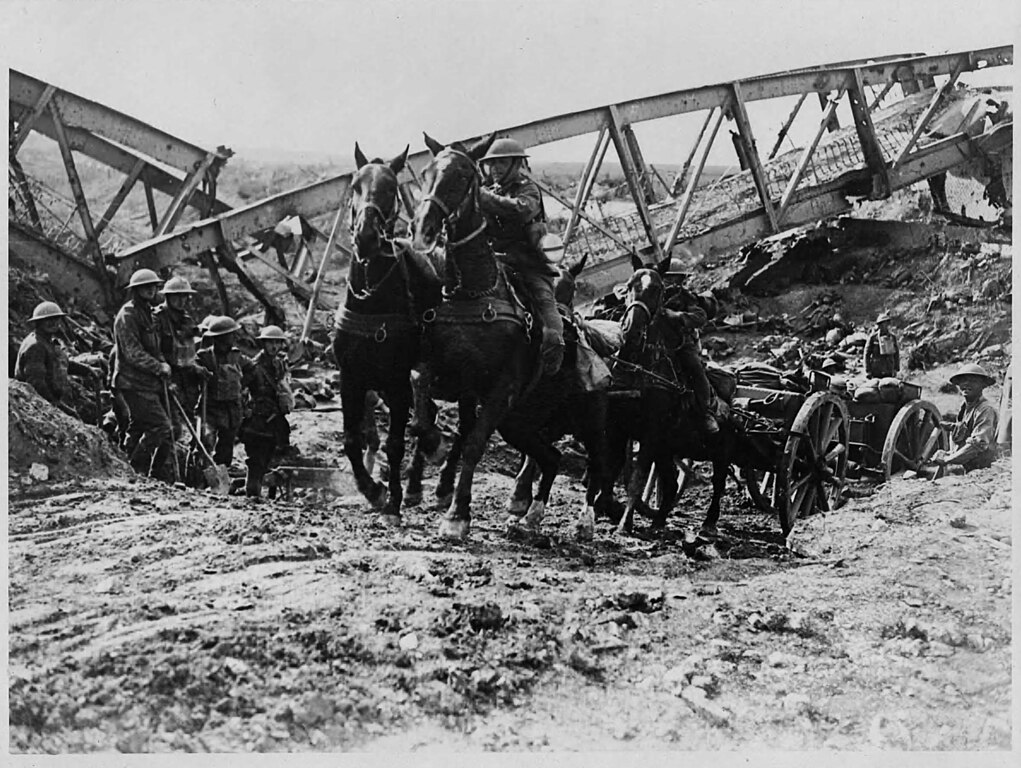
Wounded again the following year at Passchendaele it was “nothing much this time,” he said, “only the jaw fractured, shrapnel in the face and arm.”
“He was with me over there, I am glad to have you. If you are half as good a rider as your brother, you are all right. Hainer was a good man and when anything was to be done, he was the first man to volunteer.”
– Unknown Recruiting Sergeant, to Charles’ brother Harvey in 1916.
After recovering in Hospital in England, he was denied a request to return to France, so instead volunteered for a secretive mission to North Russia, where Allied forces sailed to secure a large stockpile of military equipment previously donated to Imperial Russian forces, once an ally to the Western Powers. The mission was hatched to prevent the equipment from falling into Bolshevik hands in the aftermath of the Russian Revolution. In the 9 months of fighting Hainer again distinguished himself there, so much so that the Provisional Governor decorated him with the Russian St George’s Medal “in recognition of your gallant conduct in the field when fighting with the enemies of Russia.”
He would also be decorated with the Military Medal through his own chain of command, “For Bravery in the Field” in both campaigns he fought in.
“Charles Hainer was very brave, brave almost to a fault. He was a fine fellow, quiet but ready always to do his share.”
– Captain Charles Bell
After returning to Canada, Hainer applied to the Toronto Police Force and was sworn in as Police Constable 457 on November 16th, 1920. No doubt influenced by his time in the 9th Battery, Hainer joined the Toronto Police Mounted Unit, and was reunited with fellow veterans of the 9th, Charles Chalkin and Ernest Masters. The skilled horseman would serve many years there.

By the early 1930’s, the combat veteran sought a new adventure. He traded in his trusty steed for an iron horse, and joined the adrenaline-filled world of the Toronto Police Motorcycle Squad. In these early days of motor transport, roads were chaotic and traffic fatalities were rising high. The early motor squad was responsible for enforcing traffic laws and apprehending criminals. They were agile, travelled at high speeds, and required hypervigilance and split-second decision-making skills in this era before riding helmets and safety equipment.
Hainer and his new squad were based out of the Toronto Police Central Garage in what is today Liberty Village. The area had already been a bustling industrial hub, which after the outbreak of another World War in 1939 only intensified in scale.
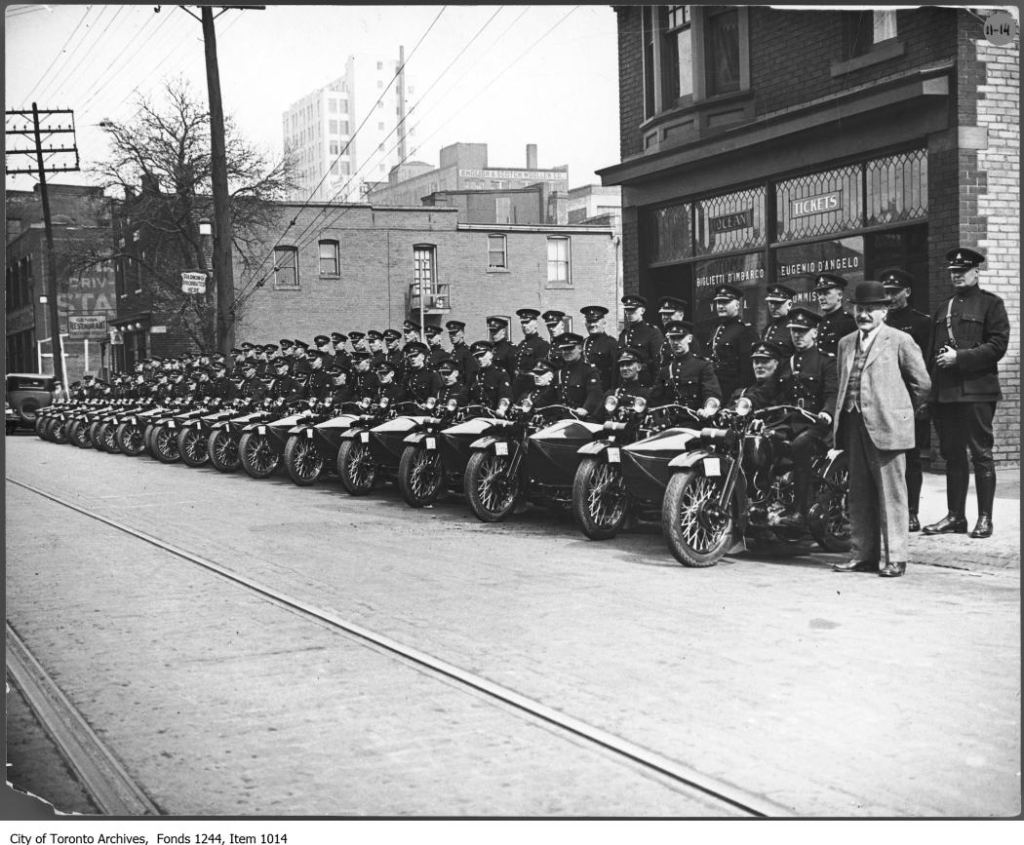
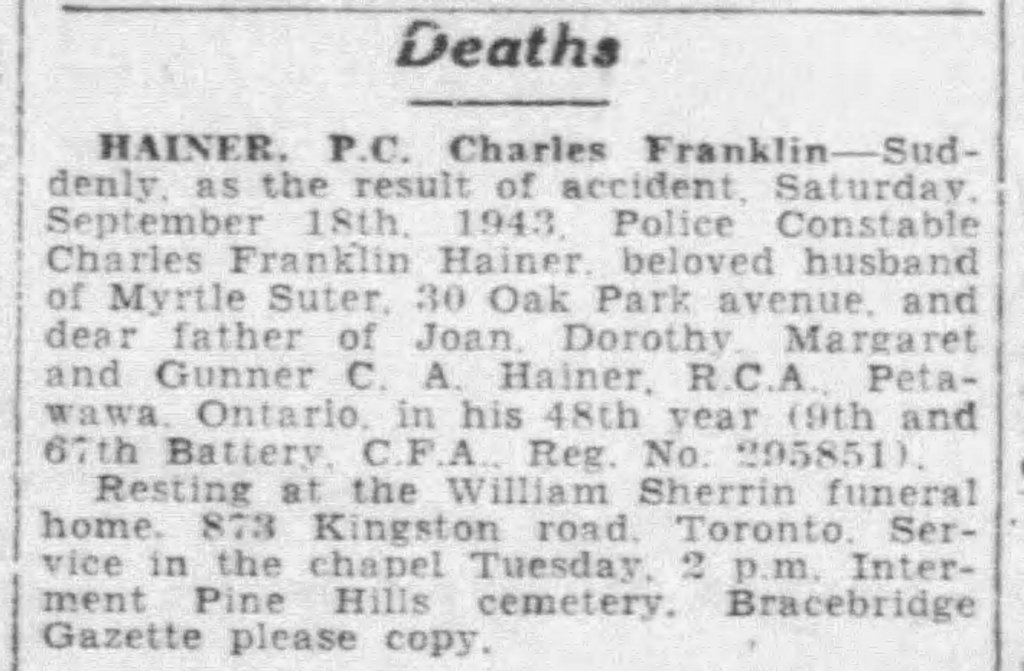
One Saturday evening, on September 18th, 1943, Hainer was riding his motorcycle down Fleet Street heading back to Central Garage. His shift was ending, and he would soon be going home to his wife Myrtle and their three daughters (a son, Albert, was away serving with the Royal Canadian Artillery). Hainer noticed his engine needed adjustment. He leaned forward to tune it but lost control. In an instant, his handlebar caught the door of a passing automobile and Hainer was violently thrown into the side of the vehicle and onto the road. Responding officers were horrified to find Hainer’s jugular vein severed, his leg and arm broken.
Despite their best efforts, Charles Franklin Hainer was pronounced dead on arrival to Toronto General Hospital.
He lies in peace at Pine Hills Cemetery, Toronto.
Sources:
- S. Dickson. Annual Report of the Chief Constable of the City of Toronto for 1922: Nominal and Descriptive Roll of the Toronto Police Force, Page 75. The Carswell Co. Ltd, Toronto, 1923.
- B. Wardle – The Mounted Squad : An Illustrated History of the Toronto Mounted Police 1886-2000, Page 83.
- C. Creed. The Niagara Historical Society, No. 34: “Whose Debtors We Are.” – “GUNNER CHARLES FRANKLIN HAINER, M.M. (No. 42691)”. The Advance Office, Niagara, 1923.
- Library and Archives Canada – Personnel Records of the First World War. Service File of No. 42691 Charles Franklin Hainer.
- The Globe. 1934, Aug. 6th, Page 4: “Scenes as Seventy Thousand Canadian Veterans Passed in Review”.
- Toronto Daily Star. 1943, Sept. 20th, Page 3: “Two Deaths Over Weekend Bring Traffic Toll to 58”.
- Toronto Daily Star. 1943, Sept. 21st, Page 13: “Comrades On Force Act as Pallbearers”.
- Toronto Daily Star. 1943, Sept. 21st, Page 24: “Deaths”.
 The Khaki and Blue Project