An Everlasting Bond: The Birth of the Toronto Police War Veterans Association.

Written and Researched by Matthew Scarlino. Toronto, 2021. Revised 2022.

It was on the evening of a mild September 14th, many years ago, that a group of Toronto police officers who had returned from the Great War met downtown at the County Orange Building. That social club, better known as Orange Hall or the Victoria Hall, was already the meeting place of the newly formed Toronto Police Association. Now the site of a drab grey office tower, the red-bricked hall was situated on the southwest corner of Queen Street East at Berti Street, opposite the Metropolitan Church, and just down the street from the old No. 1 (Court St) Police Station.
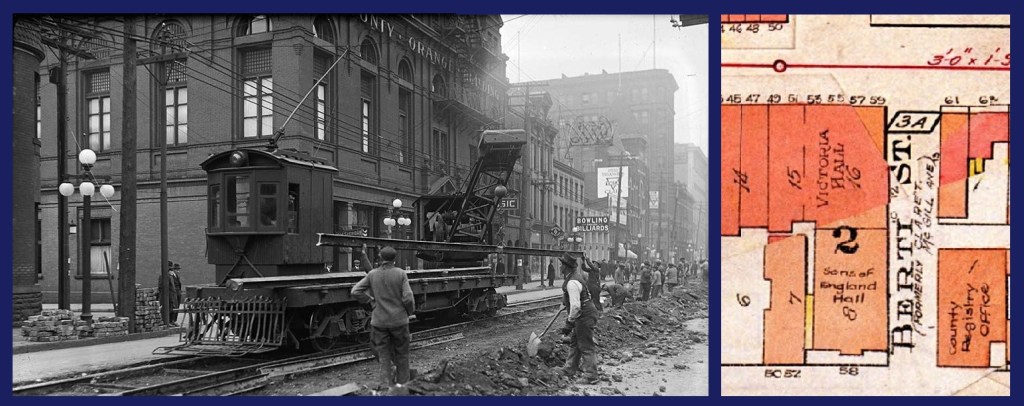
The Orange Hall, seen behind these workers, was the birthplace of the Toronto Police War Veterans Association.
[City of Toronto Archives Fonds 1231, Item 426; Goad’s Fire Insurance Plan 1924].

These police war veterans met to form an association similar to that of the pre-eminent Great War Veterans Association, the largest such veterans association at the time. Formed in 1917 while the war was still ongoing, the influential “GWVA” was held in high esteem by returned men. Therefore, during the policemen’s meeting one imagines these men adapted their aims similar to those of the GWVA.

  • To preserve the memory of those policemen who suffered and died in war for the nation and the empire; to erect and preserve monuments to their valour and sacrifice; and to establish annual memorial services.
  • To ensure proper care for their fellow police war veterans, their widows and families, and other returned soldiers, facing ill-heath, financial difficulties, or other hardships.
  • To promote pride and loyalty to Canada and the Empire and service in their interests.

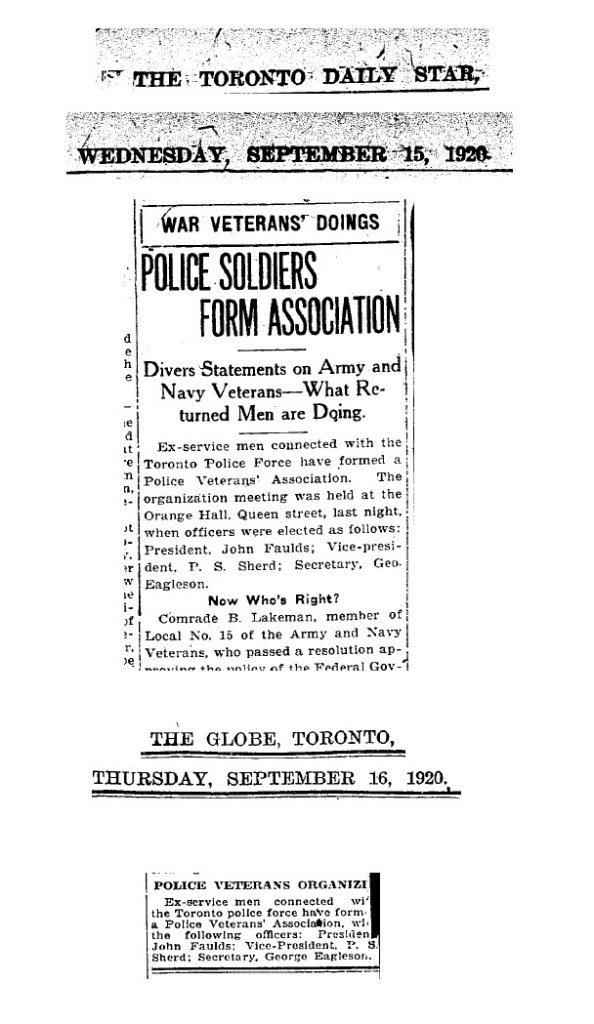
With the objectives settled, the men voted to elect its first officers. The Toronto Daily Star reported the following day:

Police Soldiers Form Association
Ex-service men connected with the Toronto Police Force have formed a Police Veterans’ Association. The organization meeting was held at the Orange Hall, Queen street, last night, when officers were elected as follows: President, John Faulds; Vice-President. P. S. Sherd [sic]; Secretary. Geo. Eagleson.

Toronto Daily Star

Elected President was Constable John Faulds, a Scot, 6’2, fair skinned with brown hair, blue eyes, and with a tattoo of a woman’s bust on his wrist. He had previously been a police officer in the United Kingdom, and a soldier in the British Army’s 3rd Battalion, Argyll & Sutherland Highlanders. Faulds emigrated to Canada and joined the Toronto Police Force in 1913, assigned to the rough and tumble old No. 4 (Wilton St) Station in Cabbagetown. Later, at 28 years old and married with a 9 month old son, he answered the call to arms and enlisted in Toronto’s 34th Battery, Canadian Field Artillery. Known as the “Aquatic Battery”, it was primarily comprised of men who were also members of the Toronto Canoe Club, the Toronto Rowing Club or the Balmy Beach Canoe Club. Training on 18-pounder guns, the natural leader quickly rose to the rank of Sergeant. He arrived in France in July 1916 as part of the 9th Brigade Canadian Field Artillery, before participating in the Somme offensive. Shortly after arriving at the front, was promoted to Warrant Officer I and appointed Regimental Sergeant-Major. He would lead his men in Canada’s major battles until December 1917 when he was awarded a temporary commission and sent to Witley Camp in England to train recruits. His friend Constable Pover wrote in a
letter to the Star that his commission was due to his bravery in the field. He returned to France in September 1918 as RSM of the 9th Brigade Artillery to fight in the final offensives of the war.

Patrol Sergeant Samuel “Tommy” Third was elected Vice President. Another tall Scotsman standing 6’2, with black hair and blue eyes. Third had been a Toronto Police constable since 1907, and was 33 years old, married and with a 10 year old son when he enlisted in the 180th (Sportsmen) Battalion, Canadian Expeditionary Force in January 1916. The unit was made up of local amateur athletes and was the choice of many TPF officers who joined the army. Third was admitted into the unit despite the medical officer’s note about a previous hernia operation and hammer toes – both ailments related to his police service. In October 1916, during “PT” (physical training) Third seriously re-aggravated his hernia, and had to be fitted with a truss, while his foot problems also worsened. Despite this, Third sailed overseas to England with his unit in November 1916, and was promoted to Sergeant due to his leadership abilities. However, his medical status saw him removed from the drafts headed to France, and he was instead posted to the 3rd Reserve Battalion (Central Ontario) at West Sandling, England in January 1917. There and for the remainder of the war, he engaged in the rigorous training of infantry soldiers destined for the front, despite his painful ailments.

Constable George Eagleson was elected Secretary. Hailing from Belfast, Ireland, Eagleson was freshfaced, tall and slim with grey eyes and had light brown hair. Eagleson joined the Toronto Police barely 20 years old, in the fall of 1914. Prior to becoming a police officer, he served in the Saskatchewan Light Horse and the Mississauga Horse of the Canadian Militia. On 13 January 1916, Eagleson enlisted with the 169th Battalion (109th Regiment), Canadian Expeditionary Force. Eagleson was quickly made acting Sergeant for the duration of their training in Canada, and sailed to England in November 1916 for further preparation. Eagleson landed in France in August 1917 days before the Battle of Hill 70, as a replacement in the 116th Battalion (Ontario County), a unit with ten former Toronto constables under their colours. Just prior to the Battle of Passchendaele, Eagleson was promoted to Corporal and later, during the Hundred Days’ Offensive was promoted to Sergeant. In October 1918, Eagleson was appointed Company Sergeant-Major during the final push.
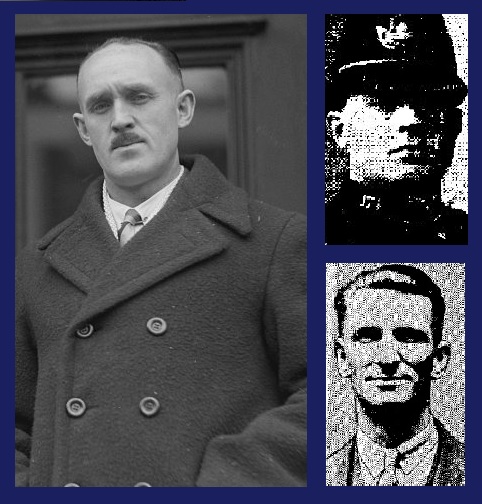
The First Executive: tough and proven leaders. President John Faulds (left), Vice President Samuel Third (top right), Secretary George Eagleson (bottom right).
[City of Toronto Archives, Fonds 1266 Item 6818; Toronto Daily Star 2 Feb 1916; Toronto Daily Star 26 Mar 1927]

With its aims and objectives settled and its officers elected, the precursor to today’s Toronto Police Military Veterans Association was born. Forgotten over generations, the meeting in that bygone hall actually took place on September 14th, 1920 – two years earlier than it has long been believed to have occurred. The newly formed Toronto Police War Veterans Association (TPWVA) wasted no time in one of its first orders of business – the erection of a monument to the service and sacrifice of members of the Toronto Police Force in the Great War.

On October 23rd, 1920, five weeks after the Association’s creation, page 9 of The Globe newspaper announced that “members of the Toronto Police Veterans’ Association have purchased a brass tablet containing the names of members of the force who enlisted, and of those killed in action during the war. The tablet will be placed in the City Hall.” Permission for this was granted shortly after Armistice Day 1920, when on November 15th the Civic Property Commission authorized the monument in the portion of City Hall (now Old City Hall) which contained the police headquarters – which occupied the Ground Floor, facing north to Albert Street, from the midsection of the building over to James Street. The next step would be to unveil the monument under suitable and dignified circumstances.

On Friday, January 21st, 1921, the first Toronto Police war memorial service took place, another aim of the TPWVA quickly achieved. It was held under partnership with the Toronto Police Amateur Athletic Association, known as the “T – P – triple A”, the senior-most association in the force. The ceremony was held in the Council Chamber of the City Hall. The Council Chamber was “crowded with relatives and friends of the men whose names were on the tablet” and also had in its audience Toronto’s Mayor Tommy Church, the Reverend Canon Dixon, and several prominent judges. The focus was on the new memorial tablet, which was set up on the Mayor’s dais, surrounded by silken flags, potted ferns and plants. Deputy Chief L.R. Geddes, President of the TPAAA, began the proceedings with a speech acknowledging this “most solemn hour” in the history of the force. The tablet was then unveiled by none other than Col. George Taylor Denison III, the renowned Victorian Age cavalry officer, and one of the most important figures in Toronto’s military history. Denison was the Police Magistrate for the Police Court at City Hall and a member of the Board of Police Commissioners. He remarked his pleasure that a permanent memorial would record the names of the Toronto Police Force’s war dead for all time, and compared the importance of the occasion to the unveiling of Brock’s Monument at Queenston Heights. Of the TPWVA, he said they acquitted themselves heroically and noted many of them had received honours and decorations. More speeches, prayers and song followed. Police Chief Samuel Dickson then spoke describing the men named on the tablet as “splendid men, every one of them,” whom he all knew personally. Deputy Chief Geddes then read aloud the names on the tablet listed under the heading “Our Gallant Dead”, before Last Post was sounded – a tradition that still holds today.
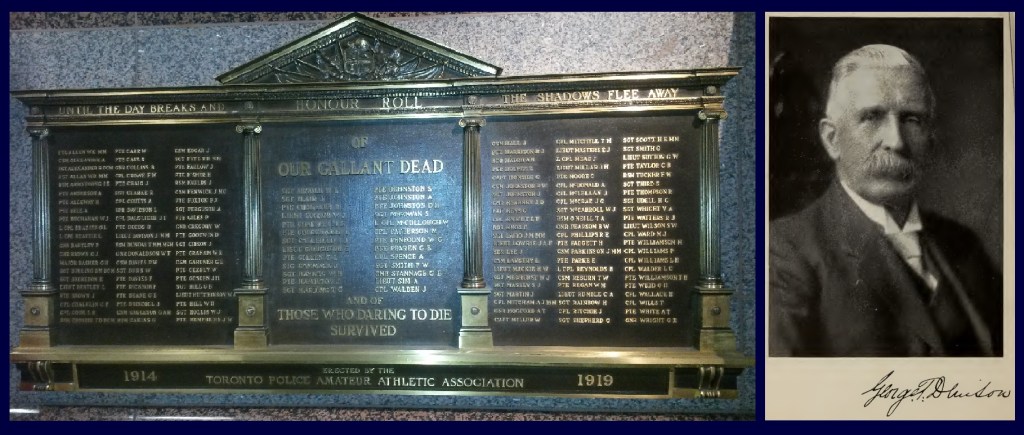
The Memorial Tablet today, in the Grenville Lobby of Toronto Police Headquarters, 40 College Street (left) and the man who unveiled it, Col. George Taylor Denison III (right).
[Toronto Police First World War Memorial Tablet, Author’s Photograph; 1920 Portrait of G.T. Denison – Recollections of a Police Magistrate, The Musson Book Co. Ltd.]

With its aims of a monument and memorial services completed, the Association moved to cement its camaraderie. Two months after the first memorial service, at a meeting of the Board of Police Commissioners held on Wednesday, March 23rd, 1921, the TPWVA was granted permission to hold their first “at-home” (a 1920’s term for a party), to take place the following month. On the evening of Thursday, April 21st, the Association’s soirée took place at Oddfellow’s Hall. A “splendid crowd” enjoyed a night of dance, cocktails, and euchre, held in the adapted Gothic Revival style building, which still stands on the northwest corner of Yonge and College Streets. Perhaps the April timing of the social had some significance. In the coming decade, the TPWVA would host a yearly “Vimy Night” every April which drew large numbers and prominent guests at elaborate ballrooms in the city. These events became a major source of income for the Association’s charitable donations and even war-time fundraising. More recently, the Vimy anniversary has been the setting for mess dinners of the modern Toronto Police Military Veterans Association.
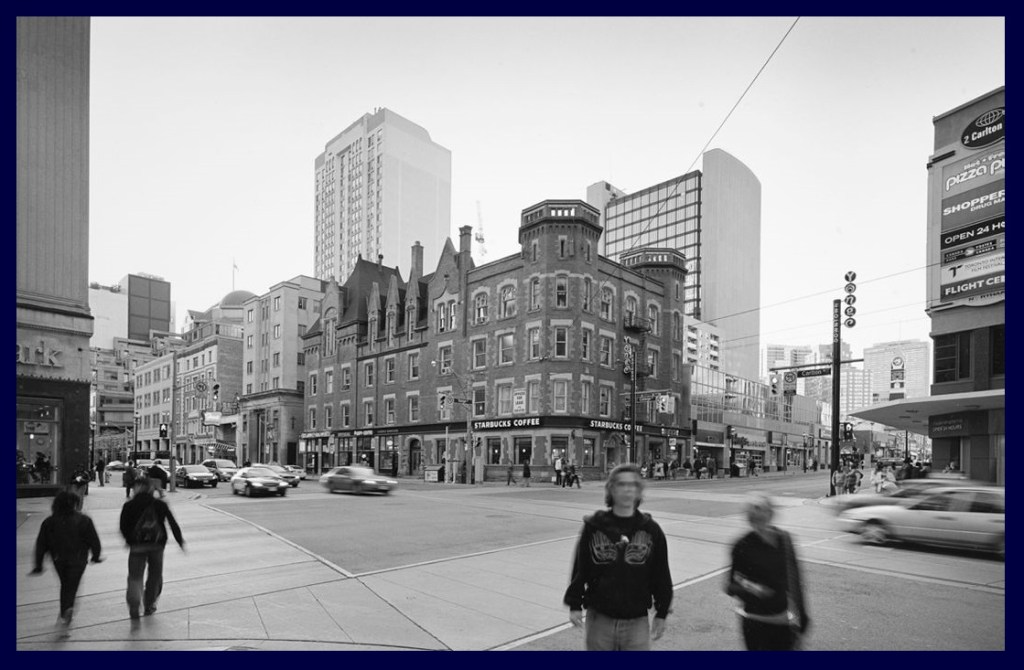
Oddfellows Hall, pictured here in 2008, is the site of the first TPWVA social, steps from the current
Toronto Police Headquarters.
[City of Toronto Archives, Fonds 1581, Series 2196, Item 26]

It is clear now that September 1920 to April 1921 saw the formation of the Toronto Police War Veterans Association and its traditions. Those events – the formation of the association, the election of an executive, the first memorial service, and the first social affair – forged an everlasting bond, to each other and to the fallen, which would last over a hundred years. The centenary is a significant achievement, and marks the Association as one of the oldest continuously serving veterans groups in all of Canada – senior even to the country’s most prominent veterans group, The Royal Canadian Legion (1925). It also marks the Toronto Police Military Veterans Association as the most resilient of City of Toronto’s municipal veterans associations in Toronto, many of which are now defunct – such as the Civic Employees War Veterans Association, the Toronto Board of Education War Veterans Association, the TTC Returned Men, and the Toronto Hydro-Electric System War Veterans Association.

Though the establishment date of the Association had long been obscured, and the actual centenary passed, the global COVID-19 pandemic would have made appropriate celebrations impossible. Therefore, official celebrations of the Centennial Anniversary of the Toronto Police Military Veterans Association continued to be scheduled for 2022.

Centennial Celebrations

In 2022, several letters of congratulation were received by the Toronto Police Military Veterans Association, including those from Chief of Police James Ramer, Mayor of Toronto John Tory, Lieutenant Governor of Ontario Elizabeth Dowdeswell and Governor General of Canada Mary Simon.

On August 20th 2022, the Association marched in its first parade since its centennial, fittingly at the centennial Warrior’s Day Parade. The TPMVA won the Goodyear Remembrance Trophy for best marching formation (with 16 or more members).

On September 14th 2022, an Anniversary Barbecue took place marking the birthday of the Association.

The biggest undertaking was the “MVA22” pilgrimage to the battlefields and war cemeteries of Europe. A delegation of the Toronto Police Military Veterans Association visited thirty-six gravesites spread over six countries and thousands of kilometres. A small Act of Remembrance service was performed at each site and embodied the Toronto Police Military Veterans Associations core values of Service and Remembrance.

MVA22 Delegation at the Canadian National Vimy Memorial (Photo: John Lo Bianco)
Sources and Further Reading:
  • Toronto Daily Star. 1920, Sept. 15th, Page 5: “War Veterans Doings – Police Soldiers Form Association”
  • The Globe. 1920, Sept. 16th, Page 9: “Police Veterans Organize”
  • City of Toronto Archives. James Salmon Collection – Fonds 1231 Item 0426: “April 29 1917 Car Track Reconstruction at Bond Street”
  • City of Toronto Archives – Fire Insurance Plans. “Goad’s Fire Insurance Map – Toronto 1924”.
  • The Great War Veterans’ Association of Canada. Constitutions and By-Laws. Ottawa, 1917.
  • Library and Archives Canada – Personnel Records of the First World War. Service Files of No. 300742 John Faulds; No. 862015 Samuel Third; No. 679253 George Alexander Rennicks Eagleson.
  • The Globe. 1920, Oct. 23rd, Page 9: “Police to Remember Those Fallen in War”
  • Toronto Daily Star. 1920, Nov. 15th, Page 2. “Honor Police Who Fell”
  • The Globe. 1921, Jan. 22nd, Page 21. “Inscribe Names on Honor Roll”
  • Toronto Daily Star. 1921, Jan. 22nd, Page 3. “Police Honor Dead Comrades in Arms”
  • Denison, George T. Recollections of a Police Magistrate. The Musson Book Co. Ltd. Toronto, 1920.
  • The Globe. 1921, Mar. 24th, Page 6. “Board Suspends Four Interpreters”
  • Toronto Daily Star. 1921, Apr. 22nd, Page 30. “Local Briefs – Police Hold Dance”
  • City of Toronto Archives. Peter MacCallum Collection. Fonds 1581, Series 2196, Item 26: “Looking north-west at College Street” 2008.
  • The Globe. 1935, Apr. 10, Page 11. “Celebrate Quarter Century on Police force on ‘Vimy Night’”
Coppers and Gunners

The links between Toronto Police and Toronto Artillery

Note: The following is a prepared speech from Matthew Scarlino, Historian – Toronto Police Military Veterans Association on occasion of a charitable donation to the Toronto Artillery Foundation, 9 May 2022. Unfortunately, a COVID-19 infection kept the author from delivering the speech, though it was ably presented by Lt. Col. (Ret’d) Dana Gidlow, CD.

Good evening distinguished guests, Ladies and Gentlemen.

The intertwined history of the Toronto Artillery and the Toronto Police is a rich one. Forged over a century, including two world wars, other conflicts and domestic service, our two organizations have shared members and values for a long time.

I’m going to speak to our closeness by looking at our service in conflict and key individuals that unite our organizations and our associations.

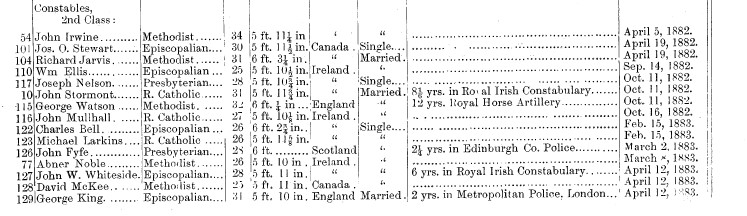
Gunners have served in the Toronto Police from the earliest days. A look at our Nominal Roll from 1886 shows that our Deputy Chief, William Stewart, was himself an artillery veteran. As for the regular beat constables, the nominal rolls simply marked prior military service as being with the “Canadian Volunteers”. Undoubtedly, there were gunners among them.

PC George Watson, late The Royal Horse Artillery, listed on the 1886 Nominal Roll.

One key figure was Constable George Watson, who had served twelve years in the Royal Horse Artillery. PC Watson was an important figure in the foundation of the Toronto Police Mounted Unit, that same year. Selected for his police talents and his expertise riding the tough draft horses of the RHA, he was promoted to Sergeant and was instrumental in the early success of the Mounted Unit, which continues to serve the citizens of Toronto to this day.

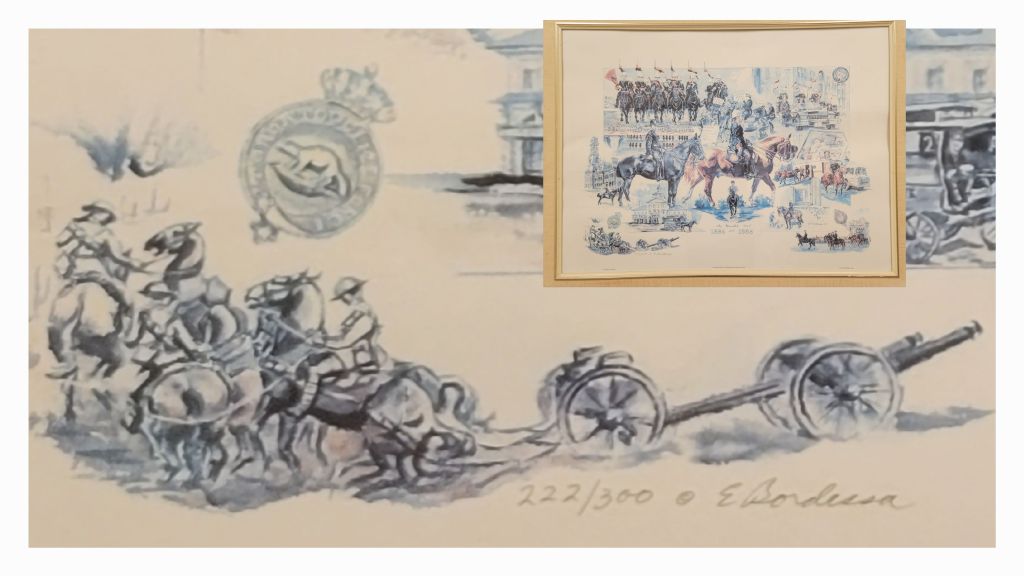
It was during the First War that our two organizations really forged their bonds. The guns still being horse-driven, four mounted policemen joined Toronto’s 9th Battery when the war broke out in the autumn of 1914. They escorted the police force’s donation of 19 police horses to the Battery.

Of our men in 9 Battery, there was:

Constable Thomas Hugh Dundas, atop police horse Bunny, who rose to the rank of Battery Sergeant-Major. He would be wounded repeatedly and was the most decorated Toronto Police officer serving in the First World War. He won the Military Medal, the Meritorious Service Medal, and was Mentioned-in-Despatches.

Constable Ernest Masters, was commissioned from the ranks due to bravery in the field.

And Constable Charlie Chalkin, atop police-horse Mischief, served in the battery until halfway through the war, when he served as a Mounted military policeman patrolling the streets of France, no doubt keeping gunners out of trouble.

Constable William Connor, atop police-horse Charlie, served in the battery until being commissioned from the ranks. As a “FOO” [Forward Observation Officer], he was wounded severely by a trench mortar while directing fire onto the enemy in the Ypres Salient. He was evacuated and died shortly afterwards.

Of the 19 police mounts in the Battery, St Patrick, or “Paddy” was among the first to fall, killed in action during the fierce fighting at St Julien in 1915. Mistake and Juryman, Vanguard and Crusader and thirteen others would perish by war’s end. The only horse to survive the war was Bunny. A popular letter-writing campaign erupted in Toronto for the safe return of Bunny – but since Bunny wasn’t an officer’s mount he was sold off with the others to Belgian farmers rebuilding their country.

Police Mounts on the Western Front with the 9th Battery, CFA, from the painting Toronto Police Mounted Unit 1886-1986 (inset) by Eileen Bordessa.

Aside from the 9th Battery, 44 Toronto police officers served in various Artillery units, including subsequent Toronto batteries, and as far afield as the British Army. This number constitutes 28% of the Toronto Police contribution in the First World War. Three of these gunners made the ultimate sacrifice and many more were wounded. For Gallantry, they accounted for one Distinguished Conduct Medal, Two Military Medals, a Meritorious Service Medal and Mention in Despatches.

It was shortly after the war that Constable John Faulds, who had served as a gunner in France, was elected first President of the Toronto Police War Veterans Association. Faulds served with Toronto’s 34th Battery. It was known as the “Aquatic Battery” as membership was made up of members of the Toronto Argonaut Club, The Toronto Canoe Club or the Balmy Beach Club. Faulds had risen to the rank of Regimental Sergeant-Major of the the 9th Brigade Canadian Field Artillery. He was awarded a temporary commission that the Toronto Daily Star reported was for bravery in the field.

This gunner, John Faulds was instrumental in founding of our association, in the summer of 1920. He was instrumental in the erection of our memorial tablets at police headquarters; the creation of our annual memorial service; and the establishment of our yearly socials.

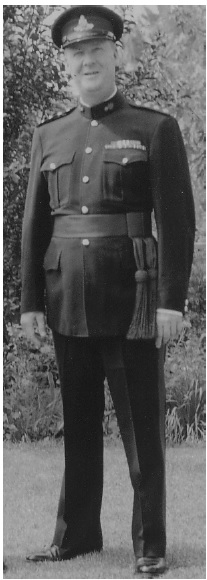
John Faulds (right), former RSM of 9th Brigade, Canadian Field Artillery and first President of the Toronto Police War Veterans Association.
City of Toronto Archives Fonds 1266, Item 6818.

During the interwar period policemen who had served as gunners swelled the ranks of our association, and many were members of the Toronto Artillery associations in existence at that time. Men such as Charles Hainer MM who would later die in the line of duty while serving in the Motorcycle Squad.

Unfortunately for a historian, personnel records of the Second World War remain largely private and undigitized, so our records from that time are less detailed. Our contribution to the Artillery this time would be smaller, with many policemen joining the Air Force and Navy unlike in the last war.

At least 10 of our officers are known to have served in the Royal Canadian Artillery. It was a small but solid contingent where half held leadership positions – with a Captain, two Battery Sergeants-Major, and two Sergeants among them.

While their exact contributions during the war still largely unknown, they would serve the city with distinction after the war.

One gunner, Constable Roy Soplet, led a daring rescue during the SS Noronic disaster. In 1949, the pleasure cruise burst into flames overnight in Toronto Harbour with 524 souls on board. Soplet was one of the first officers on scene and without hesitation jumped into the lake and rescued countless panicked swimmers in the darkness. While over a hundred people died in the disaster, not a single one was lost to drowning thanks to Soplet and a few other rescuers.

“Noronic Burns”. City of Toronto Archives Fonds 1244, Item 1518.

Another gunner, Constable David Cowan, was celebrated in newspapers for a daring fire rescue in February 1951. Cowan came upon a building engulfed in flames and charged into the upper floor apartments kicking in doors and rescued an elderly woman. When reaching the street with her, he was overcome by smoke and collapsed, spraining the poor woman’s ankle after saving her life.

Later that year, former Battery-Sergeant Major and Acting Patrol Sergeant Joseph Battersby, would be killed in the line of duty. The survivor of two world wars died while trying to secure a downed hydro wire scene.

The soldiers of 7th Toronto Regiment, additionally tasked with Light Urban Search and Rescue, would do well to remember these men.

Postwar, many gunners again joined the ranks of the Toronto Police, including two big personalities that would be active in the Toronto Police War Veterans and Toronto Artillery Associations.

Captain Francis Burtram “Bert” Saul CD was one such character. He was a veteran of the Royal Artillery and the Royal Canadian Artillery. He survived the Dunkirk evacuation, and was wounded during the Normandy Campaign. Starting as a police officer in Forest Hill after the war, he retired as the Staff Inspector of Metro Toronto Police’s Internal Affairs Unit. Bert had also continued service in the militia and was known as the no-nonsense RSM of 42nd Medium Regiment. He was firm, but fair, with a unique sense of humour. He used that experience while drilling cadets at the Police College as a Staff Sergeant in the 1960’s. One now-retired member can still remember a dressing down he got from Saul on the parade square. “Craine!” he barked, “You will be s*** upon from a great height … with incredible accuracy!”

Captain Burtram Francis “Bert” Saul, CD.
RCAA Annual Report 2001.

Bert was a founding member of the Toronto Artillery Ex-Sergeants Association and an active member of the Toronto Police War Veterans, who often led our Warrior’s Day Parade contingent. Bert passed in 2001.

Also active in both of our organizations at this time was John Bremner. John served in the Korean War driving ammunition for the guns. After the war he joined the North York Police and was later amalgamated into Metro Toronto Police where he rose to the rank of Staff Sergeant at downtown’s 52 Division. John was involved with the Toronto Artillery Ex-Sergeants association and a was a key member of the Limber Gunners, where he drove his beloved FAT (or Field Artillery Tractor). John passed in 2016.

Bringing us to today, we have in our organizations Dieter Lorenz, who served with the guns in Germany during the Cold War – or should I say the “First” Cold War? Also among us is young officer Kelvin Chu who represents the next generation of police gunners.

I’m now going to close with an excerpt from a letter written by Constable Hugh Banks, a fellow mounted officer who was serving with the 53rd Battery, RCA in England in that tense summer of 1940.

… I gave up my position to enlist and was finally sent overseas. I left behind my wife and three children. While overseas I received the sad intelligence that my wife had died. I shall never forget as long as I live the kindness bestowed to me by the Officer Commanding and the Chaplain of my unit.

Captain Rae McCleary, the chaplain, has linked himself to me for life by his great understanding sympathy. When he told the lads of my battery of my loss, a movement was started among the troops to raise money to send to Canada for the erection of a headstone on my wife’s grave […] and the stone was carved as directed by a veteran of the last war.

When it appeared that the right thing for me to do was to come home on compassionate grounds to my motherless children, I was eventually paraded before Major-General Victor Odlum. He extended to me a very manly sympathy. His words of counsel and advice I shall never forget. He told me to sit down for a moment or two; he turned to his desk and taking his pen, began to write. In a moment or two he came toward me, evidently touched by my great sorrow, and said, “you will have extra expense when you get home, and I want you to accept this little gift from me,” and he handed me a cheque for $25”.

One thing missing from the letter however, is that back home in Toronto, the head of the Battery’s Welfare Committee, a Mrs. Medland, cared for the three young children herself until Banks returned. It is clear from this letter that all members of the Artillery family – including officers and other ranks and auxiliary associations – come together to take care of one another in times of need.

It is in the spirit of this letter, that the Toronto Police Military Veterans Association makes our donation to the Toronto Artillery Foundation. May your soldiers and their families always be taken care of, and their memories never die.

Thank you, and “Thank Gawd the Guns”.

Postscript

After writing this, a few more details came to light of one Toronto Police Officer, PC Geoffrey Rumble, who joined the Royal Canadian Artillery in the summer of 1940. He would fight in the Italian Campaign and Northwest Europe. By April 1945, Rumble was now a Captain serving as a Forward Observation Officer in the 8th Canadian Infantry Brigade. After tough fighting against paratroopers and Hitler Youth in the Dutch town of Zutphen, Captain Rumble was briefly interviewed by war correspondent Douglas Amaron.

Amaron wrote that Rumble had sent a man forward during this fighting to see what was happening. He heard a shout which he interpreted as meaning that it was all right for him to move up, but when he arrived he found the Canadian wrestling with a German in a slit trench.

“I dealt with the German: then we all got into the trench,” Rumble said. “Did you kill him?” asked his Colonel. “I don’t know” Rumble replied “…he was underneath.”

After the war, Rumble rejoined the Toronto Police Department and was promoted to Sergeant. By the end of the 1950s, Rumble was in charge of Drill and Deportment at the Toronto Police College, a role he would turn over to none other than Bert Saul.

Major (Ret’d.) G. A. Rumble ED.
Rumble served a total of 42 years with the Toronto Police and died in 2008.
Dignity Memorial, 2008.

Research Sources and Further Reading:

  • F. Draper – Annual Report of the Chief Constable of the City of Toronto For the Year 1886.
  • H. Grassett – Annual Report of the Chief Constable of the City of Toronto For the Year 1918.
  • D. Draper – Annual Report of the Chief Constable of the City of Toronto For the Year 1945.

  • B. Wardle – The Mounted Squad : An Illustrated History of the Toronto Mounted Police 1886-2000. Fitzhenry & Whiteside Ltd; Markham 2002.
  • C. Mouatt et al. – The 155 year History of the 7th Toronto Regiment, Royal Regiment of Canadian Artillery 1866-2021.

  • The Royal Canadian Artillery Association. Annual Report 2000-2001. Pages 20-22.
  • E. Beno [Ed.]. “Take Post”: The Journal of The Toronto Gunner Community. Edition 10, 11 March 2016. Pages 28-30.

  • Library and Archives Canada – Personnel Records of the First World War
    • Service File of No. 42459 Charles Chalkin.
    • Service File of No. 42480 Thomas Hugh Dundas.
    • Service File of No. 42619 William Joseph Sanderson Connor
    • Service File of No. 42691 Charles Hainer
    • Service File of No. 42538 Ernest John Masters
    • Service File of No. 300742 John Faulds
  • Library and Archives Canada – Personnel Records of the Second World War
    • Service File of No. B9174 Hugh James McKay Banks
  • Library and Archives Canada – Military Honours and Awards Citation Cards 1900-1961
    • No. 311373 T.D. Crosbie
    • No. 42480 T.H. Dundas.
    • No. 316952 A.J. Mitcham.
  • Library and Archives Canada. Circumstances of Death Registers Card s
    • No. 42619 William Connor
    • No. 83763 David Hammond Johnson.
    • No. 304442 George Brewin Stannage.

  • Toronto Public Library. Historical Newspapers Database.
    • Toronto Telegram. 1916-06-?? “Death of Lieut. WJS Connor”
    • The Globe. 1917-06-30 Page 20. “Policeman’s Bravery.”
    • Toronto Daily Star. 1920-09-15 Page 5. “Policemen Form Association.”
    • The Globe and Mail. 1941-11-18 Page 6. “Glowing Tribute Paid to Splendid Officer”.
    • The Globe and Mail. 1944-10-11 Page 4. “Two Sons Manning Guns Wounded Like Father.”
    • Toronto Daily Star. 1945-04-09 Page 1. “Hitler Baby Soldiers Worse Than SS, Canadians Learn.”
    • Toronto Daily Star. 1951-02-26 Page 2. “Four Carried to Street, 21 Flee from $4,000 Fire”.
    • The Toronto Star 1987-12-15 Page D5 “Policeman Hero of Ship Disaster Ends 45-Year Career.”
    • The Globe and Mail 1989-09-16 Page D5. “The Fiery Death”.
    • Toronto Star. 2012-02-10. “Untold Story of Toronto’s Real Canadian War Horse.”
  • Toronto Police Association – Honour Roll. [https://tpa.ca/honour-roll/] Retrieved 6 May 2022.
    • Constable Charles F. Hainer, Badge No. 4457
    • Sergeant Joseph R. Battersby, Badge No. 860

Special thanks to the members of the MTP Retirees and MTPF Photographs Facebook groups for their added insight.

Victory at a Cost: Toronto Police’s World War 2 Fallen

Written and researched by Matthew Scarlino

Seventy-seven years ago, Nazi Germany was defeated after almost six long years of war.

PC Harry Connall celebrates the end of the war with citizens on Bay Street.

On May 8th 1945, Torontonians of all backgrounds came together in this city to celebrate “Victory in Europe Day”. The Fourth Reich who had invaded and occupied large swaths of the globe and committed unspeakable atrocities was no longer a threat. We owe a debt of gratitude to those who ended the menace, including the 236 members of the Toronto Police Service who took leave to serve overseas.

The Second World War Memorial Tablet which hangs in the Grenville Lobby of Toronto Police Headquarters.

They served aboard Corvettes crossing the deadly Atlantic; flew on murderous missions over the skies of Europe; and fought up the hills of Italy, through the bocage of Normandy, and slogged through the polders of the Low Countries and into the Rhineland. Many were wounded, and nine members of the Toronto City Police and two members of York Township Police would make the ultimate sacrifice.

We must never forget the debt we owe for our freedom. We will remember them.

Please click the link below to learn more about our Second World War fallen.

Alvin Sproule: Black Devil

Researched and Written by Matthew Scarlino.

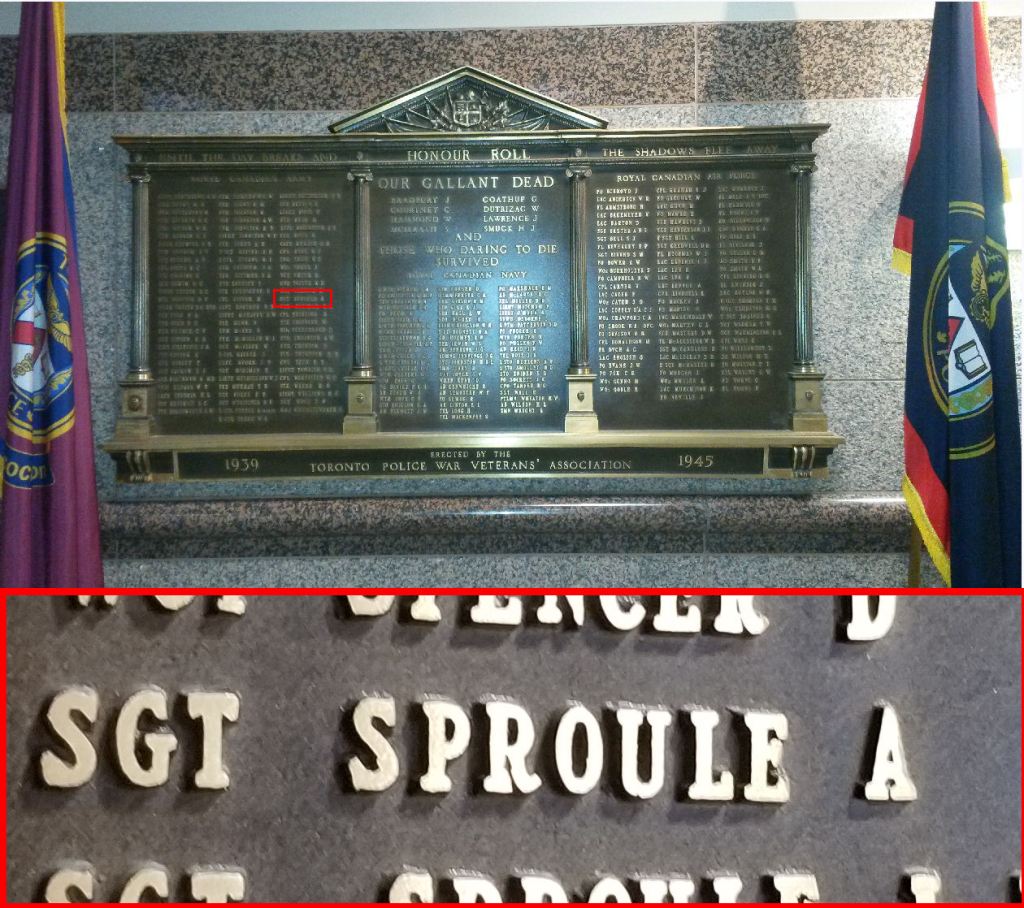
Sergeant of Detectives Alvin Sproule’s name on the Second World War memorial tablet at Toronto Police Headquarters.

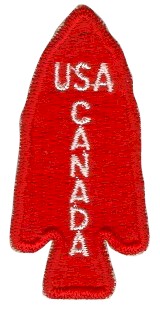
The Black Devils, officially the First Special Service Force, was a unit that struck fear into the hearts of the enemy during the Second World War. One of the original members of this elite unit was a Toronto Police constable.

Alvin Armstrong Sproule joined the Toronto Police Department in 1939 as an 18-year old Police Cadet. Once reaching the minimum age requirement of 21 years, Sproule was sworn in as Police Constable #333, but in May 1942 he took leave to enlist in the Canadian Army, joining The Royal Canadian Army Service Corps. Sproule went on to pass selection into the First Special Service Force, an elite joint American-Canadian commando unit with specialist training in hand-to-hand fighting, parachuting and mountain warfare.

Iconic arrowhead shoulder flash of the FSSF.
(Photo Credit: Bill Ellis and canadiansoldiers.com)

Sproule served in the 5th Company, 2nd Regiment of the FSSF. While exact details of Sproule’s service are still classified, one could look at the unit’s history to know what kind of finding he was involved in.

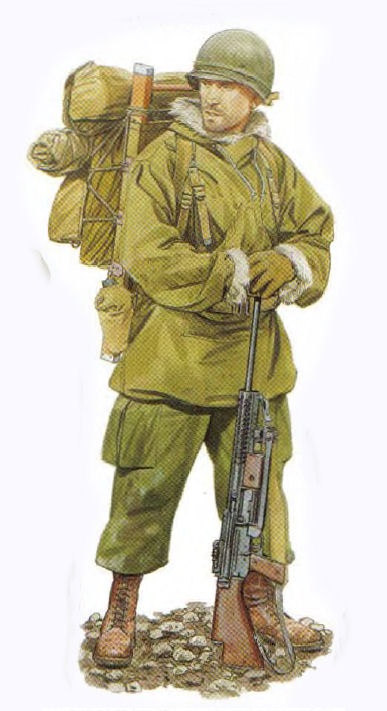
Private, First Special Service Force; Anzio, Italy 1944 by Ron Volstad.
(Photo Credit: Osprey Publishing)

The FSSF first saw action during Aleutian Campaign of 1943 in the Pacific theatre, and were then used extensively in the Mediterranean Theatre, fighting throughout Italy and Southern France. Their assault on the German-held Monte La Difesa was made into a Hollywood film The Devil’s Brigade (1968). During the infamous Anzio campaign, where they were in combat for 99 continuous days, the enemy nicknamed them “The Black Devils” due to the commandos’ tenacity and use of boot polish as face paint. After the fierce fighting in Italy, they would make a combat jump into Southern France, during a lesser-known seaborne invasion dubbed “Operation Dragoon”. They fought on in the south of France towards the Axis-held Alps, and after suffering an irreplaceable attrition rate of over 600%, were eventually disbanded. Sproule was wounded in action, but it is unclear when. The remaining Canadians were mostly dispersed to the 1st Canadian Parachute Battalion as replacements.

The First Special Service Force is perpetuated today by the Canadian Special Operations Regiment and the United States Army’s 1st Special Forces Command (Airborne).

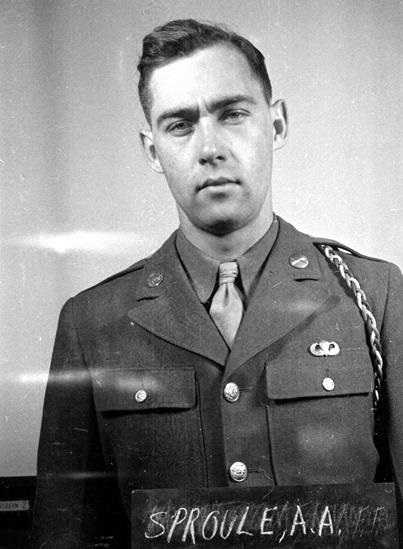
Sproule picture in the American-style FSSF uniform, where he wears US jump wings.
(Photo Credit: First Special Service Force Association)

Sproule would end the war as a Staff Sergeant.

After the war, Sproule returned to the Toronto Police Department, and would soon be “wounded” again, according to The Globe and Mail newspaper. “Annoyed at having his premises searched,” they wrote, a 43 year-old John D’Angelo “became enraged and bit the constable’s right hand”. Assaulting a former commando in such a way could not have ended well for the man.

In 1949, Sproule earned his first Good Conduct badge, earlier than the usual 7 years of good police conduct, due to merit. It carried with it an extra 10 cents pay a day. Sproule soon moved to plainclothes investigations, and in 1952, was made an Acting Detective. In 1954 he received another Good Conduct Badge.

Fellow plainclothesman Jack Webster, who would later author a memoir and establish the Toronto Police Museum, described Sproule as a “fearless police officer with a reputation for bravery.” Webster also shared an anecdote demonstrating Sproule’s fearlessness and proficiency at arms.

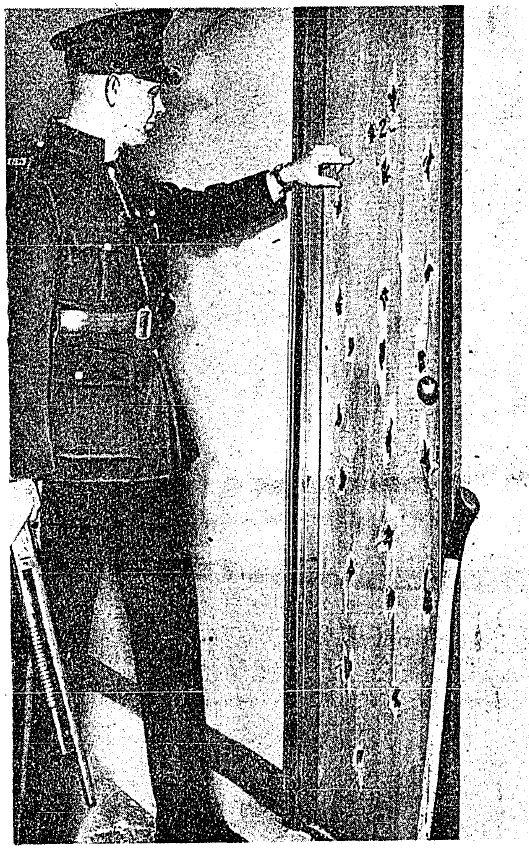
On the evening of October 26th, 1955 the pair were partnered together when each other’s regular partners were on leave. As they were making their way back to headquarters at the end of their shift, the police dispatcher broadcast that an armed man was firing shots through his hotel door near Bay and Dundas streets. Webster and Sproule were first on scene at the Ford Hotel (demolished in 1974). Terrified staff reported that the man was still barricaded inside Room 411 after shooting at an employee. Sproule called for reinforcements while Webster made unsuccessful negotiations with the male over the room phone. The gunman continued to fire his shotgun sporadically through his door.

PC Lister, also a war veteran, shows Room 411’s bullet-riddled door to photographers. (Toronto Daily Star)

After uniformed officers arrived, “Detective Sproule volunteered to go along the hallway armed with a machine gun that had been brought to the scene, and kick the door in, while spraying the room with gunfire.” Sproule, however, was overruled by Detective Inspector William Matthews, who had arrived and taken charge of the scene. Matthews was concerned that their could be hostages hidden inside.

While waiting for further direction, Sproule and Webster periodically exchanged gun fire with the man while they contained the hallway. “After one of these gunfire exchanges, the man screamed and re-entered his room. We were sure that one of us had wounded him…” The gunman, however, continued to fire through the door – “all the time shouting unintelligible words”.

Suddenly a lone shot rang out, followed by complete silence.

Suspicious of a trap, the officer-in-charge called for tear gas (new at the time at the police department) be brought to the scene. When the “large, artillery-shell-like gas canisters […] designed to be fired from a short stubby-barreled rifle” arrived, there was no one there with the experience to use them. Alvin Sproule volunteered, and re-positioned himself in the courtyard of the hotel, with a clear view to the shooter’s window. This also left him exposed.

While covering the window, contemporary newspapers reported that Inspector Matthews threw a gas grenade from an adjoining room’s window into the gunman’s. Webster however, in his eye-witness account remembers it this way: “This detective [Sproule], who was an experienced infantry soldier from the war, took careful aim and fired the canister. It was an accurate shot and went directly through the window into the room.” In any event, smoke poured out of the room within seconds.

A breaching team of Sproule, Webster and two other detectives “wearing Second World War gas masks” entered the gassed out room only to find the shooter dead from a self-inflicted gunshot wound to the stomach.

“Experienced tear gas handlers later explained to [us] that a single tear gas bullet, about the size of a .38 calibre shell, would have been sufficient to accomplish our task, and that the canister used was large enough to clear that famous ice hockey arena, Maple Leaf Gardens,” said Webster.

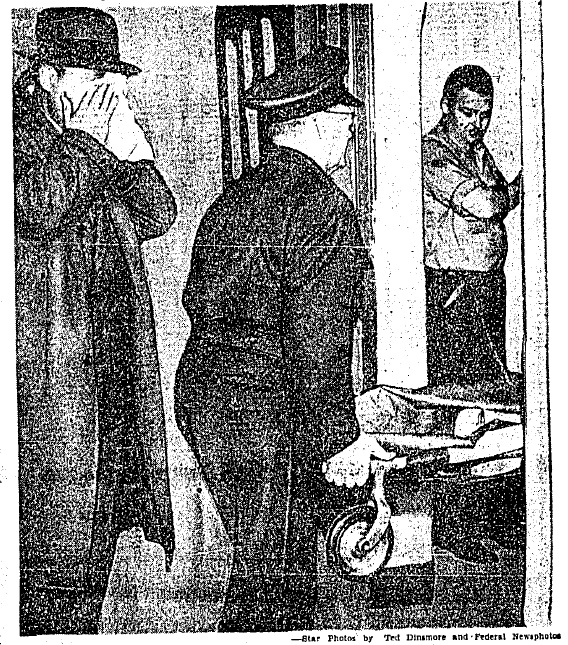
The gunman was identified as Zorano Borg of Malta. He had been described as a “usually quiet, friendly twenty-two-year-old European immigrant, who had become despondent with his new life in Canada.” Thanks to Sproule and his colleagues’ swift action, no one else was hurt, though the hotel was a little worse for wear.

Borg’s body is taken away, as Inspector Matthews wipes his eyes with a handkerchief due to the tear gas. (Toronto Daily Star)

Sproule excelled in the Detective branch, and eventually rose to the rank of Sergeant of Detectives, a bygone rank forgotten by most officers today. “The Sergeant [of Detectives] was a rank between Detective Sergeant and Inspector. Like an Army Sergeant-Major his job was never really spelled out in hard and fast terms, but he was the senior Detective, the guy who knew and had done it all and got extra pay for it.” explains retired member Mike Holland.

In 1966, Sproule had the distinction as serving as the liaison to the RCMP during the 1966 House of Commons bombing attempt by Toronto resident Paul Joseph Chartier. Sergeant of Detectives Sproule would last serve at the old 21 Division in the Keele St & Eglinton Ave W area.

The following year, on the 13th of January, 1967, Sproule collapsed and died suddenly at his home on Balaclava Avenue in Scarborough. Just 45 years old, Alvin Sproule left a wife and six children.

Sources and further reading:

  • D. Draper. Annual Report of the Chief Constable of the City of Toronto for the Year 1944, Toronto: The Carswell Co Ltd City Printers, 1945.
  • J. Webster. Copper Jack: My Life on the Force. Pages 103-105. Toronto: Dundurn Press, 1991.
  • R. Chartrand and R. Volstad. Canadian Forces in World War II. Oxford: Osprey Publishing, 2001.
  • RD Burhans. The First Special Service Force. A Canadian-American Wartime Alliance: The Devil’s Brigade. Ed Conroy Books Ltd, 1948.
  • First Special Service Force Association website. History. http://www.firstspecialserviceforce.net/history.html 2022.
  • Canadiansoldiers.com. First Special Service Force. http://canadiansoldiers.com/organization/specialforces/1ssf.htm 2022.
  • Toronto Public Library – Historical Newspapers Database. The Globe and Mail 1946-08-12, p.5 “Toronto Public Library – Historical Newspapers Database. The Globe and Mail 1946-08-12, p.5 “Man Bites Police, Police Arrest Man“; The Globe and Mail 1952-12-19, p.1 “Worked on Boyd Case Two Toronto Detectives Get Higher Positions”; The Globe and Mail 1955-10-27 p.1“Hotel Shooting Battle Ends With Crazed Gunner’s Suicide” p.3 “Tense Fearful Crowd Gathered Near Scene”; Toronto Daily Star 1955-10-27 p.1 “Buckshot Barrage Keeps Tear-Gas Police at Bay Man Kills Self in Hotel,” p.3  “Defies Tear Gas, Riot Guns, Dies in Shot-riddled Room”; The Globe and Mail 1962-02-24, p. 1 “Slapped Rabbi to Stop Hysterics Sergeant Declares at Inquiry“; The Globe and Mail 1967-01-14, p. 2 “Alvin Sproule: Sergeant, 45, Joined Police as Cadet in 1939″.