Researched and Written by Matthew Scarlino.
Note: This article was originally written in September 2017 and a version was featured on TPS News.
Throughout this 150th year of Canadian Confederation, Canadians look through our past to identify our greatest heroes and celebrate those qualities which have made and continue to make this country an amazing nation. Today we remember Patrol Sergeant Henry Earl Scott, M.M., one of the most distinguished police officers in the history of the Toronto Police Service. Twice decorated for exceptionally brave deeds – by Kings George V and George VI respectively; he is only one of two Canadians ever awarded both the Military Medal and the King’s Police and Fire Services Medal for Gallantry.

Like many heroes, Henry Earl Scott (who went by his middle name Earl) came from humble beginnings. Scott was born on May 8th, 1882 in Beeton, Ontario, to Robert and Ann Scott. Earl grew up in the town an hour north of Toronto with his four brothers and two sisters. Not much is known about these early years but it is believed he helped with his father’s local lumber business. As Earl Scott grew older, he left Beeton and traveled to the City of Toronto, moving into 82 Gloucester Street.
At 28 years of age, Scott joined the Toronto Police Force on April 1st, 1910, the same year his father died. Scott served the next few years as Police Constable No. 24 in the bustling downtown core of the growing city. In 1913, Scott made the newspaper, along with his partner P.C. Edward Koster, after raiding a Queen Street Opium den, arresting 15 men and seizing $3,600 worth of drugs – a modern-day value of $77,000 when adjusted for inflation.
In late 1914, soon after the outbreak of the First World War, Earl Scott went on military leave to enlist as a Private in the Canadian Expeditionary Force, as many other Toronto Police officers were doing at the time. Scott enlisted with the 2nd Divisional Cyclist Corps, an elite unit of bicycle mounted infantry, recruited from men deemed to have above-average intelligence and fitness. The army doctor who inspected Scott noted his modest appearance with some unflattering notes – describing him as a “dark ruddy” man with blue eyes and brown “mud coloured” hair. He was just over 5’10 with a chest measuring 41 inches. Scott and his fellow Cyclists began their advanced training to act as scouts, sentries, trench guides, stretcher-bearers, prisoner escorts, dispatch riders and couriers. In the spring of 1915, after some local training, he sailed to England on the SS Corinthian, bound for the trench-ridden and battle-scarred Western Front in France and Belgium.
By the fall of 1916, a major offensive on the River Somme pitting France and Britain against Germany, was in full swing and had cost hundreds of thousands of casualties.
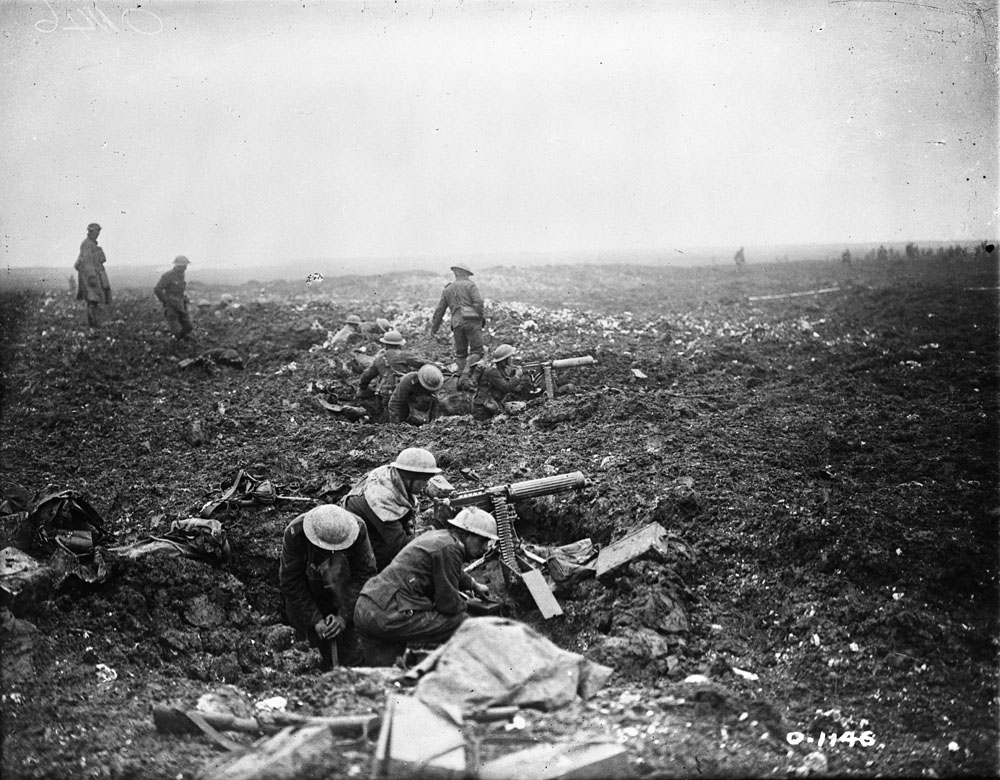
On the morning of October 8th, 1916, now Corporal Scott was detailed to command a squad of stretcher-bearers forward of the town of Courcelette, where British and Canadian troops were fighting the German 1st Army for control of the Ancre Heights. In the previous 72 hours, the bitter fighting there had cost the lives of Toronto constables Alfred Sim and Francis Smith, and wounded PC James Farlow.
On the following day, with the battle still raging, the following deeds took place which made Scott stand out among his peers. Now staged in the front line with the battle raging all around, Scott heard a strained voice calling “Stretcher!” and sprang into action leading his men over broken ground to the casualty. Scott and his men were unarmed and had white armbands marked “S.B.” in red – this was supposed to prevent them from being targeted. But all around him, Scott’s fellow stretcher-bearers were being cut down by bullets, artillery, and gas. Among the chaos, Scott found the wounded man, and two more. What happened next was nothing short of incredible. Scott picked up the helpless soldier and ran, without help, 275 metres to the Advanced Dressing Station under heavy artillery fire. After dropping the man off, Earl turned around and made his way back to the wounded men, picked up another, and carried him back through to safety. Stunned observers watched our hero take off a third time through the murderous fire. To their amazement, he soon-after reappeared, exhausted, with the last wounded man.
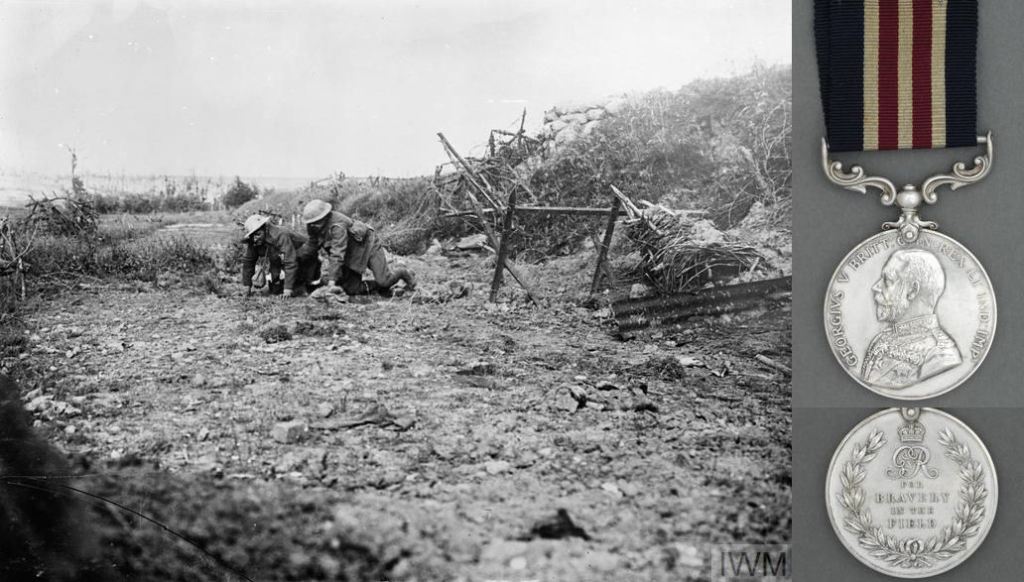
By midnight, Scott and the surviving stretcher-bearers returned to their camp exhausted. Their party had suffered 11 casualties over the last two days at the front. His superior, made aware of the incident, recommended Scott for the Military Medal, a decoration for bravery in action. The recommendation read “On the 9th October while in charge of a party of stretcher bearers engaged in bringing in wounded from the front line to the advanced dressing station unaided, carried in instant succession, three wounded men, three hundred yards under heavy shell fire.” A notice in the London Gazette on January 6th, 1917 announced that “His Majesty the KING has been graciously pleased to award the Military Medal for bravery in the Field to … 76 Cpl. H.E. Scott, Cyclist Bn.”
The War to End All Wars carried on for another two years but Scott survived, and once demobilized, returned to Toronto. Earl moved in with his widowed mother Ann, at 316 Garden Avenue in Parkdale, and returned to duty with the Toronto Police Force. Scott was soon promoted to Patrol Sergeant, at the Queen and Claremont Streets’ No. 3 Station. Scott found that he had come back to a different city, it was now the prosperous “Roaring ’20s”, the population was booming, and the relative unity and peace during the war was over. Most notably, Prohibition had been in effect since 1916. Police had their hands full enforcing the Ontario Temperance Act, and dealing with all the crime and violence of underground liquor consumption and black market trade. In those years, the now 42-year-old Earl Scott finally met the love of his life. He married May Hesson in 1925, with his mother Ann as his witness.
The 1920s came and went, and the 1930s brought in the Great Depression. Unemployment was at an all-time high, the city was crowded, and violent bank hold-ups and labour demonstrations were the new normal. In 1933, at one such demonstration in Trinity-Bellwoods Park, a lone constable was mobbed by the angry crowd. Responding to the call for assistance, Patrol Sergeant Scott arrived to the melee where he and his fellow officers were also attacked. They managed to disperse the crowd but not before our hero received a blow to the eye so hard he was sent home to recover.
Scott returned to duty soon after and, in 1935, was celebrated at a dinner with his peers after 25 years on the job at the Prince George Hotel where the TD Centre now stands. Earl Scott, however, was not finished protecting and serving the people of Toronto.

On Saturday, February 5, 1938, a greying 56-year-old Earl Scott was now assigned to No. 9 Station, at Keele and Dundas Streets in the city’s west end. When Sergeant Scott went into work for the night shift as the station duty sergeant, he had no reason to believe it would be anything but a quiet night. His duties were to manage the internal operations of the station for the night. Outside temperatures dropped below freezing after having rained all day. Scott was sitting at his desk as the hours passed when, just after 2 a.m., he heard a muffled gunshot and shouting outside. Scott immediately grabbed a flashlight and ran out to the street to find a 30-year-old Norman Ford shot in the gut and dying on the sidewalk in front of the police station. A married couple, passing by, witnessed the shooting and saw the perpetrator flee down an alleyway, so Scott ran south on Keele Street in order to cut him off.
Suddenly, he encountered the man coming out from the laneway by the nearby post office.
Out of the darkness, as Scott’s eyes fixed on the threat, he saw the suspect aiming a .32 automatic pistol. Click. The gun jammed. Scott threw a powerful right hook, knocking him to the ground where the sergeant wrestled the man who again tried to shoot him. Scott overpowered the killer, pried the gun from his hands, and brought him to his feet under arrest.
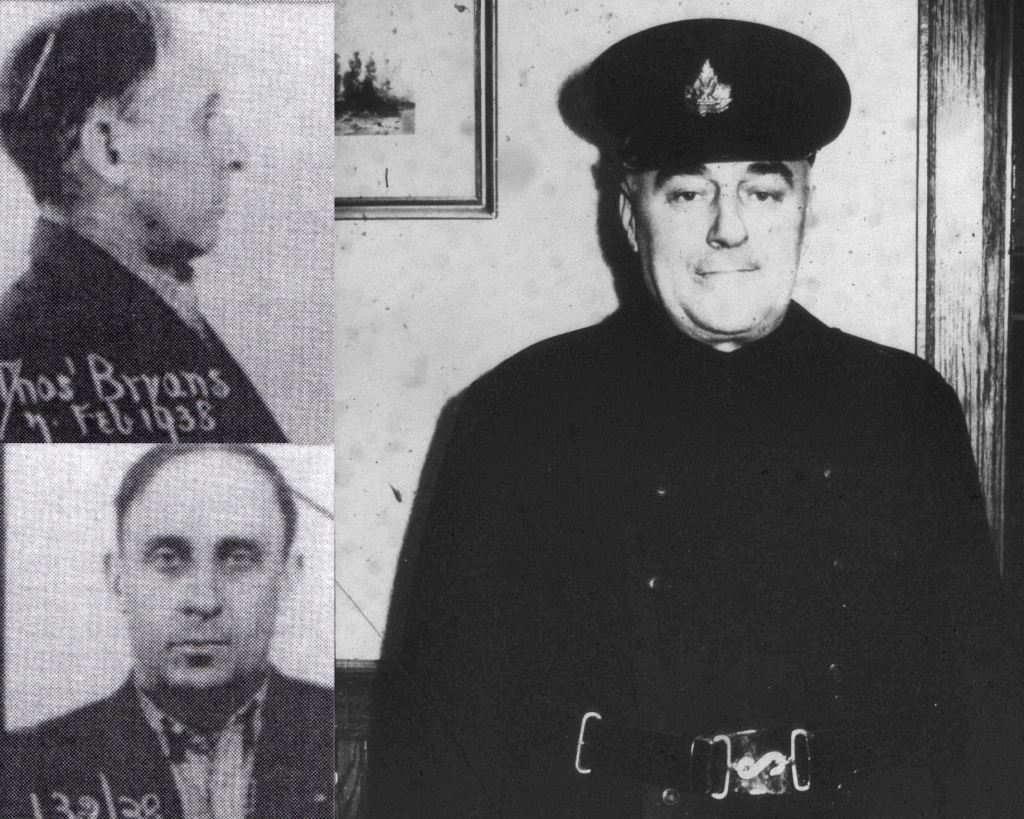
The murderer was identified as Thomas “Shorty” Bryans, a career criminal who had broken out of the Kingston Penitentiary in 1923 where he was serving time for Manslaughter. Bryans had been a member of the Red Ryan Gang, notorious for violent robberies, hold-ups and murders throughout Southern Ontario since the early 1920s.
While newspaper editors praised Scott’s bravery and his restraint in not shooting the suspect, it came out later that our hero was actually unarmed throughout the incident. As the station duty sergeant, Scott was not wearing a gun belt as usual. After finding the shooting victim out front of the station, and with utter disregard for his own safety, Scott immediately chased after the suspect, fearing any delay could allow the perpetrator to escape and kill again.
In the aftermath, Chief Draper recommended Scott for the King’s Police and Fire Services Medal for Gallantry, a decoration instituted by King Edward VII in 1909 to recognize exceptional bravery by individuals in the emergency services throughout the British Empire.
Meanwhile, for his latest crime, “Shorty” was sentenced to hang, smirking in court when his sentence was read. Bryans’ execution was carried out four months later at the Don Jail.
Scott quietly continued working until, after 32 years on the job, he retired on May 1, 1942. After years of bureaucratic process, award of the King’s Police Medal was announced by Canada’s Secretary of State in the Canada Gazette on March 20, 1943. Ten days later, at a yearly police parade and inspection at St Paul’s Church on Bloor Street East, a now-retired Scott was presented his decoration by Lieutenant-Governor The Honourable Albert E. Matthews on behalf of King George VI, becoming one of only 32 Canadian police officers ever decorated with the award.
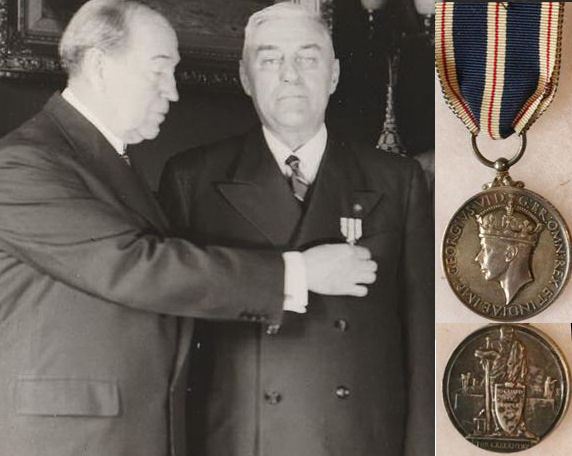
Earl Scott then lived out the rest of his days in the companionship of his loving wife, May, until he passed away on April 27, 1955, at the Toronto Western Hospital. Scott is buried at Trinity United Cemetery in his home town of Beeton, Ontario.
In keeping with the highest traditions of the Toronto Police Service, our humble Patrol Sergeant Henry Earl Scott spent his life putting others before himself, to protect and serve, and should be forever remembered as a true Canadian hero.
With Thanks to Jack Templeman and Bob Pyefinch.
Photo Credits:
- “Patrol Sergeant H. Earl Scott, M.M., in winter patrol dress, 1928” Courtesy of The City of Toronto Archives,
- Fonds 1266, Item 13017
- “Bringing in the Wounded near Albert, 1916” Courtesy of the Imperial War Museum ©IWM Q752
- “The Military Medal” Courtesy of the Imperial War Museum ©IWM OMD5788
- “The Old No. 9 Police Station” Courtesy of the Toronto Reference Library, Baldwin Collection Item S 1-854.
- “Shorty Bryans’ mugshot.” Courtesy of Library and Archives Canada
- “Scott photographed by the Globe and Mail.” Courtesy of City of Toronto Archives, Fonds 1266 Item 49441
- “Retired Patrol Sgt. H.E. Scott, being presented with the KPFSM for Gallantry” Courtesy of the Pyefinch Collection
- “The King’s Police and Fire Services Medal.” Courtesy of the Pyefinch Collection
Sources and further reading:
- Grasett, H. (1915) Annual Report of the Chief Constable of the City of Toronto for the year 1914 – p. 48. Toronto, ON: The Carswell Company Limited.
- Draper, D. (1939) Annual Report of the Chief Constable of the City of Toronto for the year 1938 – p. 39-40. Toronto, ON: The Carswell Company Limited.
- Templeman, J. (2017) To Guard My People: The King’s Police and Fire Service Medal in Canada – p. 51-52. Winnipeg, MB: Leadthrough.
- McCreery, C. (2015) The Canadian Honours System, 2nd Edition – p. 116-117, 125-128. Toronto, ON: Dundurn Press.
- Blatherwick, J. (2016) King’s Police and Fire Services Medal, Plus Other Medals to Police and Fire Services In Canada. Blatherwick.net
- The London Gazette. (1917, January 6th) Supplement 29893 to the London Gazette, Page 350.
- The Canada Gazette. (1943, March 20th) No. 12, Volume LXXVII, Page 1256.
- Toronto Daily Star. (1913, October 24th) Fifteen Chinamen Taken In, p. 11; (1920, January 14th) Several Promotions Made in Police Force, p. 3. (1938, February 7th) Sergeant Fells Alleged Slayer With Fist Blow, p. 1; Note and Comment, p. 4; Alleged Murderer Remanded After Shooting, Sec. 2 p. 1. (1938, February 9th) Police Learn N. Ford Feared Man in Cafe Armed with Revolver, p. 1; (1938, October 20th) Even Men Going to Jail Like Insp Chisholm, Sec. 2 p. 1 & 27; (1943, May 20th) 3 Police Officers Win King’s Medals, Sec. 2 p. 2.
- The Globe. (1933, June 5th) Crowd is Dispersed After Hot Fight, p. 11; (1935, April 10) Celebrate Quarter Century on Vimy Night, p. 11.
- The Globe and Mail. (1938, February 7th) Toronto Murder Laid to One of Ryan Gang, p. 1; (1938, April 29th) Thomas Bryans Smiles at Sentence of Death, p. 5; (1942, April 28th) Sgt E. Scott Resigns Force, p. 4; (1943, May 31st) King’s Medal Rewards Courage of Policemen, p. 7; (1955, April 29th) HE Scott etc., p. 4.
- Archives of Ontario. Registration of Births and Stillbirths 1869-1913; Ontario Canada Select Marriages.
- Library and Archives Canada. Census of Canada 1891, 1901, 1911, 1921. Personnel Records of the First World War; Military Honours and Awards Citations Cards 1900-61; War Diaries of the Canadian Corps Cyclist Battalion 1916/05/12 to 1919/03/31; Capital Punishment Case Files – 1938 – Bryans, Thomas.

 The Khaki and Blue Project